
Kuka robots at Miele
It becomes independent with a camera
Autonomously working robots. A Kuka KR 20 robot automates the production of drive motors for household tumble dryers at household appliance manufacturer Miele. Using a camera system, the robot works largely autonomously.
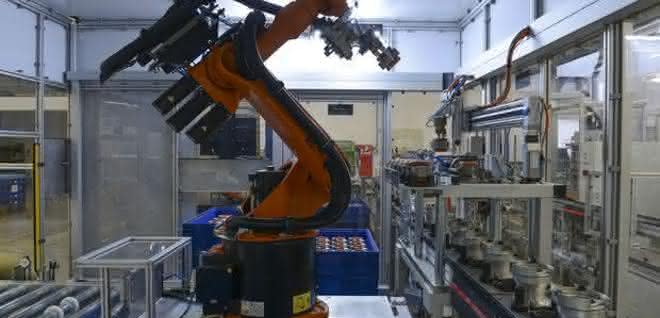
Robots are using sensors or camera systems to perceive their surroundings with increasing precision. This allows them to react flexibly to new situations and opens up completely new application possibilities. The advantages for companies are obvious: greater autonomy for industrial robots, more flexibility in component handling and shorter downtimes.
The two companies Heinen Automation and ID Ingenieure & Dienstleistungen specialize in the implementation of robot-based applications. Together, they have planned and implemented a palletizing system at the Miele household appliance manufacturer's plant in Euskirchen in North Rhine-Westphalia. A Kuka robot feeds camera-supported components into production. "It was Miele's explicit wish to realize an individual handling application that can be easily and quickly converted to different components and assembly processes," says Michael Miessen, responsible for the technological concept of the system at Heinen. The palletizing system must be able to process different components. This is why the two companies opted for the robot-based application, as it offers several advantages over a manual process or a linear gantry: "From an ergonomic point of view in particular, manual work was no longer up to date. In addition, the cycle times needed to be increased, which was no longer possible in the existing form. In order to save space, to be able to implement the system economically and to be able to guarantee the necessary flexibility, a complex cell design was dispensed with," says Michael Gottschalk, Managing Director of ID, listing the points that spoke in favor of a robot and against a linear gantry.
At the center of the system is a Kuka KR 20 robot with a special feature: It is equipped with a camera on the gripper. This checks the quantity of components to be processed as well as their exact position and detects errors caused by transportation or human intervention. This makes the robot-based application flexible and gives it a high degree of autonomy.
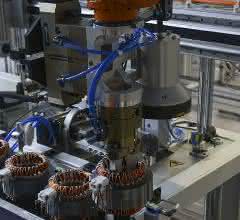
"The robot's task is to automatically feed partially assembled stators into the assembly process," summarizes Michael Miessen. The stationary motor parts are part of the drive motor of the household tumble dryers. In the first production step, an employee delivers the pallets with small load carriers (SLCs), in which the stators are stored, to the system using a pallet truck and places them on the pick-up roller conveyor. Once the pallet has been fed into the robot's work area, the robot arm moves over it. A camera is attached to one of its multiple grippers to check the filling of the small load carriers. The robot then moves over the first stator to be packed and checks its exact positioning.
The inspection is necessary because the components can deviate several centimetres from the standard due to vibrations during transport or wear on the KLT. With the help of the camera, the deviations can be detected and the stators can be picked up autonomously with the robot gripper without the help of the worker.
The robot then places the component in a turning station. There, its exact horizontal position is determined in the starting position and after a 180-degree rotation. This is necessary to compensate for any unevenness in the hall floor. At this point, the KR 20's work on the component ends. Further processing is carried out by a handling gantry, which finally positions the stator in the goods carrier. Meanwhile, the robot repeats the work process until the small load carrier has been emptied. The low payload class robot then stacks them on a pallet on the removal roller conveyor. Once all the small load carriers have been emptied and stacked on the removal roller conveyor, the filled pallet is transported out of the system. The entire process therefore requires no operator intervention.
"We are pleased that we have created an economical, but also flexible and space-saving system design. Above all, the fact that the robot is able to handle different stators from one packaging container is a big plus in terms of flexibility," says Michael Gottschalk. The demands on the robot are high, as it has to deliver the stators reliably in two-shift operation 220 days a year. According to Miele, availability should be 95 percent. In addition, an autonomy time of 104 minutes had to be guaranteed. This corresponds to a cycle time of 13 seconds for three fully loaded pallets with 160 stators each. Other Kuka components include the KR C4 controller and the Profinet interface. The system has been in operation since the beginning of March 2018. "We are delighted that the implementation went so smoothly. So far, the system has met our expectations 100 percent," says Jürgen Zdunek, Production Manager at Miele in Euskirchen.
S. Schuster/as


You might also be interested in
Basler acquires 76% of Indian image processor
Basler, supplier of image processing components for computer vision solutions, has acquired 76% of the Indian sales partner Alpha TechSys Automation.
 read more...
Process monitoring and fault detection
Cameras ensure quality during laser melting
Powder bed-based laser melting (PBF-LB/M) opens up new possibilities in additive manufacturing. Modern camera systems provide crucial process data to further increase quality and efficiency.
read more...Vision Sensor is three times faster than its predecessor
The 'CS-62' vision sensor from di-soric is around three times faster than its predecessor, the 'CS-60'. In combination with the 'nVision-i 25.1' software, it enables image processing solutions that were previously reserved for smart cameras.
read more...Thermal imaging cameras for quality control
Automated thermal imaging cameras are often suitable for quality control applications where temperature plays a role. However, while there are various solutions on the market for slow processes, it is challenging to select a camera that reliably...
read more...Easy entry into industrial VGA thermography
Reliable temperature measurement is a prerequisite for the success of many industrial processes. Berlin-based manufacturer Optris presents the Xi 640 infrared camera, a new member of its Compact Line, which enables non-contact temperature...
read more...Powder bed-based laser melting optimized
Aconity3D has set itself the goal of optimizing the stability of the manufacturing method of powder bed-based laser melting and thereby promoting its use in a wide range of industries. By using high-speed industrial cameras from SVS-Vistek, the...
read more...INDUSTRIAL Production Products of the year...
2nd place, category handling, assembly and production logistics: SICK
safeVisionary2 is the first 3D time-of-flight camera with Performance Level c safety certification. It enables safe three-dimensional environmental detection and won 2nd place in the competition for Product of the Year 2024 in the handling, assembly...
read more...Nomination Products of the Year 2024
SICK: Camera systems safeVisionary2
safeVisionary2 is the first 3D time-of-flight camera with Performance Level c safety certification. It enables safe three-dimensional environmental detection and has been nominated in the 2024 Product of the Year competition in the handling,...
read more...AI vision brings additional opportunities
The seamless integration of AI into the consumer sector has helped to improve our quality of life and make interactions with technology more efficient. In industry, AI vision with machine learning opens up new possibilities that are not covered by...
read more...