
Collaborative robot
Intelligent and award-winning
The still young cobot manufacturer Yuanda has developed a collaborative industrial robot that can feel, see and think thanks to fully integrated sensor technology, and has been honored with the handling award 2019.
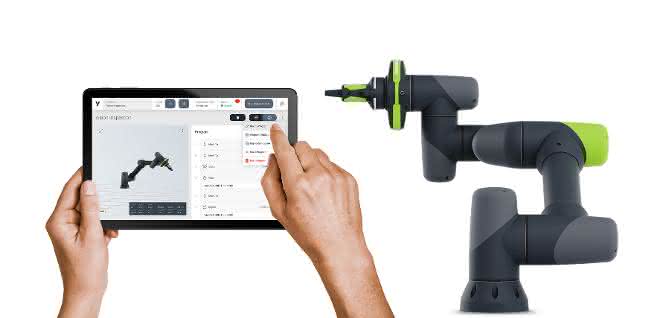
Yuanda Robotics, based in Hanover, was founded in February 2017 by German engineers and the Shenyang Yuanda Aluminum Industry Group. The company currently has just under 50 employees and its portfolio includes a collaborative robot with a payload capacity of seven kilograms and a reach of one meter. Further robots are to be added to the portfolio from mid-2020.
The collaborative robot from Yuanda was developed in Germany by an international team and meets all the requirements for human-robot collaboration in accordance with DIN ISO 10218 and 13849. The manufacturer promises a system with above-average sensor technology, functionality and safety. It is a combination of certified safety in accordance with PL d Cat. 3, fully integrated torque sensors, fully integrated vision including evaluation unit, artificial intelligence, existing end-of-arm interfaces, template-based solutions and scalable hardware and software.
Sensor technology ensures safe interaction with people and sensitive handling of objects. Intelligent learning systems control automated processes in cross-industry applications. Thanks to the integrated camera system, the robot can visually perceive and classify objects, evaluate product quality, recognize process changes and react intelligently. Hardware and software interfaces are intuitive and accessible to every user. With the graphical programming interface, applications can be configured and executed directly on the desktop computer or tablet with minimal effort. Predefined commands can be used to compile program modules via drag & drop. The desired actions can be quickly parameterized by manually guiding or remotely controlling the robot arm. The application can then be tested visually with a digital twin and executed in the real environment and monitored in real time. Ready-to-use program templates are available for quick configuration of universal tasks. Alternatively, you can create your own templates and reuse them for similar applications.
Thanks to its scalable design, the robot can be adapted to different requirements. It also has a user interface that makes the technological complexity accessible. All the robotics functionality expected of an intelligent system, as well as the functionality for physical and visual interaction with the environment, should be easy to operate and control. This is an essential feature for making collaborative robotics accessible and economical for small and medium-sized companies. as


You might also be interested in
Basler acquires 76% of Indian image processor
Basler, supplier of image processing components for computer vision solutions, has acquired 76% of the Indian sales partner Alpha TechSys Automation.
 read more...
Process monitoring and fault detection
Cameras ensure quality during laser melting
Powder bed-based laser melting (PBF-LB/M) opens up new possibilities in additive manufacturing. Modern camera systems provide crucial process data to further increase quality and efficiency.
read more...Vision Sensor is three times faster than its predecessor
The 'CS-62' vision sensor from di-soric is around three times faster than its predecessor, the 'CS-60'. In combination with the 'nVision-i 25.1' software, it enables image processing solutions that were previously reserved for smart cameras.
read more...Thermal imaging cameras for quality control
Automated thermal imaging cameras are often suitable for quality control applications where temperature plays a role. However, while there are various solutions on the market for slow processes, it is challenging to select a camera that reliably...
read more...Easy entry into industrial VGA thermography
Reliable temperature measurement is a prerequisite for the success of many industrial processes. Berlin-based manufacturer Optris presents the Xi 640 infrared camera, a new member of its Compact Line, which enables non-contact temperature...
read more...Powder bed-based laser melting optimized
Aconity3D has set itself the goal of optimizing the stability of the manufacturing method of powder bed-based laser melting and thereby promoting its use in a wide range of industries. By using high-speed industrial cameras from SVS-Vistek, the...
read more...INDUSTRIAL Production Products of the year...
2nd place, category handling, assembly and production logistics: SICK
safeVisionary2 is the first 3D time-of-flight camera with Performance Level c safety certification. It enables safe three-dimensional environmental detection and won 2nd place in the competition for Product of the Year 2024 in the handling, assembly...
read more...Nomination Products of the Year 2024
SICK: Camera systems safeVisionary2
safeVisionary2 is the first 3D time-of-flight camera with Performance Level c safety certification. It enables safe three-dimensional environmental detection and has been nominated in the 2024 Product of the Year competition in the handling,...
read more...AI vision brings additional opportunities
The seamless integration of AI into the consumer sector has helped to improve our quality of life and make interactions with technology more efficient. In industry, AI vision with machine learning opens up new possibilities that are not covered by...
read more...