
Automation
Igus robots help with Indian research
The Indian government has commissioned Robolink arms from Igus for 40 educational institutions. At a workshop in Aachen, the professors from India learned about the simple handling of the low-cost robots.
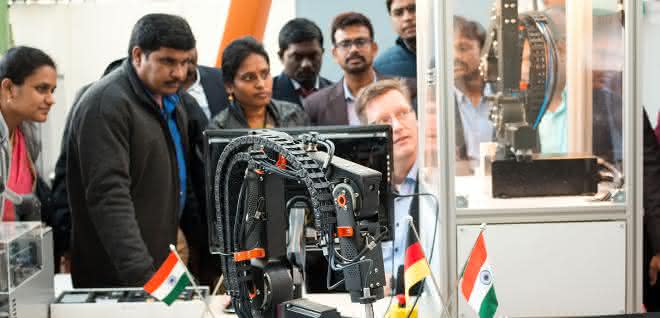
Strengthening cooperation between Germany and India - the governments of both countries have committed themselves to this goal. These efforts were intensified by a visit by Indian Prime Minister Narendra Modi and Angela Merkel to Berlin in July last year. According to Merkel, India is a strong partner as a country with a population of 1.3 billion. The declaration of intent that both countries signed to intensify their cooperation now had to be put into practice.
A key point of this declaration is closer cooperation in research and teaching. The subject of robotics and automation technology is a new and, in some cases, under-researched field at universities in India. Vangapandu Venkatanagaraju is working on behalf of the Indian government to establish knowledge transfer between Indian and German engineers. In his search for robots for teaching, he became aware of the Robolink modular system from Igus at Automatica. This gave rise to the idea of equipping universities and colleges with 80 robot arms in the field of automation technology.
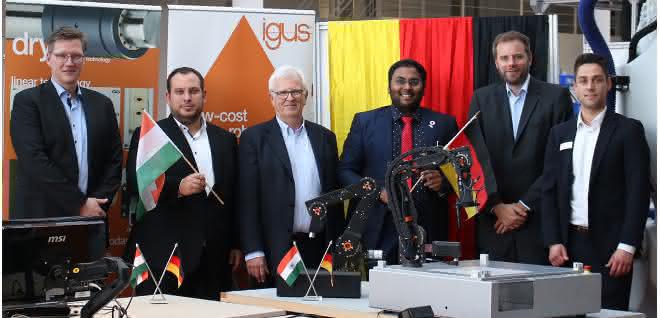
Fast operation thanks to intuitive software
The robot arms will be used to teach universities how to solve simple automation tasks in industry. 40 Indian educational institutions will each receive two robots: the Robolink DCi with four axes, integrated controller and electric magnet and a Robolink robot arm with four axes and pneumatic suction cup.
As part of a delegate trip, 24 Indian professors got to know the systems. The trip was organized by APS. The company is dedicated to the transfer of knowledge and research in the field of robotics between countries. The professors were trained by Igus low-cost robotics experts Alexander Mühlens and Kai Schmitz at an event at the Digital Capability Center in Aachen. Dr. Christian Meyer, the developer of the Robolink DCi software from Commonplace Robotics, introduced the lecturers to the use of the intuitive software. After a brief explanation, the professors were able to define some of the robot's movements and see their success live. Further projects, for example the use of low-cost robotics in textile technology, are already being planned together with APS. as


You might also be interested in
Further simplify assembly processes
In addition to the proven racks with a length of one meter, Wittenstein alpha now offers optional two-meter racks for linear systems. They are particularly suitable for use in short axes, for example, in order to simplify assembly even further.
 read more...
Hiwin manufactures its own shaft gearboxes
Have you ever waited several months for an urgently needed corrugated gearbox? Hiwin has too. That's why the Offenburg-based drive specialist has decided to produce its own space and weight-saving reduction talent.
read more...Human-robot interaction at the trade fair
Sumitomo Drive Technologies is presenting its drive solutions for automation and robotics at Automatica 2023 together with the Lafert Group. The company will be showcasing two different applications of the Tuaka drive system for robot applications...
read more...Partial automation with robots
At Automatica, Promess will be showcasing its modular individual workstations and how these can be partially automated with robot support. The servo press manufacturer will also be providing information about the latest features of its Revolution X...
read more...A new benchmark for collaborative robots
At this year's Automatica, Denso Robotics will be showcasing its innovations in the field of robotics. The collaborative Cobotta Pro product family will be the focus of the presentations. Visitors to the trade fair can see all variants in various...
read more...Clamping system for a new milling machine
Investments in machinery often lead to further purchases - as is the case at Joma-Maschinenbau, whose modern production facility has recently been supplemented by a 5-axis milling machine.
read more...Schunk wants to simplify processes in automated production
The declared aim of automation specialist Schunk is to make its customers' processes comprehensible, simple and efficient. Data transparency plays an important role in this. It enables reliable processes and provides the basis for resource-saving...
read more...Festo and Hahn Automation develop battery tester for greater safety
The success and reputation of electric vehicle manufacturers depend on the safe and flawless functioning of batteries. Hahn Automation has therefore developed a battery tester that performs a fully automated 100% test of mobile energy storage...
read more...SPN Schwaben Präzision presents gearbox solutions for automation and industrial robotics
Short cycle times, robust technology, wear-free surfaces and compact designs have always been relevant for automation and robotics solutions. This year's Automatica trend topics include "Sustainable production" and "Digitalization and AI". SPN aims...
read more...