
Human-robot collaboration
Injury rate reduced by over 95 percent
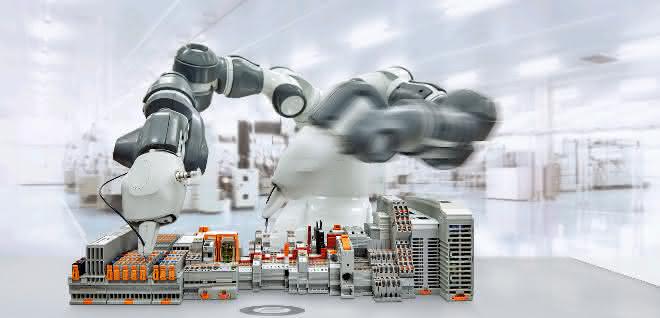
In the context of human-robot collaboration, man and machine work together without a safety guard. The example of inserting blanks into boxes shows how the safe use of a robot can be implemented in a milling application.
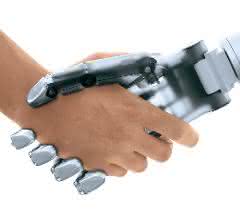
Robots have long since found their way into industry and have become indispensable. This is because they perform indispensable work, particularly in heavy-duty tasks. For some years now, specialists have been trying to realize cooperation between humans and robots in such a way that both the number of cycles and the diversity remain highly dynamic.
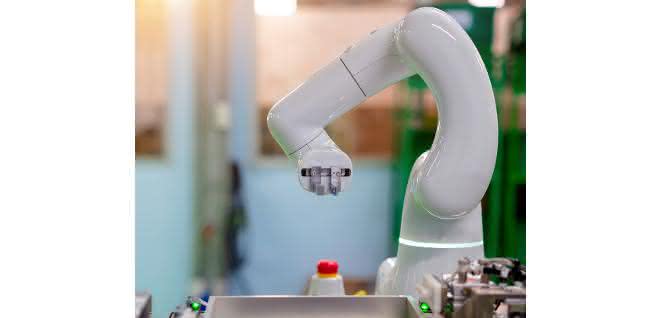
This is why collaborative robot systems are increasingly being used in industrial systems. This constellation is suitable for a variety of applications. In some cases, however, solutions are used that are referred to as collaborative robot systems, but do not operate as such. In practice, this is usually referred to as human-robot collaboration, or HRC for short. This refers to autonomous, parallel operation, which can extend to the completion of joint tasks. The article explains how such a solution can be integrated into the production process in practice.
Gain experience in a sample application
The case described is a collaborative robot extended by a handling unit, which is integrated into a production system that mills blanks from a panel. Different questions arise from this setup: What needs to be done to operate the robot safely? Should the topic of the entirety of machines be considered? Is there a significant change under certain circumstances? Do the employees perceive the robot as competition for their jobs? These aspects will become an issue in the risk assessment at the latest. Nevertheless, monotonous tasks can cause stress. A one-sided posture and monotonous movements can result in long-term damage to the musculoskeletal system. There are therefore many reasons why it makes sense to purchase collaborative robots.
In the example application, a panel consisting of several individual PCBs is inserted into the device. The milled blanks land on a conveyor belt, from which the employees manually remove them and stack them in boxes for the next processing step. This can lead to cuts on the sharp-edged blanks. Those responsible are therefore considering whether issuing personal protective equipment (PPE) could be a solution. Employees would be protected by gloves, for example.
As it is foreseeable in the long term that robots will be used more frequently and in a more versatile way in industrial processes, the reference project described serves to gather experience. It is therefore not "open-heart surgery" on a production machine. Once the collaborative robot has been integrated, the handling of HRC solutions must of course be described and instructed. However, the probability of cutting injuries is reduced by over 95 percent due to the avoidance of finger contact. The monotonous and routine movements are also eliminated.
Force measurement requires complete setup of the application
The planning phase of the application is not as extensive as initially expected, as the manufacturers of the individual components have done good preparatory work and correctly placed their products on the market with declarations of conformity. This is not a matter of course. In practice, it turns out that a CE mark affixed to a product does not necessarily mean that the marking is justified. It's a good thing that Phoenix Contact 's services are increasingly revealing that even inexperienced manufacturers have recognized the legal necessity of this issue and are addressing it.
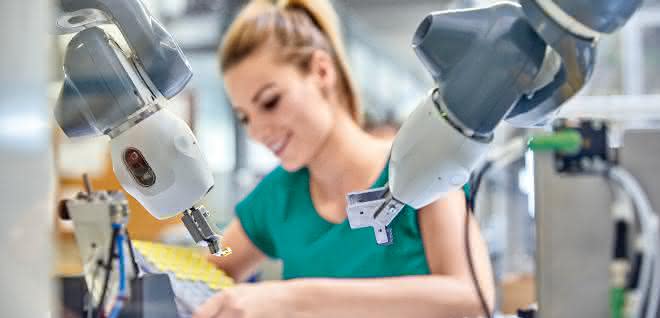
Back to the project: The individual components from the various manufacturers contain residual risks in accordance with the respective operating instructions, which have been largely minimized as part of the further design of the HRC application. Correctly, the incomplete machine is then delivered with a declaration of incorporation and assembly instructions for the complete system. The necessary safety functions are integrated on the basis of the risk assessment - not the hazard assessment, by the way - and with the help of a normative aid. At the same time, the necessary operating instructions - and not the operating manual - are created. This is followed by the planning of the HRC measurement, which is carried out in combination with the tool and the final product. To carry out a force measurement, the robot application must be fully set up. The travel paths must be programmed and the peripherals - such as storage devices - must be permanently installed.
Grippers need to be redesigned
A pointed, fork-shaped gripper is required so that the blanks can be gripped from the conveyor belt. The concept was to use the same grippers that are used inside the milling machine to place the blanks. However, this poses the challenge that piercing hazards cannot be detected with an HRC measurement. Due to the small contact surface, the measured pressure would inevitably exceed the limit values.
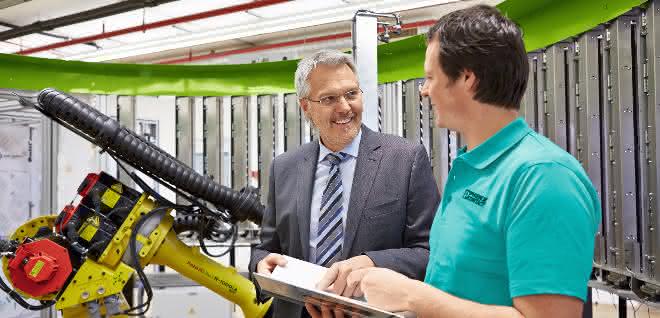
Placing the blanks in the appropriate containers also requires sensitive evaluation. The thinnest blanks are less than one millimeter thick. Consequently, the risk of cuts cannot be ruled out if employees reach into the deposit container during the movement. After closer inspection, the grippers are redesigned so that there is an area of at least one square centimeter plus a radius of two millimeters on three edges during the lowering movement. The gripper edge remains sharp-edged. The measurement will show whether the described redesign is sufficient.
How do the sharp-edged blanks behave during movement? The solution is that the grippers move to a set position when picking up the blank and the force is switched off when the position is reached. The blank is then held by positive locking and residual tension. The blank therefore falls out of the grippers immediately if a collision occurs. However, the strength of the collision must also be verified with the load cell. The challenge arises from the fact that the transient force must not be exceeded. The board must therefore fall out of the gripper position before the limit value is reached.
Pressures and forces can be visualized
All in all, the solution is already proving to be a success, as the contact rate of employees gripping the circuit board with their fingers has fallen from 100% to less than 5%. This leaves a residual risk that needs to be evaluated as part of the risk assessment. And what did the measurements reveal? In fact, there is no longer a risk of stinging. In the event of a collision, the surface area and the programmed movement force in the lowering direction show values that are in the middle of the normal range. The specialists have also successfully mastered the second challenge: the PCB falls out of the grippers in the event of a collision. The gripping force is just sufficient to reliably place the blank from the conveyor belt into the storage container. For the lowering movement within the container, the approach has been programmed to implement a diagonal lowering movement from the center. The pressure and force measurement allows the pressures and forces that occur to be visualized and evaluated accordingly.
Once the measurement has been completed and all documents have been compiled, the risk assessment has been approved and the necessary conformity assessment has been carried out. The latter confirms compliance with the legal requirements. The project is completed by issuing the declaration of conformity and affixing the CE marking. The machine is then transferred to the operator's area of responsibility.
Henrik Vandieken, B.SC, and Benjamin Peters, both Competence Center Services, Phoenix Contact Germany, Blomberg
Control integration should be reviewed
In order for HRC robots to be used safely, they must be tested. However, this statement is only part of the truth: Rather, the correct integration into the control system must be checked. The safety specialists at Phoenix Contact have found that it is worth taking a look at this aspect. They usually do this as part of a supplementary test or machine inspections, which they see as an extension of the risk assessment.
As part of such an inspection, the implementation of the safety functions, the state of the art of the safety devices and their correct installation, including the safety distances, are checked. The electrical, pneumatic, hydraulic and other equipment is also checked. As already described, the HRC measurement can be part of the inspection. The Competence Center Services team provides support in the specific implementation of the detected and defined steps. Further reading can be found in the book "Betreiberpflichten für Alt- und Gebrauchtmaschinen" from Reguvis Verlag.


You might also be interested in
From risk to resilience
NIS2 significantly increases the requirements for industrial security concepts. In addition to cyber resilience, physical access protection is becoming increasingly important.
 read more...
Security Operations Center module
When cyber attacks reach production
Adlon is further developing its Security Operations Center and adding another module to the existing Managed SOC for Microsoft 365 environments (based on Managed XDR): Managed SOC Advanced.
read more...Lifecycle management and safe IO-Link communication
At SPS, Pilz will be presenting solutions that combine safety and security in production. The focus is on the digital Myzel Lifecycle Platform, a SaaS offering for the management of machinery and personnel over the entire lifecycle.
read more...The basics of warehouse safety
Safety in the warehouse primarily relates to the employees. However, goods must also be transported safely and transport equipment must not be damaged.
read more...Environmental containers and fire protection
Companies can choose from a wide range of environmental containers for storing chemicals and other hazardous substances.
read more...Secure focus on access
To ensure comprehensive safety, holistic safety concepts for safety and industrial security on machines are required. Authorizations and access must be clearly regulated.
read more...Added value through safety and productivity
Machine malfunctions can have serious consequences and put people's health at risk. Functional safety therefore plays a central role in industry. With control and inverter technology including integrated safety functions from ABB, plant operators...
read more...Protect Ethernet interfaces
Pilz is expanding its portfolio of operating and signaling devices with the control element PIT oe ETH. It is equipped with an Ethernet port that can be activated and protects freely accessible Ethernet interfaces in industry against unauthorized...
read more...Protective tool in everyday life
Cybershield is a company founded in 2021 with a focus on operational technologies and has set itself the goal of significantly advancing IT security in the OT sector and supporting customers.
read more...