

Human-robot collaboration
More productive electronics production
The highly dynamic market and the increasing shortage of skilled workers present manufacturing companies such as Weidmüller with major hurdles. This particularly affects the assembly process as the final link in the value chain. Flexible human-robot collaboration (HRC) can help to better master these challenges.
The Weidmüller Group specializes in the manufacture of electrical connection technology and electronics. Together with its customers, it is shaping the digital transformation - with products, solutions and services for smart industrial connectivity and the Industrial Internet of Things.
These can be found in various sectors such as mechanical engineering, the process industry, energy generation and renewable energies, transportation technology, building infrastructure and in the field of device manufacturers. Weidmüller has long been involved in the topic of Industry 4.0 and
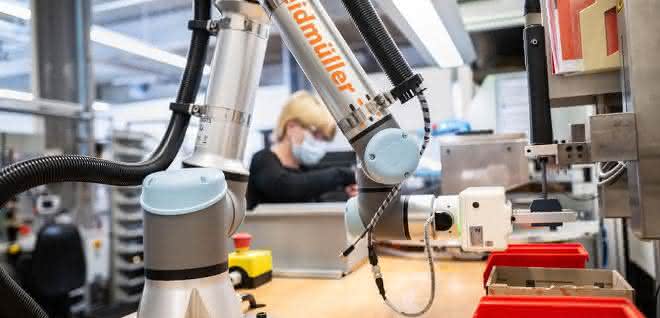
has therefore been using a collaborative robot from Universal Robots in the assembly of electromechanical components at its headquarters in Detmold for some time now.
Development of a hybrid workplace solution
As part of the SafeMate research project, which is funded by the Federal Ministry of Education and Research (BMBF) in the "Innovations for the production, services and work of tomorrow" program, strategies and concepts for the introduction and design of collaborative assembly workstations were developed. The focus was on safe workplaces that offer employees a recognizable benefit and make their work easier. In addition to renowned German companies such as Lenze, Lufthansa Sky Chefs, Miele and Sennheiser, Weidmüller from Detmold was also part of this research project.
Assembly process partially automated with cobots
Until recently, employees at Weidmüller carried out the assembly process for electromechanical components completely manually. As part of Safe-Mate, Weidmüller's process engineer Tobias Stuke and his team finally carried out a potential analysis to determine the individual tasks of man and machine in order to create a task-optimized division of labour.
The result: a cobot is ideal for carrying out the monotonous and force-intensive tasks of the work process with consistently high quality. However, it is not possible without humans and their skills, for example when gripping and removing small parts of different dimensions from the pile or crate. They are better able to recognize and sort them. Humans are also superior to their robot colleagues when it comes to feeding parts into the correct position and the subsequent inspection process.
Based on these findings, Weidmüller finally partially automated the assembly process in an initial pilot application by using human-robot collaboration (HRC). The result was a hybrid assembly workstation in which humans and robots work in parallel. The monotonous and force-intensive tasks are carried out by the robot, while the cognitively demanding tasks are still performed by humans.
Increasing productivity and employee satisfaction
A cobot from Universal Robots with an all-electric HRC-02 servo gripper from UR+ partner Zimmer is now being used at Weidmüller for the new hybrid workstation for assembling electromechanical components. This works alongside its human colleague: First, the employee assembles the connector elements, then the cobot presses in the electrical contact elements, joins the connector housing and finally screws the connection contacts together. Both the robot and the gripper are easy and intuitive to program, quick to install and simple to operate.
Process engineer Tobias Stuke is satisfied: "Thanks to the optimal distribution of tasks between man and machine, we were able to significantly reduce waiting times throughout the entire assembly process and thus increase productivity. At the same time, we are relieving the machine operator of time-consuming and labor-intensive, monotonous tasks."
Weidmüller involved its employees in the cobot implementation process right from the start, ensuring a high level of acceptance of the new technology. Overall, the company is now better equipped to compete globally in the face of an increasing shortage of skilled workers.
Andrea Alboni, Universal Robots (Germany)


You might also be interested in
Hamburg Regional Court issues preliminary injunction against Elite Robots Germany
In the copyright dispute between Teradyne Robotics and Elite Robots Germany, the Hamburg Regional Court has issued an interim injunction. The distribution of the software and products concerned is prohibited, and there is also a comprehensive...
 read more...
Schunk founds tech spin-off for humanoid robot hands
Schunk is bundling its activities in humanoid robotics by founding its own spin-off at the beginning of January. The aim of the new company is to develop modular humanoid robot hands for industrial applications.
read more...Partnership for humanoid robotics
Schaeffler and Neura Robotics jointly develop humanoids
Schaeffler and Neura Robotics will work together in the future to develop and supply key components for humanoid robots. The systems will also be integrated into Schaeffler's global production network.
read more...Yaskawa at the Automatica 2025
AI meets robotics
At this year's Automatica, everything at Yaskawa revolves around AI-based robotics solutions for the smart factory and beyond. As a trade fair highlight, the manufacturer is presenting its new Motoman Next product concept.
read more...Kassow Robots at the Automatica
7-axle vehicle in action
At Automatica, Kassow Robots will be presenting a wide range of industrial applications for production and logistics tasks that provide new impetus for efficiency and flexibility in industrial automation.
read more...Robotics and automation in six exhibition halls
From June 24 to 27, 2025, Automatica, the trade fair for intelligent automation and robotics, will bring industry and research together in six exhibition halls. Preparations are in full swing.
read more...Interview with Jörg Rommelfanger
Robotics in 25 years
The annual IFR report shows that the number of industrial robots is steadily increasing worldwide. They have already played an important role in ABB's portfolio for decades. In an interview with INDUSTRIAL Production, Jörg Rommelfanger, Head of...
read more...Reliable end effector for cobots
Collaborative robots are now widely used for a wide range of handling tasks. SMC offers three versions of the RMH pneumatic gripper for this purpose; it is compatible with cobots from a total of twelve companies.
read more...7-axis cobots with controller in robot base
With the Edge Edition, Kassow Robots has launched the world's first 7-axis cobots with a controller integrated into the robot base.
read more...