
Collaborating robots
How cobots optimize assembly
Collaborative robots provide support in assembly and relieve employees of monotonous tasks. Companies of all sizes benefit from this, as the examples of Albrecht Jung and Opel show.
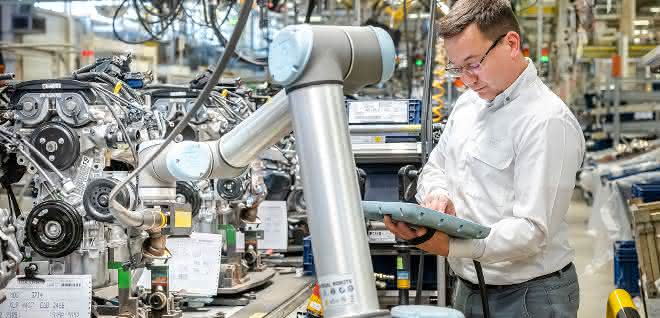
Assembly tasks require sensitivity and skill: delicate small parts often have to be positioned with millimeter precision and the force required to do so must be precisely measured. For a long time, precision and fine assembly tasks were therefore considered difficult to automate. Collaborating robots are changing that. There are several reasons why they are particularly suitable for use in assembly.
Thanks to integrated force-torque sensors, cobots have the necessary dexterity to precisely tighten screws or insert pin connections, for example. They work with extreme precision and repeat accuracy - in the case of the UR3e model from Universal Robots with up to plus/minus 0.03 millimetres. This enables them to perform a movement in exactly the same way for hours. This would hardly be possible for a human being. Cobots can also work around the clock if required, allowing companies to make optimum use of their machine capacities.
More flexible and less complicated than classic industrial robots
Admittedly, classic industrial robots can also carry out movements precisely and with a high degree of consistency. But unlike these, cobots are also highly flexible. With the appropriate peripheral devices, they can easily assemble different materials such as plastic, wood or metal. Their end effectors can be exchanged quickly so that one and the same cobot can perform different tasks.
Thanks to their lightweight design, users can also use cobots in production exactly where they are needed. The robots also save space: even the UR16e, which is already considered one of the largest lightweight robots with a payload of 16 kilograms, has an average footprint of just 190 millimeters. Small desktop robots such as the UR3e only need 128 millimeters. In addition, cobots can work directly next to humans after a successful risk assessment.
Cobots are also intuitive to operate. By simply moving the robot arm into position, users can set waypoints and train it for new tasks. This reduces changeover times and eliminates the need for time-consuming and costly training.
By completing assembly tasks quickly and reliably, cobots increase process efficiency, reduce waste and make optimum use of machine capacities. In combination with the short integration time, their purchase pays for itself in just six to nine months. This also makes the investment affordable for small and medium-sized companies.
Cobots also relieve employees by taking over monotonous tasks. At the same time, they minimize the risk of injury and free up capacity that employees can use for more demanding tasks.
Albrecht Jung: Medium-sized company increases throughput with cobots
Albrecht Jung also wanted to relieve its employees of the burden of working with intricate small parts. The medium-sized company from the Sauerland region specializes in electrical installation technology. At its plant in Lünen, the company is now partially automating its production with eight collaborative robots from Universal Robots.
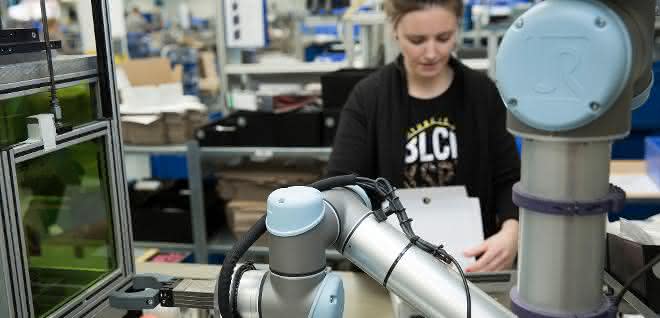
Below is a UR5 robotic arm that assists in the assembly of smart radios. A shift worker places a fully assembled power supply unit in a fixture. At the touch of a button, the robot arm starts moving and places the part in a laser chamber, where it is lasered on the front and back. It then removes the part again and places it in a second holder. The employee can use the time during laser cutting to fold shipping boxes and clean finished parts. She then packs them into the boxes and assembles a new power supply unit at the same time.
At another workstation, a UR3 screws together circuit boards for the digital radios. This is an ideal task for the small tabletop robot, which is particularly suitable for light assembly tasks: Weighing eleven kilograms, it can lift up to three kilograms and rotate each joint through 360 degrees, the end joint even indefinitely. By using the cobots, Jung increases its throughput and relieves employees of strenuous routine tasks - while maintaining the same high quality.
Opel: UR10 assembles 30 engine blocks per hour
The car manufacturer Opel also supports its employees with cobots. At its plant in Eisenach, Thuringia, a UR10 robot arm screws air conditioning compressors onto engine blocks in two-shift operation. Right next to the employees, it tightens three screws to exactly 22 Newton meters every two minutes - that's more than 1,200 screws per day. He works on 30 engines of up to seven different types per hour.
A signal from the assembly line control system tells the cobot which type of motor it is currently facing and how it needs to tighten the screws on it. "Compared to conventional industrial robots, we don't have to install any external cages or light barriers with the cobots from Universal Robots," reports Steve Geinitz, who works as a production engineer at the Opel plant in Eisenach. After a successful risk assessment, the UR10 is allowed to work right next to the employees. It only needs one square meter of space and therefore fits easily into the production environment.
Thanks to their precision, repeat accuracy and flexibility, cobots are ideal for assembly tasks. They relieve employees of strenuous work with delicate small parts or ergonomically unfavorable tasks. At the same time, they create capacity for more demanding tasks and help employers to counter the shortage of skilled workers. Companies, including SMEs, benefit from more efficient assembly processes and higher product quality thanks to cobots. In this way, they keep their production profitable and remain competitive. Andrea Alboni/as


You might also be interested in
Hamburg Regional Court issues preliminary injunction against Elite Robots Germany
In the copyright dispute between Teradyne Robotics and Elite Robots Germany, the Hamburg Regional Court has issued an interim injunction. The distribution of the software and products concerned is prohibited, and there is also a comprehensive...
 read more...
Schunk founds tech spin-off for humanoid robot hands
Schunk is bundling its activities in humanoid robotics by founding its own spin-off at the beginning of January. The aim of the new company is to develop modular humanoid robot hands for industrial applications.
read more...Partnership for humanoid robotics
Schaeffler and Neura Robotics jointly develop humanoids
Schaeffler and Neura Robotics will work together in the future to develop and supply key components for humanoid robots. The systems will also be integrated into Schaeffler's global production network.
read more...Yaskawa at the Automatica 2025
AI meets robotics
At this year's Automatica, everything at Yaskawa revolves around AI-based robotics solutions for the smart factory and beyond. As a trade fair highlight, the manufacturer is presenting its new Motoman Next product concept.
read more...Kassow Robots at the Automatica
7-axle vehicle in action
At Automatica, Kassow Robots will be presenting a wide range of industrial applications for production and logistics tasks that provide new impetus for efficiency and flexibility in industrial automation.
read more...Robotics and automation in six exhibition halls
From June 24 to 27, 2025, Automatica, the trade fair for intelligent automation and robotics, will bring industry and research together in six exhibition halls. Preparations are in full swing.
read more...Interview with Jörg Rommelfanger
Robotics in 25 years
The annual IFR report shows that the number of industrial robots is steadily increasing worldwide. They have already played an important role in ABB's portfolio for decades. In an interview with INDUSTRIAL Production, Jörg Rommelfanger, Head of...
read more...Reliable end effector for cobots
Collaborative robots are now widely used for a wide range of handling tasks. SMC offers three versions of the RMH pneumatic gripper for this purpose; it is compatible with cobots from a total of twelve companies.
read more...7-axis cobots with controller in robot base
With the Edge Edition, Kassow Robots has launched the world's first 7-axis cobots with a controller integrated into the robot base.
read more...