
Removal of sprue
Cobot optimizes injection moulded parts production
Harrison Manufacturing, a manufacturer of custom plastic injection molded parts, uses the Sawyer collaborative robot from Rethink Robotics in its Jackson, Mississippi facility. The cobot took over ergonomically demanding tasks and thus increased production throughput.
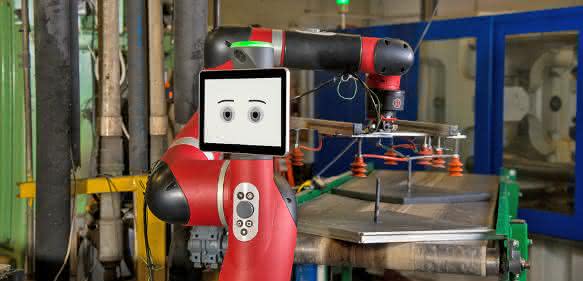
Harrison Manufacturing was founded in 2005. The company specializes in injection molding and value-added light assembly for the automotive and consumer goods industries. As a family-owned, high-volume manufacturing company, Harrison does not have the space for bulky safety cages that traditional industrial robots require. For this reason, the small footprint required by Sawyer was ideal for the company. Harrison uses Sawyer for a task where the cobot removes the sprue from injection molded parts and passes them on for packaging.
Within a short space of time, Harrison achieved tangible benefits. Sawyer improves the quality and consistency of the manufactured parts by removing the sprue from the injection molded parts and passing them on for packaging. This monotonous task often leads to errors or accidents. Thanks to Sawyer, Harrison's employees can now take on other functions. The smart cobot removes the sprue for them, a movement that puts strain on the wrists and often results in injury. Sawyer also performs the task with greater consistency, thereby improving the quality of the parts.
"We have been looking for an automation solution for this task for a long time. Conventional solutions were too big of an investment or simply not suitable for our needs," said Scott Harrison, Founder and President of Harrison Manufacturing. "Thanks to Sawyer, we are able to dedicate our employees to less onerous tasks while increasing throughput with additional shifts to meet the growing demands of our customers."
Harrison plans to commission a second Sawyer in another section of the production line in the near future. While the first Sawyer removes the sprue from the injection-molded parts and then places them on the conveyor belt, the second cobot will receive the parts, pack them and signal to the employees when the parts are ready to be palletized. The company is considering using Sawyer for a range of other tasks in the future, including parts inspection and quality control, pick-and-place tasks and loading and unloading the assembly line. "The second Sawyer has already been ordered," confirms Scott Harrison. "After the quick and straightforward commissioning of our first Sawyer, we are confident that the second cobot will be up and running just as quickly and smoothly." as


You might also be interested in
The AKIMI Research Project at WZL
Agent-Based AI Aims to Simplify Robotics for Small and Medium-Sized Businesses
The AKIMI research project is developing an agent-based AI designed to significantly simplify the setup, programming, and reconfiguration of robotic systems for small and medium-sized enterprises. The goal is to make robotics more flexible and...
 read more...
BS Rollen Strengthens Its Presence in North Rhine-Westphalia
With the groundbreaking ceremony, BS Rollen is launching the construction of a new company facility in Hückeswagen. The new building will house administrative offices, an assembly line, and a high-bay warehouse, and is intended to facilitate further...
read more...Intelligent brownfield networking
Many industrial companies are struggling with established plant structures and proprietary interfaces. Stefan Klaus' presentation will show in a practical way how brownfield environments can be efficiently networked with open technologies and made...
read more...Factory-X in practice
How can set-up processes in highly variant production be automated efficiently? Markus Benndorff from soffico shows how Factory-X, industrial data rooms and modular architectures create new possibilities for flexible production concepts.
read more...Mechanical engineering | Case study
Cordless in brush production
The machine manufacturer Wöhler Bohemia is integrating wireless HMI panels from Keba into its brush production systems. The background to this is the need for flexibility, robotics integration and new market strategies.
read more...International product approvals as a strategic competitive advantage in the global market
Which certificates are valid worldwide? Christian Latte, Head of Technical Compliance and Approval Officer at Hummel AG, explains this in an interview. He provides insights into product approvals and explains why early approval strategies shorten...
read more...Foundry modernizes plant park with continuous wire belt shot blasting system
The Spanish foundry Funosa is modernizing its equipment fleet with an RDGE 1250 wire belt continuous shot blasting machine from Rösler. Focus: sand removal from heavy iron castings, energy efficiency, ease of maintenance and ESG strategy.
read more...How bridging steps, stairs and catwalks are changing processes in production and logistics
At Logimat 2026, Munk Günzburger Steigtechnik will be showcasing modular bridging steps, stairs, platform and walkway systems for production, warehousing and logistics. With online configurators, distances can be efficiently shortened, processes...
read more...Drilling cycles optimized
A new replaceable head drill from Walter can reduce machining time in series production thanks to its patented interface and screwless design.
read more...