

Representative survey
Half of German companies use robots
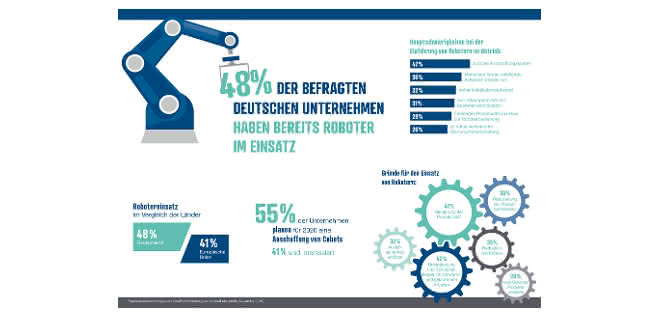
Almost half of German companies are already using robots. This was the result of a representative survey of 1600 European decision-makers conducted by the retailer Reichelt Elektronik. Reducing the workload of employees is an important motive.
There is hardly a sector or branch of industry in which robots are not already in use or where research is at least being carried out into possible applications. Digitalization and automation remain the most important topics and the biggest challenges for companies.
In a recent representative survey, Reichelt Elektronik asked 1,600 decision-makers, including 500 from Germany, from the fields of software design, engineering, development, programming, IT and purchasing about their views on the use of robots and their experiences.
Germany is ahead
The study shows that almost half of German companies (48%) already use robots for various activities. This puts Germans above the European average: 41% of companies in Europe have already opted for robot solutions. This contrasts with almost 57 percent who do not yet use robots. However, 44% of all respondents are planning to purchase robots or expand their existing robot solution in the next year.
In addition to increasing productivity (47 percent) and reducing costs (38 percent), companies in Germany are hoping above all to reduce the workload of their employees: around 42 percent of robots are purchased for physically heavy and dangerous tasks.
SMEs are pioneers
It is interesting to note that companies with 250 to 500 employees in particular have already invested in automation (70 percent). With fewer (100-249) and more (500+) employees, only just under 60 percent of respondents confirm that they already use robots.
The most common areas of application for robots in Germany include physically heavy, dangerous and repetitive work. However, robots are no longer isolated machines that operate behind fences. There is great interest in collaborative robots, known as cobots, which work hand in hand with humans: 55% of the companies surveyed are planning to purchase one in the next year, while 41% have no concrete plans. However, robots are also used for tests (36%), demonstrations (25%) or for training purposes (25%).
Acquisition costs biggest hurdle
As robot solutions are usually associated with higher acquisition costs, the majority (42%) of German respondents also see this as the greatest difficulty in introducing robots. One in three companies also fear the high installation costs and that the new technology may not be compatible with existing systems. 35 percent are convinced that the tasks involved can best be carried out by humans. On the other hand, two out of three companies state that they have a budget of at least 50,000 euros for automation. One in three respondents can even budget for more than 100,000 euros. For a purchase of this size, companies primarily expect comprehensive technical advice (56%) and support in the event of technical faults (58%).
During the consultation and decision-making phase, companies should also consider looking for a reliable supplier of accessories and spare parts.
"Hardly any other industrial sector offers as much potential as automation. New technologies allow us to hand over ever more complex tasks to robots. Despite some challenges, we are convinced that the trend towards more automation through the use of robots will continue in 2020. The market is developing rapidly and there are more and more solutions that are also affordable for medium-sized companies," comments Tobias Thelemann, Product Manager at Reichelt Elektronik.dsc


You might also be interested in
Hamburg Regional Court issues preliminary injunction against Elite Robots Germany
In the copyright dispute between Teradyne Robotics and Elite Robots Germany, the Hamburg Regional Court has issued an interim injunction. The distribution of the software and products concerned is prohibited, and there is also a comprehensive...
 read more...
Schunk founds tech spin-off for humanoid robot hands
Schunk is bundling its activities in humanoid robotics by founding its own spin-off at the beginning of January. The aim of the new company is to develop modular humanoid robot hands for industrial applications.
read more...Partnership for humanoid robotics
Schaeffler and Neura Robotics jointly develop humanoids
Schaeffler and Neura Robotics will work together in the future to develop and supply key components for humanoid robots. The systems will also be integrated into Schaeffler's global production network.
read more...Yaskawa at the Automatica 2025
AI meets robotics
At this year's Automatica, everything at Yaskawa revolves around AI-based robotics solutions for the smart factory and beyond. As a trade fair highlight, the manufacturer is presenting its new Motoman Next product concept.
read more...Kassow Robots at the Automatica
7-axle vehicle in action
At Automatica, Kassow Robots will be presenting a wide range of industrial applications for production and logistics tasks that provide new impetus for efficiency and flexibility in industrial automation.
read more...Robotics and automation in six exhibition halls
From June 24 to 27, 2025, Automatica, the trade fair for intelligent automation and robotics, will bring industry and research together in six exhibition halls. Preparations are in full swing.
read more...Interview with Jörg Rommelfanger
Robotics in 25 years
The annual IFR report shows that the number of industrial robots is steadily increasing worldwide. They have already played an important role in ABB's portfolio for decades. In an interview with INDUSTRIAL Production, Jörg Rommelfanger, Head of...
read more...Reliable end effector for cobots
Collaborative robots are now widely used for a wide range of handling tasks. SMC offers three versions of the RMH pneumatic gripper for this purpose; it is compatible with cobots from a total of twelve companies.
read more...7-axis cobots with controller in robot base
With the Edge Edition, Kassow Robots has launched the world's first 7-axis cobots with a controller integrated into the robot base.
read more...