

Gripper selection
Who grabs what best and when?
Selection of gripper models. The market for collaborative robotics is growing. The success of automation stands and falls with the choice of the right end-of-arm tooling (EoAT) - i.e. grippers, sensors or tool changers.
In times when humans and robots work hand in hand, there are collaborative grippers for all possible aspects of industrial production. Whether in food production, textiles or the automotive industry - cobots relieve employees across all sectors and ensure more efficient processes. The market for EoAT, which makes robotic arms functional in the first place, is growing accordingly. According to the International Federation of Robotics (IFR), its global sales potential will quadruple to 1.4 billion euros by 2023. The range of applications for gripping tools is also expanding: sensors and software give them the necessary sensitivity to even take on tasks in precision assembly or sensitive surface treatment. At the start of every automation project, the question therefore arises as to which gripper model is the right one.
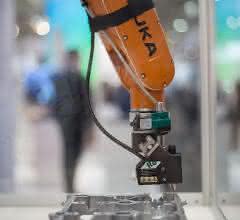
Collaborative robot arms and grippers are typically used for pick & place tasks. These include palletizing, packaging and machine loading. The basic advantage of automating these tasks is that processes can be accelerated while maintaining constant performance, which increases productivity. In the food and pharmaceutical sectors, automation also reduces the risk of contamination.
Collaborative two-finger grippers are generally recommended for pick & place applications. Features such as individually adjustable fingertips or depth compensation make their use more efficient, as the grippers can adapt better to the task at hand and grip objects more precisely. In order to automate complex processes particularly efficiently, it also makes sense to use a double gripper: such models are able to handle two objects at the same time, which further reduces throughput times.
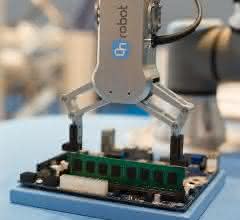
Which model is the right choice in each individual case depends on the parameters of the object to be handled. For example, the gripper must be able to lift the respective weight and therefore be approved for a certain load capacity. The size and circumference of the object are also decisive. Grippers with a larger span are advantageous as they can adjust more flexibly to the circumference of the object. However, it is generally advisable to choose the smallest possible model that meets your needs. The heavier the gripper itself, the lower the available payload of the robot arm. Users also save costs, space and energy.
In addition to weight and size, the shape of the objects to be handled is also decisive. If the objects are large and flat, a vacuum gripper makes sense. This is the case, for example, when handling solar panels, tiles or displays. In particular, models with adjustable arms and adjustable suction power are able to lift flat objects of different sizes and geometries. Models without an external air supply are also particularly space-saving and can therefore be integrated more easily into the production layout.
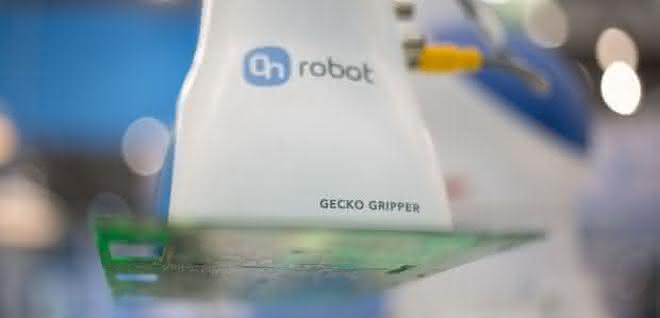
However, vacuum grippers have two disadvantages: firstly, their suction cups can leave marks on sensitive surfaces. Secondly, it is not possible to create a vacuum on every surface, for example on porous or perforated structures such as drilled circuit boards. In such cases, adhesive gripping systems such as Gecko grippers provide a remedy. These are modeled on the biological structure of gecko feet: when their gripping surfaces, which are coated with tiny hairs, are pressed onto an object, van der Waals forces are generated that enable them to lift the object without delay. Slight, controlled tilting of the gripper releases the adhesion again. The provider OnRobot made this technology available for broad industrial use for the first time in 2018.
The special adhesion grippers are also suitable for users looking for an energy-efficient solution, as they do not require electricity to maintain the gripping process. Which gripper makes sense in each individual case, however, is also determined by the required payload: Gecko grippers lift objects weighing up to around four kilograms, whereas collaborative vacuum grippers such as the VG10 from OnRobot are also suitable for heavier loads of up to around ten kilograms.
In precision and fine assembly, the challenge is often to precisely position delicate workpieces of different sizes and shapes despite imprecise positioning. This is the case, for example, when inserting pin connections. In the context of industrial production, robot arms often have to deal with soft, deformed materials or irregular workpieces. Nevertheless, they have to insert the pins into the narrow openings they contain.
To achieve this, the devices must be able to detect even the slightest resistance in order to correct their course in real time. Smart grippers with integrated sensors and corresponding software are particularly recommended for this purpose: They can feed the process data recorded by the sensor directly back to the robot arm and adjust its movement without delay. This enables them to carry out precise assembly processes without knowing the exact parameters in advance. The RG2-FT gripper from OnRobot, for example, has an integrated proximity sensor and force/torque sensors in its "fingertips", enabling it to grip objects in a centered position and insert valves into cylinder heads or mount manual gearboxes, for example.
Quality control also requires a high degree of flexibility, as grippers are regularly confronted with objects of different sizes. In addition, these are often sensitive, such as sample vials. Only with the right sensor technology, such as force-torque or proximity sensors, is the gripper able to adjust the pressure applied in such a way that the object in question is not damaged. The measurement of forces can also be automated cost-effectively using haptic sensors, which is relevant when testing plug connections, for example.
With this in mind, two-finger grippers with integrated sensors or in combination with a corresponding sensor module are also primarily suitable for quality inspection. The following generally applies to the location of the sensors: if the robot arm has to memorize complex motion sequences in the course of its task, a model in which the sensors are installed between the arm and gripper is advisable. A gripper with integrated sensors is particularly advantageous if it is to perform precision tasks such as fine assembly. If higher forces are expected in the process, a gripper with an external sensor is recommended, as the integrated sensors are more sensitive.
When treating surfaces - be it deburring, polishing or grinding - the use of classic grippers is less recommended than the combination of necessary tools with corresponding sensor modules. The main challenge in surface treatment lies primarily in precisely metering the force applied by the tool and keeping it constant. In addition, the end effector must be able to follow the contours of the workpiece precisely. With force/torque sensors such as the HEX models from OnRobot, a robot arm is able to do this even without complex programming. Which gripper is particularly useful and when can only be determined for each individual case. It remains to be said: The gripping range, payload and sensor technology should be matched as precisely as possible to the respective requirements. Smart grippers are generally advantageous as they adapt dynamically to situational requirements. In any case, users should make sure to choose products that are easy to integrate and operate. Collaborative Plug & Produce solutions pay for themselves quickly and make it possible to experience the full benefits of human-robot collaboration: maximum flexibility, greater efficiency in production and relief for employees exactly where a helping hand is needed.
Enrico Krog Iversen/as


You might also be interested in
Hamburg Regional Court issues preliminary injunction against Elite Robots Germany
In the copyright dispute between Teradyne Robotics and Elite Robots Germany, the Hamburg Regional Court has issued an interim injunction. The distribution of the software and products concerned is prohibited, and there is also a comprehensive...
 read more...
Schunk founds tech spin-off for humanoid robot hands
Schunk is bundling its activities in humanoid robotics by founding its own spin-off at the beginning of January. The aim of the new company is to develop modular humanoid robot hands for industrial applications.
read more...Partnership for humanoid robotics
Schaeffler and Neura Robotics jointly develop humanoids
Schaeffler and Neura Robotics will work together in the future to develop and supply key components for humanoid robots. The systems will also be integrated into Schaeffler's global production network.
read more...Yaskawa at the Automatica 2025
AI meets robotics
At this year's Automatica, everything at Yaskawa revolves around AI-based robotics solutions for the smart factory and beyond. As a trade fair highlight, the manufacturer is presenting its new Motoman Next product concept.
read more...Kassow Robots at the Automatica
7-axle vehicle in action
At Automatica, Kassow Robots will be presenting a wide range of industrial applications for production and logistics tasks that provide new impetus for efficiency and flexibility in industrial automation.
read more...Robotics and automation in six exhibition halls
From June 24 to 27, 2025, Automatica, the trade fair for intelligent automation and robotics, will bring industry and research together in six exhibition halls. Preparations are in full swing.
read more...Interview with Jörg Rommelfanger
Robotics in 25 years
The annual IFR report shows that the number of industrial robots is steadily increasing worldwide. They have already played an important role in ABB's portfolio for decades. In an interview with INDUSTRIAL Production, Jörg Rommelfanger, Head of...
read more...Reliable end effector for cobots
Collaborative robots are now widely used for a wide range of handling tasks. SMC offers three versions of the RMH pneumatic gripper for this purpose; it is compatible with cobots from a total of twelve companies.
read more...7-axis cobots with controller in robot base
With the Edge Edition, Kassow Robots has launched the world's first 7-axis cobots with a controller integrated into the robot base.
read more...