
Gripper
Separating circuit boards in a team
MRK in the electronics industry. In a depaneling machine from Schunk Electronic Solutions, a robot arm with a Schunk gripper takes over the loading and unloading. This significantly increases efficiency in electronics production, as a single employee can operate up to five machines simultaneously.
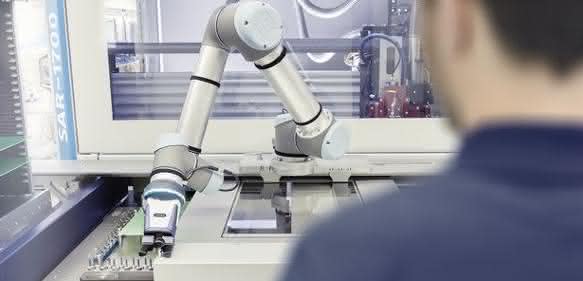
"In the coming years, the proportion of HRC-capable machines and systems will increase rapidly," emphasized Henrik A. Schunk on the occasion of the tenth Schunk Expert Days on Service Robotics. "Teamwork with robots will soon be as natural and intuitive as driving a car or working with a computer," said the initiator and organizer of the symposium for applied service robotics. At Schunk, things are moving at a rapid pace when it comes to collaboration: following an initial pilot application in its own gripper assembly, the family-owned company is now using a demonstration system from its subsidiary Schunk Electronic Solutions to show how depaneling systems for the electronics industry can be made collaborative and the benefits associated with this.
Depaneling machine with robot arm
The system consists of the SAR 1700 depaneling machine and a six-axis UR5 robot arm from Universal Robots, which is equipped with a Co-act-EGP-C gripper from Schunk. Whereas employees previously had to load stand-alone machines such as the SAR 1700 with the electrical assemblies individually by hand, it is now sufficient to manually refill the depaneling magazine for the robot.
Everything else is done by the machine: the robot reaches into the magazine, removes a panel, places it in the machine, closes the door and presses the start button. As soon as the milling machine has separated the PCBs, the robot arm places the parts on a conveyor belt and the process starts again. The magazine has space for up to 32 panels. If required, the employee can take over at any time and load the machine manually.
"The collaborative concept significantly increases efficiency in electronics production," explains Henrik A. Schunk. "Instead of one or two machines, operators can now operate up to five depaneling machines at the same time, for example. This means the solution pays for itself within a very short time."
As the SAR 1700 is specially designed for smaller companies and the investment is comparatively low, electronics production can be successively expanded with additional machines. Each one can be flexibly equipped manually or automatically to suit individual requirements.
DGUV-certified gripper fits all cobots
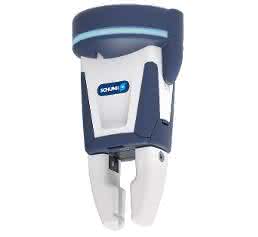
The Co-act-EGP-C gripper used in the application is the world's first inherently safe industrial gripper to be certified and approved for collaborative operation by the German Social Accident Insurance (DGUV). The two-finger parallel gripper, which is controlled via digital I/O, covers a wide range of applications - from small parts assembly in the electronics and consumer goods industries to assembly applications in the automotive sector. It meets the requirements of ISO/TS 15066 and is designed so that people cannot be injured. This includes a protective cover as well as a safe current limiter. To make collaboration with the operator as fluid and intuitive as possible, the 24 V gripper is equipped with LED lighting in traffic light colors. The user can use these to signal the current status of the module.
It is supplied as a completely pre-assembled unit with a suitable interface for cobots from Kuka, Fanuc or Universal Robots. Interfaces for robots from other manufacturers are also available on request. The complete control and power electronics are installed inside the gripper so that it does not take up any space in the control cabinet. To further minimize the commissioning effort, Schunk is planning programming modules for all common cobots. as


You might also be interested in
Hamburg Regional Court issues preliminary injunction against Elite Robots Germany
In the copyright dispute between Teradyne Robotics and Elite Robots Germany, the Hamburg Regional Court has issued an interim injunction. The distribution of the software and products concerned is prohibited, and there is also a comprehensive...
 read more...
Schunk founds tech spin-off for humanoid robot hands
Schunk is bundling its activities in humanoid robotics by founding its own spin-off at the beginning of January. The aim of the new company is to develop modular humanoid robot hands for industrial applications.
read more...Partnership for humanoid robotics
Schaeffler and Neura Robotics jointly develop humanoids
Schaeffler and Neura Robotics will work together in the future to develop and supply key components for humanoid robots. The systems will also be integrated into Schaeffler's global production network.
read more...Yaskawa at the Automatica 2025
AI meets robotics
At this year's Automatica, everything at Yaskawa revolves around AI-based robotics solutions for the smart factory and beyond. As a trade fair highlight, the manufacturer is presenting its new Motoman Next product concept.
read more...Kassow Robots at the Automatica
7-axle vehicle in action
At Automatica, Kassow Robots will be presenting a wide range of industrial applications for production and logistics tasks that provide new impetus for efficiency and flexibility in industrial automation.
read more...Robotics and automation in six exhibition halls
From June 24 to 27, 2025, Automatica, the trade fair for intelligent automation and robotics, will bring industry and research together in six exhibition halls. Preparations are in full swing.
read more...Interview with Jörg Rommelfanger
Robotics in 25 years
The annual IFR report shows that the number of industrial robots is steadily increasing worldwide. They have already played an important role in ABB's portfolio for decades. In an interview with INDUSTRIAL Production, Jörg Rommelfanger, Head of...
read more...Reliable end effector for cobots
Collaborative robots are now widely used for a wide range of handling tasks. SMC offers three versions of the RMH pneumatic gripper for this purpose; it is compatible with cobots from a total of twelve companies.
read more...7-axis cobots with controller in robot base
With the Edge Edition, Kassow Robots has launched the world's first 7-axis cobots with a controller integrated into the robot base.
read more...