

Geo-navigation technology
Yesterday a forklift, tomorrow a robot
Industrial truck manufacturer Hyster Europe is working together with French robotics specialist Balyo and is presenting robotics solutions using the Hyster LO7.0T tow tractor as an example.
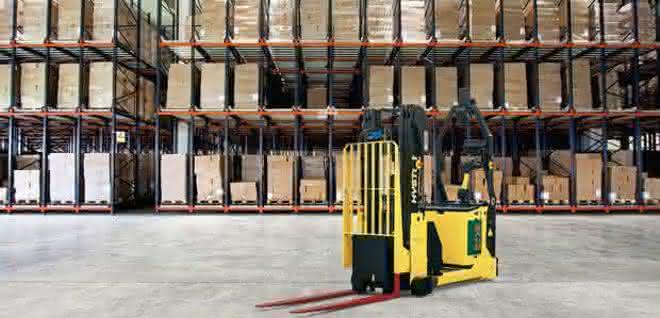
The tug equipped with forklift-based robot technology is one of the first forklift models that Hyster Europe has equipped with Balyo Geo navigation technology. No complex changes to the infrastructure are required to automate logistical processes. Instead, the industrial trucks orient themselves to their surroundings with the help of natural building features. Hyster relies primarily on the Geoguidance system for navigation. This system, which is based on so-called lidar technology, determines the position of the forklift truck by orienting itself to fixed points, such as walls, shelves or the building structure. Reflectors or other physical navigation aids are also not necessary.
These robotic solutions are based on forklift trucks from series production, so the industrial trucks can still be operated manually. The robot technology can be switched off at any time and the driver can control the machines manually if required. This means that the forklift truck can also be used spontaneously for other tasks. This is how the robotic solutions for Hyster forklifts differ from automated guided vehicles: AGVs automatically follow their set routes and cannot be operated manually. In addition, some AGVs are limited in their navigation and cannot always avoid obstacles. Hyster trucks equipped with Balyo geo-navigation technology simply take a different route if necessary. If a truck equipped with a geo-guidance system encounters an obstacle, in most cases the software determines an alternative route and the "robot" can continue its journey automatically.
Hyster currently offers several industrial trucks with robot technology - such as the S1.0C, S1.2C and S1.5C counterbalanced pallet trucks and the LO2.5 low lift order pickers. In addition, several tugs used with tugger trains to feed production lines can be equipped with the robotic solutions.
The route to be taken by the tugger train can be saved in the tugger train. After appropriate training, the tugger trains travel to their destinations automatically and stop independently at the individual stations. Prerequisite: The configuration of the tugger train remains unchanged and the weight of the loads to be transported remains approximately the same; otherwise the tuggers must be retrained. If necessary, the robot technology can also be switched off and the tugs are controlled by the driver as usual. pb


You might also be interested in
Fraunhofer IOSB Opens Humanoid Robots Lab
The Fraunhofer IOSB is opening a Humanoid Robots Experience Lab in Karlsruhe, Lemgo, and Ilmenau. Companies and organizations can use these facilities to test potential applications for humanoid robots and develop pilot projects.
 read more...
Artificial Intelligence in Manufacturing
Trumpf and IPAI Are Expanding a European AI Network for Industry
The high-tech company Trumpf is an official partner of the IPAI AI network in Heilbronn. Together, the partners aim to exchange experiences, develop new AI applications for industrial use, and advance the development of artificial intelligence in...
read more...Case Study: Networked Manufacturing Platform for Toolmaking
Using a networked manufacturing platform, Escha GmbH & Co. KG, a manufacturer of industrial fastening technology, has comprehensively modernized its toolmaking operations.
read more...Barcelona Declaration on Robotics and...
Robotics Associations Adopt Global Automation Strategy
The global robotics industry is stepping up its collaboration. The associations AER Automation, A3, IFR, and VDMA Robotics + Automation have formed a long-term alliance by signing the “Barcelona Declaration on Robotics and Automation 2026.” The...
read more...Jane Heffner is the new president of the International Federation of Robotics
Jane Heffner is the new president of the International Federation of Robotics. Adrien Brouillard has been appointed vice president of the global federation.
read more...Greater Transparency in the Robotics Market
RoboFinder Launches as an Independent Comparison Platform
Launch at Gitex Europe: 'RoboFinder' aims to bring more transparency to the professional service robotics market. In this interview, founder and CEO Brian Engels discusses market potential, challenges, and the goals of the new platform.
read more...Artificial Intelligence for the Physical Space
Alibaba Expands Qwen Model Family with a Robotics Suite for Physical AI
Alibaba is expanding its Qwen model family with a robotics suite for Physical AI. The three models—for manipulation, navigation, and simulation—are designed to assist autonomous robots with complex tasks in real-world environments.
read more...International Federation of Robotics
U.S. Robotics Industry Sees Double-Digit Growth
In the U.S., sales of industrial robots rose by 11% compared to the previous year: 38,000 units were newly installed in 2025. This significant recovery is driven by robust growth in the food industry and other non-manufacturing sectors. However, the...
read more...Development Collaboration for Humanoid Robotic Hands Launched
Schunk is entering into a new development partnership with Robert Bosch Robotics. Their shared goal is to develop an industrial-grade robotic hand that can be integrated into various humanoid robot systems.
read more...