
FORobotics
Trends in robotics
Mobile ad-hoc cooperating robot teams in the factory of the future. The "FORobotics" research network is investigating the possible applications and potential of autonomous, mobile robots in production. Alone or in a team with the worker, the robots take on varying tasks and can be used flexibly in the factory.
A classic production line with robot automation consists of several robots that perform repetitive, monotonous and highly specialized tasks, such as spot welding. Such systems are usually used to manufacture one product in large quantities. The individualization of consumer goods leads to multi-variant production. The vision is that the production plant of the future will be able to manufacture a variety of products in quantities of one.
Another trend is the shift from seeing robots as tools to seeing them as "partners" that work hand in hand, allowing human and machine skills to be combined profitably. Enthusiasts are predicting that an era of human-robot collaboration will soon dawn.
Ultimately, digitalization leads to more easily reconfigurable systems. The historically strong link between a manufacturer's hardware and software has already been loosened in the areas of computer and smartphone technology. Operating systems are used there to integrate hardware components and software applications from different manufacturers into one system; individual components can then be easily replaced.
Mobile robot teams
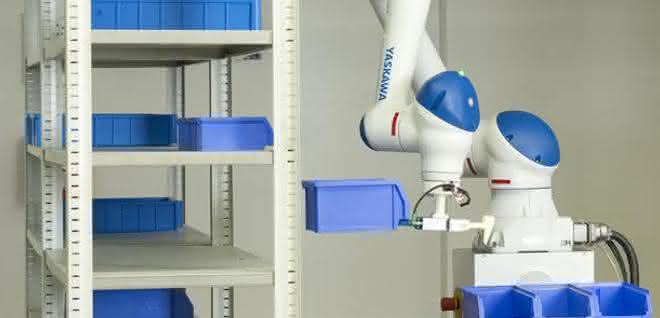
Mobile robots can be used to create reconfigurable, multi-variant production systems. Such robots can use their tools flexibly in terms of location or carry out transportation. Division of labor and collaboration can be used to solve tasks that cannot be handled by one robot alone or that require a diverse set of skills. A team of robots and humans can solve complicated tasks and can be assembled and reconfigured for specific tasks. Key aspects here are mobility, collaboration and dynamic reconfiguration. The "FORobotics" research network, which is funded by the Bavarian Research Foundation and consists of more than 25 partners from research and industry, is working on this topic. In the past, use cases in an industrial environment were analyzed and specifications for the hardware and software platform of an ad-hoc cooperating mobile robot were derived. The challenge here is that people and machines are no longer separated by a safety fence. On the one hand, safeguards must be put in place to protect people from interference and injuries caused by the robot. On the other hand, the robot is also exposed to an unstructured, dynamic environment without a safety fence. Where all operating equipment has a defined place inside the safety fence, people can perform unpredictable actions outside or obstacles can suddenly block the path of travel.
Task-oriented planning
The use of mobile robots in dynamic, unstructured environments combined with the desire for flexible execution of varying production tasks places new demands on resources. Within planning and programming, the trend is moving away from a static and imperative approach towards a dynamic and task-oriented one. To this end, the research association is pursuing a holistic approach from the level of production planning and control through to the field level.
The range of functions of a mobile robot depends on its hardware configuration and installed software modules and can be described by its capabilities, such as "moving" or "gripping". On this basis, the functionalities for realizing certain capabilities are encapsulated in individual software modules (apps). In contrast to traditional industrial robots, the apps do not contain static program sequences, but implement autonomous behaviour, such as navigation to a target pose including dynamic avoidance of unforeseen obstacles. Based on apps from the consumer sector, the aim is to freely configure the capabilities of the mobile robot by individually compiling its apps within a modular software architecture.
The production tasks to be performed by the mobile robot are described semantically analogous to its capabilities. This enables automatic matching and thus assignment of production tasks to alternative resources. Variable configuration of a robot's skill profile and the possibility that identical tasks can be performed by robots with a heterogeneous structure lead to a high level of complexity in planning. This fact is countered by the hierarchical decomposition of tasks and planning at different levels of abstraction. In the future, the dynamic selection of resources and the flexible composition of suitable team constellations will be realized, thus enabling simple adaptation to new use cases and rapid reaction to changing conditions in production.
L. Heuss/S. Roder/pb

Briefly explained: The iwb
The Institute for Machine Tools and Industrial Management (iwb) at the Technical University of Munich is one of the largest production engineering research institutes in Germany and comprises two chairs of the Faculty of Mechanical Engineering in Garching near Munich. The two chairs, the Chair of Industrial Management and Assembly Technology and the Chair of Machine Tools and Production Engineering, define the research content and main topics in the fields of additive manufacturing, machine tools, assembly technology and robotics, joining and cutting technology as well as in the area of production management and logistics.
www.iwb.mw.tum.de

Briefly explained: The MHI e.V.
The Wissenschaftliche Gesellschaft für Montage, Handhabung und Industrierobotik e.V. (MHI e.V.) is a network of renowned university professors - institute directors and chair holders - from German-speaking countries. The members conduct both fundamental and application-oriented research on a wide range of current topics in the fields of assembly, handling and industrial robotics. Further information on the society, its members and activities: www.wgmhi.de.


You might also be interested in
Fraunhofer IOSB Opens Humanoid Robots Lab
The Fraunhofer IOSB is opening a Humanoid Robots Experience Lab in Karlsruhe, Lemgo, and Ilmenau. Companies and organizations can use these facilities to test potential applications for humanoid robots and develop pilot projects.
 read more...
Artificial Intelligence in Manufacturing
Trumpf and IPAI Are Expanding a European AI Network for Industry
The high-tech company Trumpf is an official partner of the IPAI AI network in Heilbronn. Together, the partners aim to exchange experiences, develop new AI applications for industrial use, and advance the development of artificial intelligence in...
read more...Case Study: Networked Manufacturing Platform for Toolmaking
Using a networked manufacturing platform, Escha GmbH & Co. KG, a manufacturer of industrial fastening technology, has comprehensively modernized its toolmaking operations.
read more...Barcelona Declaration on Robotics and...
Robotics Associations Adopt Global Automation Strategy
The global robotics industry is stepping up its collaboration. The associations AER Automation, A3, IFR, and VDMA Robotics + Automation have formed a long-term alliance by signing the “Barcelona Declaration on Robotics and Automation 2026.” The...
read more...Jane Heffner is the new president of the International Federation of Robotics
Jane Heffner is the new president of the International Federation of Robotics. Adrien Brouillard has been appointed vice president of the global federation.
read more...Greater Transparency in the Robotics Market
RoboFinder Launches as an Independent Comparison Platform
Launch at Gitex Europe: 'RoboFinder' aims to bring more transparency to the professional service robotics market. In this interview, founder and CEO Brian Engels discusses market potential, challenges, and the goals of the new platform.
read more...Artificial Intelligence for the Physical Space
Alibaba Expands Qwen Model Family with a Robotics Suite for Physical AI
Alibaba is expanding its Qwen model family with a robotics suite for Physical AI. The three models—for manipulation, navigation, and simulation—are designed to assist autonomous robots with complex tasks in real-world environments.
read more...International Federation of Robotics
U.S. Robotics Industry Sees Double-Digit Growth
In the U.S., sales of industrial robots rose by 11% compared to the previous year: 38,000 units were newly installed in 2025. This significant recovery is driven by robust growth in the food industry and other non-manufacturing sectors. However, the...
read more...Development Collaboration for Humanoid Robotic Hands Launched
Schunk is entering into a new development partnership with Robert Bosch Robotics. Their shared goal is to develop an industrial-grade robotic hand that can be integrated into various humanoid robot systems.
read more...