
Industrial robots
Flexible handling with cobots
The use of cobots has many advantages over conventional robots - especially in terms of flexibility for changing applications. Nicolas Lauzier, Senior Product Manager at Robotiq, the specialist for palletizing solutions, explains how robotic employees can be integrated into existing production processes.
We are seeing an increasing use of cobots across a wide range of applications thanks to their unique flexibility. While companies use standard industrial robots for their day-to-day operations, the use of cobots is growing in applications where greater flexibility is required, but not at the expense of volume or performance. This is particularly the case in applications where products are currently processed manually. This means that significant modification or reconfiguration of the physical product environment is not required.
One of the main factors in the increasing use of cobots is the ready availability of simpler and more cost-effective systems that include standard hardware, assembly and auxiliary components. This is an attractive alternative to larger and fixed automation systems. Although these systems require larger investments, they can take a long time to deploy and may only be suitable for a single part or application - with a correspondingly long payback period.
Specifically in the area of palletizing, there is traditionally a choice between "bundled" systems, consisting of a number of components from different suppliers packaged as a standard solution, or working with a supplier to create a custom solution based on any productivity goal. Customized solutions often result in extended development and testing time. This results in a system that can be challenging to reconfigure or redeploy if requirements change down the line.
Evaluate systems using simulations
However, using off-the-shelf products for a cobot palletizing application in the form of a cobot palletizer allows for faster simulation of the application in terms of its feasibility and predictability, as well as likely throughput and payback time. Some of the leading companies in this field even offer free online configurators specifically for this purpose. There, an analysis can be carried out based on, for example, part dimensions, weight and required throughput. This approach also allows for a quicker risk assessment compared to more complex systems made up of components from different suppliers, where there may not be universally compatible software. In this case, each time the application is modified, an entirely new risk assessment is required, which may involve significant costs and delays, to assess the impact of the new application on the production environment and the systems within it.
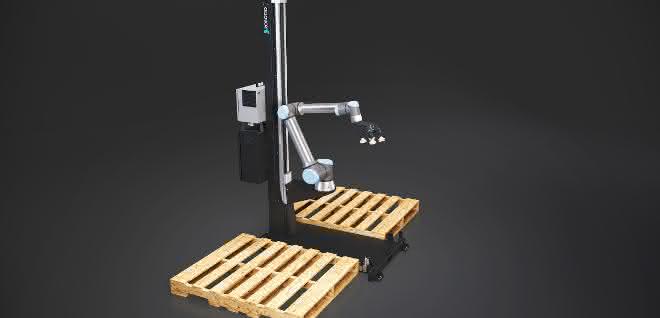
Driving the adaptation is the development of easy-to-integrate application kits that allow companies to take advantage of automated palletizing. This solution offers all the flexibility associated with traditional robotic palletizing and is typically based on smaller cobots that do not require cages or fences as they can detect people moving nearby and react accordingly. At the same time, they deliver good throughput and can be easily reprogrammed if production requirements change.
An example could be an application in a food, beverage or consumer goods facility where standard products manufactured throughout the year are processed on dedicated palletizing lines by larger robotic systems installed on site. In this case, occasional or specific applications such as Christmas or customized items with a different carton dimension can be handled by a standard cobot system that can be quickly reprogrammed and repurposed.
The cobot during bin-picking
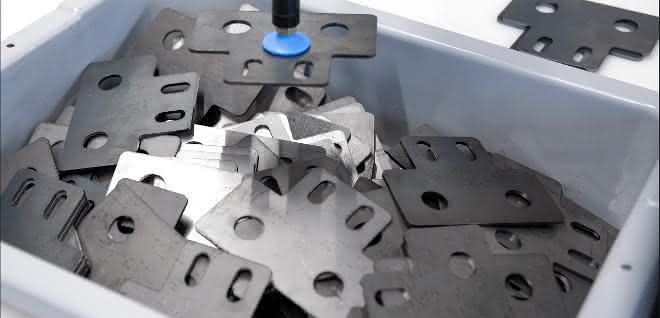
Another example of the contribution of cobots is bin-picking. Traditional approaches have focused on requiring a robot to locate objects with its vision system, then grasp and correctly configure them before feeding them to the assembly machine in the correct position. Modern systems can simply pick up a certain number of the objects and move them to a separate, flat surface. This approach only requires a simple robotic camera. It is suitable for any task where the objects are not fragile and do not need to be gripped in the same way each time. The standard 2D vision sensor of a robot then recognizes the objects that have been transferred to the second surface and picks them up individually. This eliminates the need for expensive scanning and sensing systems and programming algorithms, bringing the use of cobots within the scope of a wider range of applications - and within the financial reach of most SMEs.
An example of an application would be the automotive sector, where components for different vehicles may be similar but not exactly the same. In this case, investing in a customized parts feeder would not be appropriate. However, standard software can be used to reprogram a robot so that it can process components with different dimensions without significant downtime.
The value of such cobot use in palletizing or bin picking is likely to increase even further, as the integrated monitoring systems can detect anomalies and send automatic alerts in the event of a problem. This is a significant advantage for any company that operates unmanned or unsupervised production using cobots.


You might also be interested in
Plagiarius 2024 negative prize
On January 26, 2024, the Plagiarius campaign awarded its dreaded "Plagiarius" negative prize for the 48th time to manufacturers and retailers of particularly brazen counterfeits and fakes.
 read more...
Ivalua honors winners of the Generative AI...
AI-supported "add-ons" for buyers within 48 hours
Ivalua, provider of cloud-based spend management solutions, announced the winners and innovations of the first Generative AI Innovation Cup. The competition took place in December 2023. It was open to all Ivalua partners and employees - more than...
read more...Efaflex celebrates 50 years of high-speed...
The emphasis is on "fast"
Since day one, Efaflex has wanted to use new technologies as early as possible and drive progress in the industry. This year, the family business is celebrating its 50th anniversary under the motto "Fast Forward".
read more...Security of supply even during power outages
In the winter of 2022, Germany was worried about energy shortages. The drugstore retailer dm did not paint any horror scenarios, but nevertheless saw the possibility of controlled, temporary, regional power cuts (brownouts).
read more...Safety technology in mechanical engineering
Modules with new functions
Euchner's product highlights at EMO 2023 include the communication-capable solenoid interlocks.
read more...Transforming the paper industry towards climate neutrality
Together with partners from industry and research, Voith is developing a project for the optimization of energy and material flows in paper production. The aim of the research project is to develop a digital framework that enables effective process...
read more...Up to 95 percent less flue gas thanks to direct extraction
The requirements for occupational safety measures and safety technology are also constantly increasing in welding technology. The Technical Rules for Hazardous Substances (TRGS) stipulate that welding fumes and harmful substances must be extracted...
read more...Competitive advantages with large machines
Whether 3D-printed components for machines and systems, prototypes or aids for design: additive manufacturing is almost indispensable for modern companies in mechanical and plant engineering and automation if they want to play in the premier league.
read more...Transport technology from the modular system
Many transport tasks can be realized with the help of linear technology. Pre-configured solutions are available to simplify the interaction between the linear unit, motor, gearbox and controller. This minimizes the effort required for research and...
read more...