
Networked robots
Exploring foreign worlds with robot teams
Researchers want to link autonomous machines together so that they can tackle difficult tasks together in the deep sea or on Mars.
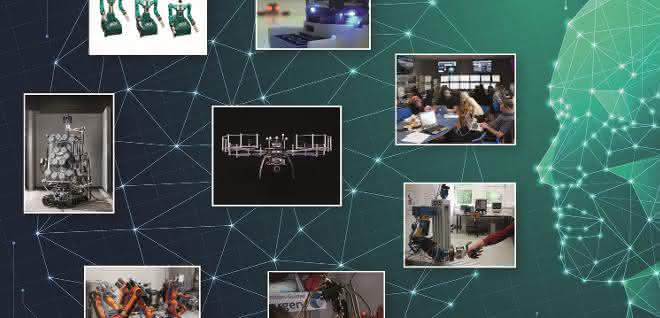
The Seven Samurai, the "banana flank pioneers" Manni Kaltz and Horst Hrubesch, the Rolling Stones, Marvel's Avengers - whether in fiction or reality: high-performance teams can overcome challenges and achieve goals that individuals would fail at despite their outstanding abilities. Scientists at the Karlsruhe Institute of Technology (KIT) and other research institutions want to transfer these findings to robotics and explore the deep sea or distant planets with specialized robot teams.
"Autonomous robot networks will be a key technology in the future," says Michael Flad, head of the Cooperative Systems research group at the Institute of Automatic Control Systems (IRS) at KIT. Together with numerous partners, researchers at KIT want to assemble and coordinate robot teams in the Arches project in such a way that they can independently set up equipment or take samples in hostile environments such as Mars or the seabed.
Floating or flying drones are to scout out suitable locations for equipment or investigations, while other units move there and load, bring or remove material. "For such tasks, we need robotic systems with a wide range of capabilities," says Flad. For example, the robots need to be able to grasp and manipulate previously unknown objects, adapt to changing environments and, above all, distribute and coordinate tasks within a team. In addition to reliable algorithms that bundle information and enable coordination, this would also require interfaces that enable human operators and the robot team to plan and coordinate the mission together.
Flad sees future opportunities to widely apply the technologies developed in the Arches project in autonomous driving as well as in logistics and transportation. There is great potential here for machines that coordinate with each other and act together. Special robot systems are already being used in freight transport, for example when unloading container ships. However, these can only move in known environments and cannot react to unforeseen events. "Without cooperation between the autonomous systems and interaction between them and humans, who will still be present as an actor at least in the medium term, automated driving cannot bring any increase in traffic safety, time savings or comfort," says Flad. In addition, heterogeneous robot teams could be used to support helpers in disaster areas or in the dismantling of nuclear facilities. pb
On the KIT side, the following are involved in the ARCHES project, which is funded by the Helmholtz Association of German Research Centers: the Institute of Automatic Control Systems (IRS), the Institute of Anthropomatics and Robotics (IAR), the Institute of Technology and Management in Construction (TMB) and the Nuclear Waste Management, Safety and Radiation Research (NUSAFE) program. Partners are the Alfred Wegener Institute Helmholtz Center for Polar and Marine Research, the GEOMAR - Helmholtz Centre for Ocean Research Kiel and the German Aerospace Center.
As "The Research University in the Helmholtz Association", KIT creates and imparts knowledge for society and the environment. The aim is to make significant contributions to global challenges in the fields of energy, mobility and information. To this end, around 9,300 employees work together on a broad disciplinary basis in the natural sciences, engineering, economics, humanities and social sciences. KIT prepares its 25,100 students for responsible tasks in society, business and science through research-oriented university studies. Innovation activities at KIT bridge the gap between knowledge and application for the benefit of society, economic prosperity and the preservation of our natural resources.


You might also be interested in
Dr. Christina Franke is Engineer Powerwoman 2023
An independent jury, consisting of the members of the WomenPower congress advisory board, has chosen Dr. Christina Franke as Engineer Powerwoman. The announcement was made at the opening of the WomenPower career congress on April 21 in Hanover.
 read more...
Record sales and employee growth at Ziehl-Abegg
Ziehl-Abegg has published its annual figures for 2022. With a turnover of 873 million euros, the company increased by around 22 percent compared to the previous year. The number of employees rose to 5,100 globally and 2,800 in Germany.
read more...Turnover exceeds 4 billion euros for the first time
At the end of the 2021/22 financial year on June 30, 2022, the Trumpf Group recorded the highest turnover in the company's 99-year history with a strong increase in turnover of 20.5 percent to 4.2 billion euros.
read more...Companies have difficulties assessing their cyber risk
A new study by Trend Micro reveals that 54 percent of companies worldwide are dissatisfied with the maturity of their cyber risk assessment capabilities.
read more...New Head of Finance at Mapal
Matthias Cöster has 14 years of professional experience as CFO.
read more...Matthias Lapp becomes Chairman of the Management Board
The Lapp family business will be managed by the third generation from October 1. Matthias Lapp, grandson of company founder Ursula Ida Lapp, takes over as CEO of Lapp Holding.
read more...Compact computer for industry
As a versatile and compact computer, the Raspberry Pi is also interesting for industry. However, appropriate adaptations to the harsh production environment are necessary to bring the Raspberry Pi world into factories.
read more...Full power in a double pack
From September 22 to 26, 2021, the "EuroSkills", the European Skills Championships, will take place in Graz, Austria.
read more...Gregor Langer takes over the management of RK Rose+Krieger
Hartmut Hoffmann, who has managed the business of RK Rose+Krieger since 2008, is retiring on June 30. His successor from July 1 will be Dr. Gregor Langer.
read more...