
Exoskeleton
Much less effort
Exoskeleton for workers. Comau has presented the wearable exoskeleton Mate. It is designed to support movement for both repetitive and daily tasks.
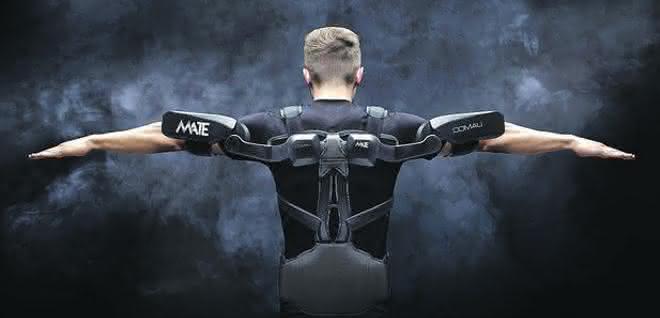
Ergonomics has been a top priority for some time now. Mate also aims to improve the quality of work by providing continuous and advanced movement support in an efficient and ergonomic way. The Mate fit for workers exoskeleton uses an advanced passive spring structure to provide lightweight, breathable and effective postural support without the need for batteries, motors or other disruptive devices. Thanks to the partnership between Comau, Össur, a leading company in the field of non-invasive orthopaedics, and IUVO, a spin-off company of the Bio Robotics Institute (Scuola Superiore Sant'Anna) specializing in wearable technologies, it is compact and ergonomically designed. Mate can reproduce every movement of the shoulder and fits the body like a "second skin".
The exoskeleton was developed in close collaboration with factory workers and is a direct response to their specific needs. With this exoskeleton, they can perform the same tasks as before, but with far less effort. For Comau, this development is a good opportunity to reach a global market that, according to the IFR, grew by more than 60 percent from 2015 to 2017 and is estimated to grow by a further 25 percent per year until 2020. Around a third of exoskeleton applications will probably be in the industrial sector.
Mate is an important part of Comau's Human Manufacturing Technology strategy, a concept in which people are the key players in the smart factory together with state-of-the-art digital tools, enabling technologies and "intelligent" industrial robotics as part of a networked production system. Comau
sees this as a vision and commitment to innovative, open and user-friendly technologies. It is the first in a series of wearable robotics concepts that Comau is developing and marketing in partnership with IUVO and Össur. One aspect of the cooperation is the shared desire to advance and further develop human-machine collaboration in different sectors. pb


You might also be interested in
Motors, gearboxes and encoders: Faulhaber expands Ø 16 mm portfolio
Faulhaber is expanding its portfolio with new DC motors from the SXR and GXR family, a 16 mm planetary gearbox and the IEX3 magnetic encoder for compact drive solutions.
 read more...
New drive solutions for industrial automation and robotics
Faulhaber presents drive solutions with the new GXR and SXR motor family, which offer high efficiency and flexibility in combination with powerful gearboxes and encoders. These optimized components open up new possibilities for applications in...
read more...Marco Altherr becomes new Chief Financial Officer
The Supervisory Board of Ziehl-Abegg has appointed Marco Altherr as the company's new Chief Financial Officer (CFO). Altherr will take up his post in May 2025.
read more...Hydrogen storage in metal hydride
With its focus on storage systems for green hydrogen in solid form (metal hydride), GKN Hydrogen presents itself as a pioneer in safety and efficiency for the industry. GKN Hydrogen offers safe storage systems for green hydrogen and focuses on two...
read more...INDUSTRIAL Production Products of the year...
2nd place, Robotics category: EGS Automation
The SUMO automation systems from EGS Automation - economical standard solutions for automating a wide range of processes in plastics and metalworking - took second place in the robotics category in the competition for Product of the Year 2024.
read more...More productivity with Drive Intelligence
The trends in automation are productivity, sustainability and connectivity. Baumüller is launching new products on the market that address these trends, including new tools for smart energy monitoring, condition monitoring in the drive and new...
read more...Intelligence in Motion
At SPS, Koco Motion will be showcasing its expertise in customized drive solutions based on DC and BLDC motors, stepper motors, servo motors, linear drives and controllers.
read more...Nomination Products of the Year 2024
EGS Automation: SUMO automation systems
The SUMO automation systems from EGS Automation, economical standard solutions for automating a wide range of processes in plastics and metalworking, have been nominated in the Robotics category in the competition for Product of the Year 2024.
read more...Transport technology from the modular system
Many transport tasks can be realized with the help of linear technology. Pre-configured solutions are available to simplify the interaction between the linear unit, motor, gearbox and controller. This minimizes the effort required for research and...
read more...