

Packaging robotics
Energy bars efficiently packaged
Schubert packs muesli bars at Riverside Natural Foods. The heart of the toploading system is the Transmodul and several robot units.
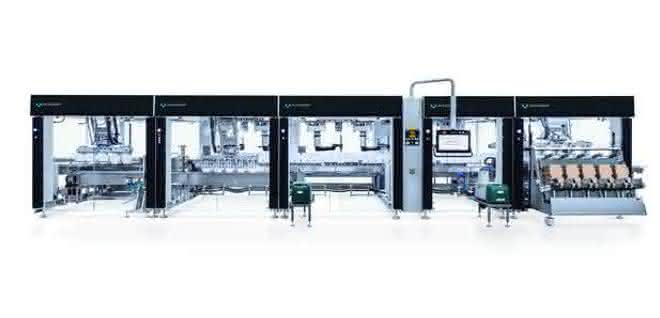
The Canadian company Riverside Natural Foods produces muesli balls and muesli bars with organically grown ingredients under the Madegood brand. In order to support its growth, the company decided to automate the end-of-line packaging process into flow packs. The choice fell on a TLM system from Schubert, which is also suitable for future packaging tasks thanks to its flexibility and scalability. Another decisive factor for Riverside was the proximity to the Canadian team from Schubert North America, which provides the service.
In addition to the technical aspects, the Canadian customer liked the compact design of the system and the quick format changeover. Riverside ordered a TLM picker line with five sub-machines for the final packaging of one type of muesli balls. The TLM machine was to end-pack the muesli snacks packed in tubular bags with packs in different flavors in various carton sizes and in special formats of pouch packs. Schubert developed various packaging sizes according to customer requirements, which were created in consultation with Riverside with regard to the packaging design and optimum machine runability.
Riverside produces its muesli balls in five different flavors: Chocolate Chips, Berry Mix, Apple Cinnamon, Chocolate Banana and Strawberry. The snacks are currently packaged in boxes of 4, 5 and 28, each with one flavor. In the application at Riverside, five F4 pick-and-place robots place up to 400 pouches per minute into cartons. The different flavors can be pre-grouped using the Transmodul transport robot and an image recognition system so that the muesli snacks can be packed either automatically on the TLM machine or, optionally, manually in large bags of 20 products each. The products are fed by three identical vertical TNA tubular bag machines, each with a capacity of 150 bags per minute.
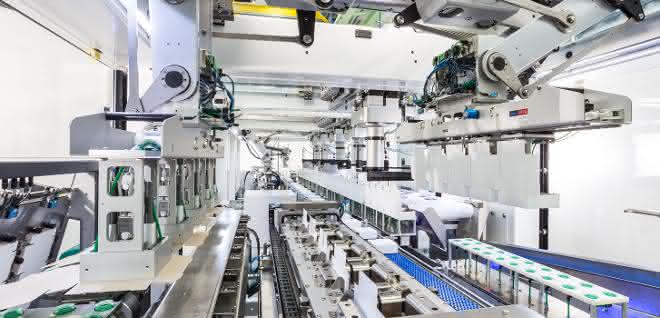
For packaging in cartons, the products of one flavor are fed into the system on up to three continuously running conveyor belts. At the same time, the different carton blanks are automatically removed from the magazine and then erected and glued by an F2 robot. The transmodules transport the cartons to the next station, where five F4 pick-and-place robots fill them with the products.
Two scanners detect the orientation and position of the tubular bags over a width of 600 millimetres. This information is transmitted to the F4 pick-and-place robots to correctly pick up and place the tubular bags in the cartons. The filled cartons are then transferred to a vacuum conveyor by a first F2 robot, where a second F2 robot closes them in a single step and places them on the outfeed conveyor.
For the special formats used to pack the tubular bags into larger bag packs, the scanner also recognizes the flavour based on the product color. This enables intelligent pre-grouping of the muesli balls with different flavors, which are fed unsorted onto the product conveyor. The tubular bags are pre-grouped in groups of four - two per flavor - on the transmodules and transferred to the outfeed belt for further processing by Riverside using F2 robots. pb


You might also be interested in
Conrad continues to grow
Conrad Electronic now generates 80% of its sales with business customers and has successfully developed from a traditional technology retailer into a B2B procurement platform. The company aims to become Europe's leading procurement platform for...
 read more...
AI finds its way into automotive customer service
In addition to computer solutions for vehicle diagnostics, Getac now also offers AI-based digital tools that support customer contact in service operations.
read more...SMC: "Preferred Supplier" from Bosch
The technology and service company Bosch has recognized SMC for the performance of its automation technology in factory and process automation and awarded it the status of "Preferred Supplier" in the material group "Standardized Pneumatic Devices".
read more...Combined ERP forces
The medium-sized ERP providers Step Ahead Software, Godesys and Informing merge to form the Step Ahead Group.
read more...Cybersecurity for asset-intensive companies
Forge Cybersecurity Platform, the new software platform from Honeywell, has been developed for the cybersecurity of asset-intensive companies and critical infrastructures. The platform is available in three versions.
read more...Automated machine tool as a success factor
Industry 4.0 is the hot topic of the moment. For small and medium-sized companies and contract manufacturers, it holds great potential for increasing production efficiency step by step. The focus here is on efficient and user-specific automation...
read more...Nemo hand vacuum lifts all materials
A new addition to the Eurotech portfolio is the battery-operated Nemo vacuum cleaner, which is suitable for handling almost all surfaces.
read more...Future-oriented cobot projects
Three pillars of successful cobot initiatives
What is important if cobot projects are to be future-oriented? Automation and robotics expert Omron has identified three aspects for human-machine collaboration.
read more...Short-stroke linear actuator instead of pneumatic cylinders
The new short-stroke linear actuator from Ketterer Antriebe and halstrup-walcher is characterized by high dynamics and a large stroke in a compact size. Thanks to the integrated electronics, the drive is easy to control compared to pneumatic...
read more...