
Deburring plate
System for deburring and finishing
Robot-supported complete solution. Deburring is an elementary process in the production of ready-to-install crankshafts for cars and trucks. Indat Robotics has now developed a complete robot-assisted solution for deburring and finishing crankshafts, which, according to the manufacturer, achieves a high level of repeat accuracy and is designed to work economically even with small batch sizes.
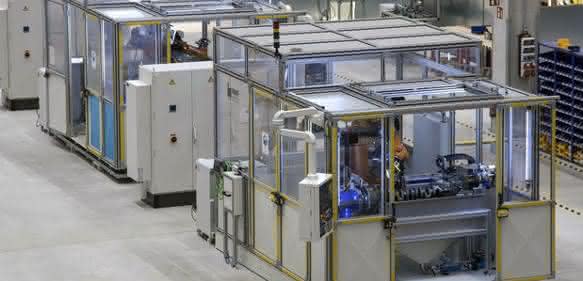
The particularly demanding rounding of the oil bores on the connecting rod and main bearing is performed by a robot. The solution consists of two separate robot cells with a modular design that can be easily adapted to individual requirements and integrated into existing production lines.
All components of the cells - from the pick-up table to the robot - are mounted on a platform and completely enclosed. The two cells each occupy only around twelve square meters of production space and can be linked via a loading gantry, for example, and loaded automatically via a roof hatch. Manual loading using lifting gear is also possible.
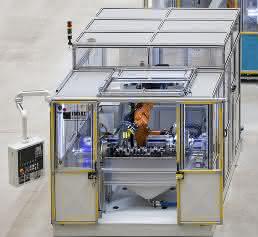
Crankshafts up to a shaft length of 1,200 millimetres and a weight of 150 kilograms can be machined. In the first cell, the cheeks in the cut run-out, which are created during the preceding turning/milling process, and the oil bores in the bore waste are deburred. Once the shaft has been placed on the appropriate prisms, it is clamped and centered using a tailstock and headstock. Both can be precisely positioned via a servo drive. Radial alignment is performed by an alignment unit, which brings the first pin bearing of the crankshaft into the zero degree position. A rotary drive then turns the shaft into the respective position for deburring, which is carried out by the robot with the appropriate tools. An automatic changing system ensures that the different deburring tools can be changed quickly and in line with the process. An integrated set-up station, which is accessible from the outside, also enables worn tools to be changed without interrupting the ongoing process.
The workpiece is then transferred to the second cell, where finishing takes place. Here, the robot uses various milling and brushing tools to round off the oil holes and remove the burrs on the balancing holes. The exact position of the oil bores on the connecting rod and main bearing is determined with the help of a camera. This ensures precise rounding with an accuracy of plus/minus 0.1 millimeters. All the tools required in this process area are stored as a double set in a tool rack. Worn tools can also be removed and replaced here without interrupting the process. After this process, the workpiece is ready for installation and can be preserved and packaged for transportation. sw


You might also be interested in
The AKIMI Research Project at WZL
Agent-Based AI Aims to Simplify Robotics for Small and Medium-Sized Businesses
The AKIMI research project is developing an agent-based AI designed to significantly simplify the setup, programming, and reconfiguration of robotic systems for small and medium-sized enterprises. The goal is to make robotics more flexible and...
 read more...
BS Rollen Strengthens Its Presence in North Rhine-Westphalia
With the groundbreaking ceremony, BS Rollen is launching the construction of a new company facility in Hückeswagen. The new building will house administrative offices, an assembly line, and a high-bay warehouse, and is intended to facilitate further...
read more...Intelligent brownfield networking
Many industrial companies are struggling with established plant structures and proprietary interfaces. Stefan Klaus' presentation will show in a practical way how brownfield environments can be efficiently networked with open technologies and made...
read more...Factory-X in practice
How can set-up processes in highly variant production be automated efficiently? Markus Benndorff from soffico shows how Factory-X, industrial data rooms and modular architectures create new possibilities for flexible production concepts.
read more...Mechanical engineering | Case study
Cordless in brush production
The machine manufacturer Wöhler Bohemia is integrating wireless HMI panels from Keba into its brush production systems. The background to this is the need for flexibility, robotics integration and new market strategies.
read more...International product approvals as a strategic competitive advantage in the global market
Which certificates are valid worldwide? Christian Latte, Head of Technical Compliance and Approval Officer at Hummel AG, explains this in an interview. He provides insights into product approvals and explains why early approval strategies shorten...
read more...Foundry modernizes plant park with continuous wire belt shot blasting system
The Spanish foundry Funosa is modernizing its equipment fleet with an RDGE 1250 wire belt continuous shot blasting machine from Rösler. Focus: sand removal from heavy iron castings, energy efficiency, ease of maintenance and ESG strategy.
read more...How bridging steps, stairs and catwalks are changing processes in production and logistics
At Logimat 2026, Munk Günzburger Steigtechnik will be showcasing modular bridging steps, stairs, platform and walkway systems for production, warehousing and logistics. With online configurators, distances can be efficiently shortened, processes...
read more...Drilling cycles optimized
A new replaceable head drill from Walter can reduce machining time in series production thanks to its patented interface and screwless design.
read more...