

Composite concrete driving axle
Concrete goes into series production
Concrete travel axles in series production. Seven composite concrete travel axles from IPR are being used in series production for the first time in the paint shop of a car manufacturer. The axles are low-vibration and quiet, and they also require 90 percent less energy than an aluminum axle base.

The travel axles for the paint shop of a major car manufacturer needed to be more efficient, economical and sustainable. The commissioned original equipment manufacturer Eisenmann alpha-tec regularly automates complex path-oriented applications with industrial robots and is familiar with the latest developments on the travel axle market. The choice fell on the composite concrete travel axis from IPR - Intelligent Peripherals for Industrial Robots, which has many advantages over the existing metal variants. This is the first time this travel axle technology has been used in series production. Where space is at a premium and noise and vibrations need to be reduced, the new composite concrete travel axle is a cost-effective solution with an excellent eco-balance. The four composite concrete models introduced so far are suitable for 95 percent of all industrial robots on the market.
A total of seven travel axles with a total length of 39.5 meters and nine carriages for just as many robots are now being used by the German car manufacturer in the cavity preservation and seam sealing areas - three more axles are currently being requested. The challenge: they have to run automatically with all additional modules without any problems.
This is precisely where Eisenmann comes in with its service package: The system partner takes over the creation of the specifications, the design of the system, its assembly through to the commissioning of mechanics, industrial robots, application and dosing technology, material supply and conveyor technology. In this way, the original equipment manufacturer ensures that its customers can concentrate on what they do best - their core business: producing cars.
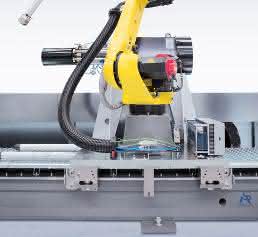
The seven travel axles with a base body made of composite concrete are a central component of the automated solution and are absolutely suitable for series production. The composite concrete is a targeted development for use in a wide range of industries. It has a property profile that is tailor-made for production and handling - for example, it is low-vibration and quiet. In addition, the entire product range is silicone-free and can therefore also be used in special areas such as this paint shop without any problems.
The successful tests at the independent materials testing office in Kaiserslautern confirm the suitability for series production: the composite concrete driving axle was subjected to an endurance test with 2.5 million cycles - this corresponds to an operating time of around ten years. IPR's design calculations have been confirmed in the endurance test and show the same reliability as the aluminum or steel models.
The developers at IPR have placed great emphasis on the sustainability of the material. Here too, the figures speak for the innovation: around 75 percentCO2 savings and 90 percent less energy consumption compared to an aluminum axle base.
"We have already worked with IPR successfully and in a spirit of trust on other joint projects. We value our partner's expertise and reliability, also in terms of adherence to schedules and the smooth implementation of individual customer requirements," says Stephanie Lücking, Project Manager at Eisenmann. IPR built the first travel axis in 2006 and is a strong development expert in this field. Ceiling, wall, vertical, carriage and floor travel axes made of composite concrete, aluminum and steel ensure movement in assembly and handling technology, loading and unloading units and painting applications. The modular systems, ranging from small to large, have a load capacity of up to twelve tons and can be flexibly extended. There are practically no limits to the length. To date, IPR has sold more than 1,500 travel axles worldwide. as


You might also be interested in
Plagiarius 2024 negative prize
On January 26, 2024, the Plagiarius campaign awarded its dreaded "Plagiarius" negative prize for the 48th time to manufacturers and retailers of particularly brazen counterfeits and fakes.
 read more...
Ivalua honors winners of the Generative AI...
AI-supported "add-ons" for buyers within 48 hours
Ivalua, provider of cloud-based spend management solutions, announced the winners and innovations of the first Generative AI Innovation Cup. The competition took place in December 2023. It was open to all Ivalua partners and employees - more than...
read more...Efaflex celebrates 50 years of high-speed...
The emphasis is on "fast"
Since day one, Efaflex has wanted to use new technologies as early as possible and drive progress in the industry. This year, the family business is celebrating its 50th anniversary under the motto "Fast Forward".
read more...Security of supply even during power outages
In the winter of 2022, Germany was worried about energy shortages. The drugstore retailer dm did not paint any horror scenarios, but nevertheless saw the possibility of controlled, temporary, regional power cuts (brownouts).
read more...Safety technology in mechanical engineering
Modules with new functions
Euchner's product highlights at EMO 2023 include the communication-capable solenoid interlocks.
read more...Transforming the paper industry towards climate neutrality
Together with partners from industry and research, Voith is developing a project for the optimization of energy and material flows in paper production. The aim of the research project is to develop a digital framework that enables effective process...
read more...Up to 95 percent less flue gas thanks to direct extraction
The requirements for occupational safety measures and safety technology are also constantly increasing in welding technology. The Technical Rules for Hazardous Substances (TRGS) stipulate that welding fumes and harmful substances must be extracted...
read more...Competitive advantages with large machines
Whether 3D-printed components for machines and systems, prototypes or aids for design: additive manufacturing is almost indispensable for modern companies in mechanical and plant engineering and automation if they want to play in the premier league.
read more...Transport technology from the modular system
Many transport tasks can be realized with the help of linear technology. Pre-configured solutions are available to simplify the interaction between the linear unit, motor, gearbox and controller. This minimizes the effort required for research and...
read more...