

Collaborative robot cell
Come on, let's share!
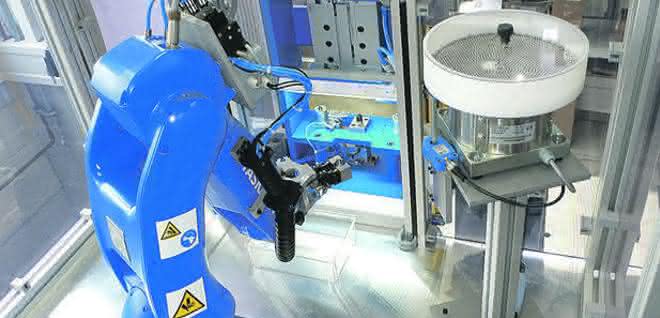
Collaborative robot cell for the production of safety valves. Weiss Kunststoffverarbeitung has developed a robot cell using "on-board resources" in which the operator and the robot share the complex assembly of a miniaturized safety valve.
The division of labor between plastics processors and their customers is changing. Customers increasingly want complete, ready-to-install components rather than injection-molded parts, and this applies not only to the automotive industry, but also to other sectors such as the household appliance industry and mechanical engineering. For this reason, the assembly division at Weiss Kunststoffverarbeitung has grown steadily in recent years. As an engineering-oriented company, Weiss pursues the goal of utilizing the latest trends in this area as well.
The robot cell that is currently being put into operation at the Illertissen plant is a good example of this. A safety valve just 15 millimetres high is assembled in the cell, using filigree metal purchased parts such as springs, washers, valve tappets and balls in addition to injection-moulded parts. The company's assembly experts have put the principle of division of labor between humans and robots into practice. Dipl.-Ing. Robert Heller, whose responsibilities at Weiss include the design of production and automation technology: "The robot works very precisely and without fatigue, while the worker can make mistakes but is more flexible."
The cell is designed so that both "colleagues" can make the most of their respective strengths. In the first step, the worker standing in front of the cell assembles the central components in an assembly device. Then the robot inside the cell takes over. It inserts other small parts - a very small ball, for example. The worker then gives the signal to press the parts together, which is done pneumatically via a cylinder.
Now it's the robot's turn again. It removes the assembled valve from the fixture and places it in a test device, where it undergoes two pressure tests at 0.9 and two bar. After this one hundred percent test (in which the valve must remain closed during the 0.9 bar test and open when pressurized to two bar), a test stamp is applied using a marking system and the valve is ready for dispatch.
Weiss has put the principle of human-robot collaboration into practice here in a way that is as simple as it is elegant: Humans and robots each have access to the shared workspace. There is no safety fence or other spatial separation between worker and robot. Instead, the work area is protected on both sides by a pair of light barriers. Both pairs of light barriers are connected in terms of control technology and safety so that the robot does not reach into the shared work area when the operator is inserting or removing parts there. Conversely, the robot is stopped if it is currently active in the work area and the operator also reaches into it.
It goes without saying that the robot's control system is also integrated into this simple and practical safety concept. Robert Heller: "We used the robot manufacturer's 'Function Safety Unit' here, which has recently become available as an option: a plug-in card that can also be used to program safety areas, for example." pb


You might also be interested in
From risk to resilience
NIS2 significantly increases the requirements for industrial security concepts. In addition to cyber resilience, physical access protection is becoming increasingly important.
 read more...
Security Operations Center module
When cyber attacks reach production
Adlon is further developing its Security Operations Center and adding another module to the existing Managed SOC for Microsoft 365 environments (based on Managed XDR): Managed SOC Advanced.
read more...Lifecycle management and safe IO-Link communication
At SPS, Pilz will be presenting solutions that combine safety and security in production. The focus is on the digital Myzel Lifecycle Platform, a SaaS offering for the management of machinery and personnel over the entire lifecycle.
read more...The basics of warehouse safety
Safety in the warehouse primarily relates to the employees. However, goods must also be transported safely and transport equipment must not be damaged.
read more...Environmental containers and fire protection
Companies can choose from a wide range of environmental containers for storing chemicals and other hazardous substances.
read more...Secure focus on access
To ensure comprehensive safety, holistic safety concepts for safety and industrial security on machines are required. Authorizations and access must be clearly regulated.
read more...Added value through safety and productivity
Machine malfunctions can have serious consequences and put people's health at risk. Functional safety therefore plays a central role in industry. With control and inverter technology including integrated safety functions from ABB, plant operators...
read more...Protect Ethernet interfaces
Pilz is expanding its portfolio of operating and signaling devices with the control element PIT oe ETH. It is equipped with an Ethernet port that can be activated and protects freely accessible Ethernet interfaces in industry against unauthorized...
read more...Protective tool in everyday life
Cybershield is a company founded in 2021 with a focus on operational technologies and has set itself the goal of significantly advancing IT security in the OT sector and supporting customers.
read more...