
Cobots with integrated AI
Are today's cobots the longed-for helpers?
To ensure efficient and safe human-robot collaboration, cobots need to be sensitive and have certain cognitive abilities. New cobots with special sensors and integrated AI can achieve this.
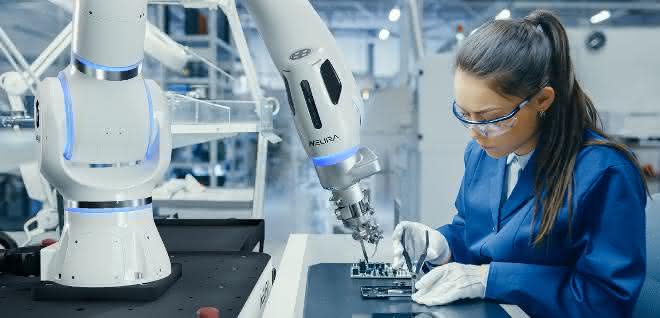
Robot automation has brought a level of efficiency, precision and scale to manufacturing that would have been impossible to achieve with traditional human labor. Such machines are now commonplace in various industries. They take over dangerous work and free human workers from mundane, repetitive tasks. Most of these robots are used in production lines and are programmed to repeat a specific task, such as moving objects between predefined locations or assembling basic components. Although such robots now reliably outperform humans in terms of speed and accuracy, they are unaware of their surroundings and must be isolated in safety cages or behind protective fences.
Today's fast-paced industrial landscape has led to the development of collaborative robots (cobots) that can work with humans in shared environments and are more flexible to use. However, today's cobots lack human-like perception of the environment and cannot work as efficiently and safely as would be required for a universal solution. For this reason, cobots usually still require a fence or barrier to protect workers, which goes against the original idea of collaboration. The cobots can perform repetitive tasks, but cannot cooperate with humans. This limits their scope of action and freedom of action.
Particularly in view of the shortage of skilled workers, which will continue to increase in the coming years, it is time to find possible solutions for cooperation between humans and robots in order to exploit the many opportunities for robots in the future. An increasingly ageing society goes hand in hand with the shortage of skilled workers and raises new problems, such as the care and appropriate provision of care for people in old age. In the future, these challenges can no longer be handled by humans alone and require a safe and efficient solution. Conventional cobots do not offer this, as they cannot reliably recognize people in their environment.
Collaboration with purpose
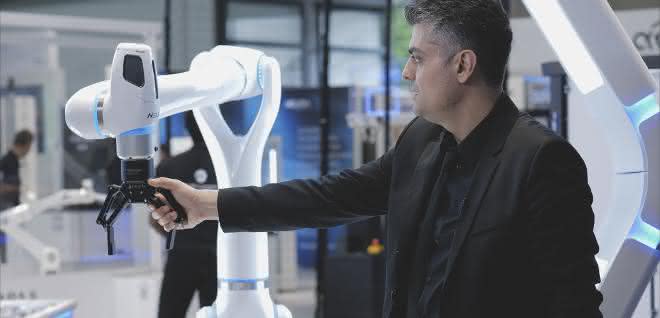
To enable true collaboration between humans and machines, cobots need senses to perceive their surroundings and cognitive intelligence to interact safely with humans in different environments. With these senses, they can be used in a wide variety of areas while ensuring the safety of humans. They also enable collaborative work with people. For example, robots can pass components to humans, pick up objects or perform other supportive tasks. Robots with these senses are cognitive robots such as "MAiRA".
With integrated artificial intelligence and novel non-contact, safe human detection technology, MAiRA can sense the environment and easily adapt to all industrial environments. With its sensors and integrated AI combined with high precision, MAiRA opens up a new era of robots and offers countless possibilities for interaction. The "Touchless Safe Human Detection" technology enables the contactless detection of humans within a radius of up to 3 m around the robot and ensures safe interaction. The technology prevents collisions and ensures that people are not touched by the robot at any time. This is done by the robot reducing its speed based on the given distance and calculating alternative paths around the human. The data provided is processed by an artificial intelligence that directly adjusts the action. The sensor can be integrated into any device or used independently. Force-torque sensors in all axes allow the robot to feel and thus offer the possibility of limiting forces. This enables work to be carried out with high precision and minimizes the risk of injury. This precision is reflected in the high absolute and repeat accuracy.
Operable without experience
In addition, cognitive robots can relieve people and take over dangerous tasks. This gives people more time for enjoyable activities and allows them to focus on interactive tasks with their fellow human beings. The simple interaction with the robots means that they can also be operated by people without robotics experience. This opens up a wide range of application areas such as intelligent robot welding, machine loading, autonomous pre-picking and many more.
Cobots and, above all, robots with cognitive abilities will be needed to overcome the increasing shortage of skilled workers in the future, both in the manufacturing industry and in other areas such as care and hospitals. If the problem of the shortage of skilled workers and an ageing society is not tackled today, it will be too late to develop promising solutions in the near future. Cognitive robots offer an all-encompassing solution here, as they can take on a wide range of tasks and operate safely in a shared environment with humans. A future with robots will be unavoidable, especially as the benefits for humanity are immense.
The course must now be set for the spread of robots so that they can be used smoothly in industry and other areas. The robots from Neura Robotics are already ready to be used to support and interact with humans and to take on independent tasks.


You might also be interested in
Further simplify assembly processes
In addition to the proven racks with a length of one meter, Wittenstein alpha now offers optional two-meter racks for linear systems. They are particularly suitable for use in short axes, for example, in order to simplify assembly even further.
 read more...
Hiwin manufactures its own shaft gearboxes
Have you ever waited several months for an urgently needed corrugated gearbox? Hiwin has too. That's why the Offenburg-based drive specialist has decided to produce its own space and weight-saving reduction talent.
read more...Human-robot interaction at the trade fair
Sumitomo Drive Technologies is presenting its drive solutions for automation and robotics at Automatica 2023 together with the Lafert Group. The company will be showcasing two different applications of the Tuaka drive system for robot applications...
read more...Partial automation with robots
At Automatica, Promess will be showcasing its modular individual workstations and how these can be partially automated with robot support. The servo press manufacturer will also be providing information about the latest features of its Revolution X...
read more...A new benchmark for collaborative robots
At this year's Automatica, Denso Robotics will be showcasing its innovations in the field of robotics. The collaborative Cobotta Pro product family will be the focus of the presentations. Visitors to the trade fair can see all variants in various...
read more...Clamping system for a new milling machine
Investments in machinery often lead to further purchases - as is the case at Joma-Maschinenbau, whose modern production facility has recently been supplemented by a 5-axis milling machine.
read more...Schunk wants to simplify processes in automated production
The declared aim of automation specialist Schunk is to make its customers' processes comprehensible, simple and efficient. Data transparency plays an important role in this. It enables reliable processes and provides the basis for resource-saving...
read more...Festo and Hahn Automation develop battery tester for greater safety
The success and reputation of electric vehicle manufacturers depend on the safe and flawless functioning of batteries. Hahn Automation has therefore developed a battery tester that performs a fully automated 100% test of mobile energy storage...
read more...SPN Schwaben Präzision presents gearbox solutions for automation and industrial robotics
Short cycle times, robust technology, wear-free surfaces and compact designs have always been relevant for automation and robotics solutions. This year's Automatica trend topics include "Sustainable production" and "Digitalization and AI". SPN aims...
read more...