
Process automation
Cobots in machining
Rising quality standards, increasing product and size diversity and growing cost pressure in the machining industry can only be mastered with the help of clever process automation. When used correctly, robotics solutions provide competitive advantages and make work considerably easier for workers by relieving them of heavy and monotonous manual tasks.
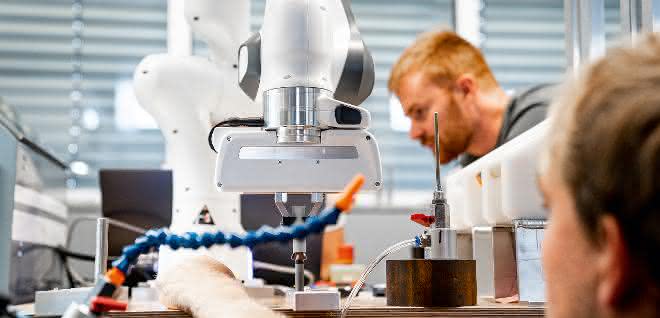
It is not surprising that robots are already in use in many large companies. However, smaller family businesses and SMEs are often still left out of the robot automation process. This is because they are faced with questions such as: Do we have the know-how to commission the robot and adapt it to our requirements? Or: Is the solution flexible enough to take on different tasks?
The medium-sized company Moser Zerspanungstechnik from Kressbronn on Lake Constance also had these and similar concerns. The successful family business specializes in turned and milled parts and mainly manufactures for customers in the electronics, special machine construction and aerospace sectors. For junior boss Hannes Moser, the automation of the company and the associated competitive advantages for production and the workforce are a matter close to his heart, for which he has found the right solution with a collaborative robotics solution from TQ. Today, the manufacturing company not only benefits from a significant increase in process reliability and speed, but also from a considerable reduction in workload for its employees. After just three months of using Franka Emika's Panda robot, the results are so good that Moser has already ordered a second robot. However, Moser also first had to find out whether the automation of the desired production processes was even possible and profitable.
Is the desired automation feasible?
"We wanted to test whether a robotics solution was generally suitable for our needs with as little monetary investment as possible," recalls Moser. To find out, he sent a feasibility inquiry to various robot manufacturers. The decisive response finally came from TQ. "We were asked to send in a video of the process in question, which TQ then analyzed without obligation and was able to confirm that our project could be implemented with a collaborative robot - a so-called cobot - from Franka Emika."
To this end, Moser sent an example of the component to be manufactured and the relevant deburring mandrel to TQ in advance. A test process was set up there in the Franka Solution Center and the feasibility of the request was documented by video. After that, everything went very quickly. TQ brought a test robot to the first appointment, which the Moser Zerspanungstechnik team was able to set up immediately in production and test how the process could be automated on the relevant machine. The initial results were achieved straight away and Moser was then offered the opportunity to test and fine-tune the set-up for a week. The Franka-Emika robot used can learn the various motion sequences to be automated by hand and can be operated easily and intuitively via a touch display. To program various sequences, such as gripping an object or repeating a process, different apps are then selected from a menu on the laptop using drag-and-drop, arranged and then executed by the robot.
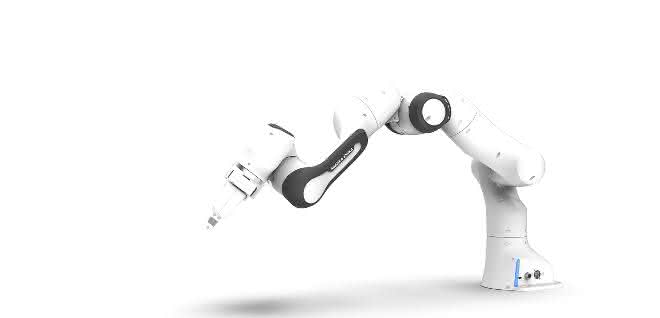
The machine to which the cobot is connected at Moser processes a large product portfolio with many different article numbers. To teach the cobot, it was mounted on an appropriately stable table in front of the relevant lathe. "We were looking for a solution that would allow us to achieve significant time savings when setting up and retooling the various components. Therefore, a key requirement for the new application system was that it should be easy to operate and retool with little computer application experience. This is exactly the case. The system is designed so that users can quickly learn and reprogram it themselves - without any previous robot experience. After just one week of testing, everyone was able to operate the robot completely intuitively. I was surprised at how quick and easy it was," says Hannes Moser.
Amortization after three months
The specific application at Moser is as follows: The cobot removes the component from a parts chute, inserts it into the lathe, removes it from the machine again after machining and finally drops it into a box as bulk material. "The system runs smoothly," says Moser happily. When asked about the biggest advantages of the new installation, he explains: "Firstly, the quality is now consistently at the highest level, as the robot always carries out the process in exactly the same way and manual sources of error are eliminated. The robot also doesn't take a break and doesn't need a vacation. As a result, the company benefits from a significant increase in process speed and has been able to massively increase its productivity. "Looking back on the first three months, we can already say that we have been able to achieve a very high ROI. The robot has already paid for itself."
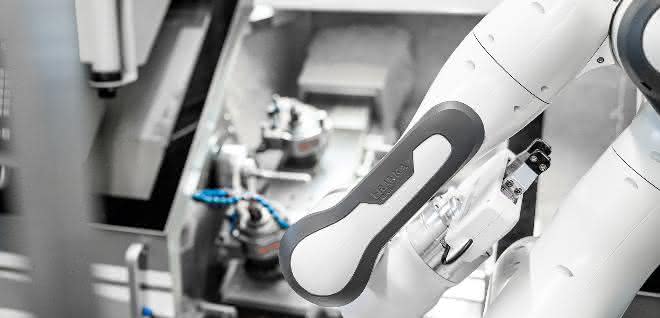
The higher process reliability and speed as well as the increase in productivity are not the only advantages of the cobot system. The employees at the machine also benefit from the new solution in their day-to-day work: "The robot really makes our lives easier," confirms Jonas Fürst, machining mechanic at Moser. "The system is very easy to operate and it relieves us of heavy and monotonous tasks, such as the physically strenuous pressing on of sleeves, which used to be done manually. This process is now completely automated." The production team is also pleased with the relief and time savings during changeover. "I can simply program the robot to take over the changeover, which is much faster than if employees had to do it. We save a lot of time," says Fürst. His conclusion: "If you process large quantities and can cope with monotony and physical exertion, then cobots are definitely the future here, I'm sure of it. And the employees can then concentrate on the tasks that really require their dexterity and individual know-how".
Meeting delivery deadlines despite system failure
Another decisive factor in choosing the solution was the availability and reliability of the TQ service team. "We had a lot of telephone contact during the test week, as the team was familiarizing itself with the new solution at the time - it all worked really well," says Moser. The fact that the service also works smoothly in an emergency was demonstrated during a system failure. After a brief telephone clarification, Moser Zerspanungstechnik was immediately supplied with a replacement robot and was able to continue production as usual after just 48 hours. "At the time, it quickly became clear that only a replacement would make sense, as we had to continue working quickly in order to meet our delivery deadlines. We managed to do this, even though a lot had naturally built up in the two days. But that wasn't a problem, because the replacement robot simply worked longer into the night, so we were able to make up the time quickly," says Moser.
Moser is so satisfied that TQ has now received an order for a second Cobot. With the first robot, the company has already been able to combine the work of the original two machines and is currently using the system to produce all products that previously required two machines. The employees can easily program the changeover to other article numbers themselves. So why a second cobot now? "With the second robot, we have even more alternative options in case there is a problem with one of the machines. And in general, we can then map all the article numbers that we produce on two robots - that's our goal," explains Moser.


You might also be interested in
Fraunhofer IOSB Opens Humanoid Robots Lab
The Fraunhofer IOSB is opening a Humanoid Robots Experience Lab in Karlsruhe, Lemgo, and Ilmenau. Companies and organizations can use these facilities to test potential applications for humanoid robots and develop pilot projects.
 read more...
Artificial Intelligence in Manufacturing
Trumpf and IPAI Are Expanding a European AI Network for Industry
The high-tech company Trumpf is an official partner of the IPAI AI network in Heilbronn. Together, the partners aim to exchange experiences, develop new AI applications for industrial use, and advance the development of artificial intelligence in...
read more...Case Study: Networked Manufacturing Platform for Toolmaking
Using a networked manufacturing platform, Escha GmbH & Co. KG, a manufacturer of industrial fastening technology, has comprehensively modernized its toolmaking operations.
read more...Barcelona Declaration on Robotics and...
Robotics Associations Adopt Global Automation Strategy
The global robotics industry is stepping up its collaboration. The associations AER Automation, A3, IFR, and VDMA Robotics + Automation have formed a long-term alliance by signing the “Barcelona Declaration on Robotics and Automation 2026.” The...
read more...Jane Heffner is the new president of the International Federation of Robotics
Jane Heffner is the new president of the International Federation of Robotics. Adrien Brouillard has been appointed vice president of the global federation.
read more...Greater Transparency in the Robotics Market
RoboFinder Launches as an Independent Comparison Platform
Launch at Gitex Europe: 'RoboFinder' aims to bring more transparency to the professional service robotics market. In this interview, founder and CEO Brian Engels discusses market potential, challenges, and the goals of the new platform.
read more...Artificial Intelligence for the Physical Space
Alibaba Expands Qwen Model Family with a Robotics Suite for Physical AI
Alibaba is expanding its Qwen model family with a robotics suite for Physical AI. The three models—for manipulation, navigation, and simulation—are designed to assist autonomous robots with complex tasks in real-world environments.
read more...International Federation of Robotics
U.S. Robotics Industry Sees Double-Digit Growth
In the U.S., sales of industrial robots rose by 11% compared to the previous year: 38,000 units were newly installed in 2025. This significant recovery is driven by robust growth in the food industry and other non-manufacturing sectors. However, the...
read more...Development Collaboration for Humanoid Robotic Hands Launched
Schunk is entering into a new development partnership with Robert Bosch Robotics. Their shared goal is to develop an industrial-grade robotic hand that can be integrated into various humanoid robot systems.
read more...