
Robot app
Cobot against monotony
In Brackenheim, Baden-Württemberg, the metalworking company Honecker is demonstrating how collaborative robots can support human colleagues and relieve them of monotonous, physically strenuous tasks.
The medium-sized company Honecker has been manufacturing stamped, bent and drawn sheet metal parts since 1976, supplying small and medium-sized companies in a wide range of industries. These companies use Honecker products in power tools, skis and ski bindings, electromechanical components, medical devices and construction components, among other things. The shapes and geometries of the parts to be manufactured are as varied as the applications - not a primary field of application for a robot. Much to the regret of Phelia Honecker, project manager at Honecker and responsible for the production of prototypes, among other things. She represents the third generation of the family business and had been waiting for the right application for a robot for some time.
"When one of our customers then ordered a large number of specific stamped parts that had to be processed by hand by the employees, we were ready to enter the robot era," explains Phelia Honecker. "Processing the parts involves countless manual gripping processes and moving heavy elements. This work can be detrimental to the health of our employees. And we want to prevent that at all costs." During the process evaluation, Honecker quickly realized that a classic industrial robot would not suit the company. When Honecker heard about the tactile Franka-Emika robot, she knew that this cobot could be suitable. A key decision criterion for the selection was the ease of use and programming of the robot. As the employees are not robot experts, the tactile robot was the best choice for the new project.
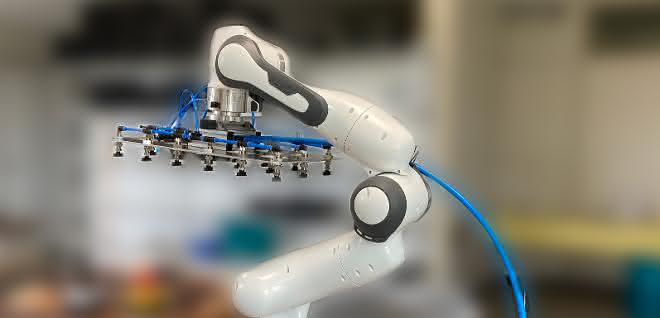
The work process is as follows: The punched aluminum blank comes out of the grinding machine in a template. The employee picks up the template and carries out a visual inspection. If the stamped parts are in order and show no signs of damage, the employee releases them for the robot. The robot now moves to the previously defined position, picks up the punched parts with the help of a defined contact pressure and a switched-on vacuum, places them on the stack in the designated box and then releases the vacuum.
Cobot app from TQ enables intelligent stacking
The particular challenge of this application is that no constant value can be programmed for the placement of the punched parts, as the stack of punched parts does not have a fixed height - it grows with each placed part, and if an employee removes punched parts, its height is reduced. The solution to this challenging task is provided by the "Move-to-contact" app developed by TQ for the Franka Emika. This function module is always used when a position size or contact surface is variable. In this case, the robot's "sensitivity" comes into play. This means that the Franka Emika robot moves its arm with the picked-up punched part to the position at which it registers contact with the uppermost stacking layer. This is the signal for it to switch off the vacuum and deposit the punched part.
Although this process sounds quite complicated, it can be programmed via the app with just three clicks. Phelia Honecker explains: "We built the cobot ourselves and programmed it independently with the help of the clear TQ tutorials. Thanks to the intuitive operation, we controlled the work process ourselves and it ran very well after a short time. We only needed support from the TQ team of experts when it came to fine-tuning." Honecker was also able to use its own expertise in the development of the gripper tool for the robot arm: The in-house toolmaking department manufactured the gripper itself according to the company's own requirements. This can now grip several parts at once if required and transport them further with the vacuum system.
The staff's initial skepticism was quickly overcome when it became apparent how quickly the tactile robot took over the unpleasant, monotonous and physically strenuous tasks for the employees. "We all don't want to give the Cobot back," was the unanimous opinion. Another plus for Honecker is the increase in quality thanks to the consistent precision with which Franka Emika works. Even after ten hours of continuous picking and placing processes, there are no signs of concentration or fatigue.
For Christian Honecker, responsible for the commercial management of the company, the collaborative robotics solution from TQ also represents high added value. "We had previously evaluated other robot solutions, but their use was always too complex. We would have had to invest high costs in robot training for employees and maintain a large installation space. In addition, the required production flexibility is lost with an industrial robot. With the enormous variety of different parts that we produce, this would not be feasible for us." TQ-Cobot systems, on the other hand, are designed so that an employee can program the system manually and interact directly with the Franka Emika in the event of a malfunction. This is simple, intuitive and quick to learn. Thanks to the robot's seven axes, this is possible even in the smallest of spaces.
And what is Phelia Honecker's advice to other companies facing similar considerations? "Just try it out and don't be shy." She adds: "We are impressed with how quickly the complete solution was up and running. And when problems arose, the TQ team provided quick and competent support."


You might also be interested in
Further simplify assembly processes
In addition to the proven racks with a length of one meter, Wittenstein alpha now offers optional two-meter racks for linear systems. They are particularly suitable for use in short axes, for example, in order to simplify assembly even further.
 read more...
Hiwin manufactures its own shaft gearboxes
Have you ever waited several months for an urgently needed corrugated gearbox? Hiwin has too. That's why the Offenburg-based drive specialist has decided to produce its own space and weight-saving reduction talent.
read more...Human-robot interaction at the trade fair
Sumitomo Drive Technologies is presenting its drive solutions for automation and robotics at Automatica 2023 together with the Lafert Group. The company will be showcasing two different applications of the Tuaka drive system for robot applications...
read more...Partial automation with robots
At Automatica, Promess will be showcasing its modular individual workstations and how these can be partially automated with robot support. The servo press manufacturer will also be providing information about the latest features of its Revolution X...
read more...A new benchmark for collaborative robots
At this year's Automatica, Denso Robotics will be showcasing its innovations in the field of robotics. The collaborative Cobotta Pro product family will be the focus of the presentations. Visitors to the trade fair can see all variants in various...
read more...Clamping system for a new milling machine
Investments in machinery often lead to further purchases - as is the case at Joma-Maschinenbau, whose modern production facility has recently been supplemented by a 5-axis milling machine.
read more...Schunk wants to simplify processes in automated production
The declared aim of automation specialist Schunk is to make its customers' processes comprehensible, simple and efficient. Data transparency plays an important role in this. It enables reliable processes and provides the basis for resource-saving...
read more...Festo and Hahn Automation develop battery tester for greater safety
The success and reputation of electric vehicle manufacturers depend on the safe and flawless functioning of batteries. Hahn Automation has therefore developed a battery tester that performs a fully automated 100% test of mobile energy storage...
read more...SPN Schwaben Präzision presents gearbox solutions for automation and industrial robotics
Short cycle times, robust technology, wear-free surfaces and compact designs have always been relevant for automation and robotics solutions. This year's Automatica trend topics include "Sustainable production" and "Digitalization and AI". SPN aims...
read more...