
Bionic cobot
Bionic approaches in robotics
Human-robot collaboration. The Bionic-Cobot is inspired by the natural movements of the human arm. Festo uses it to demonstrate what a safe and direct human-robot collaboration could look like.
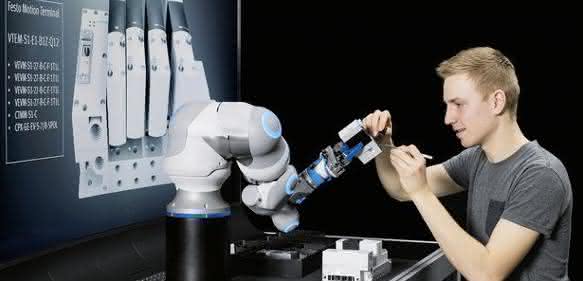
Robots could be used as assistance systems, particularly for monotonous or dangerous tasks, and relieve the burden on humans. The strict separation between the work areas of humans and robots is increasingly being abolished; a collaborative workspace is being created. Bionic lightweight robots are virtually predestined for safe human-robot collaboration due to their natural movement patterns and the compliant pneumatics used.
Pneumatic lightweight robot with human motion sequences
The Bionic-Cobot's movement patterns are modeled on the human arm, from the shoulder to the upper arm, elbow, ulna and radius to the hand. It makes use of the natural mechanism of action of the biceps and triceps muscles, i.e. the efficient interplay of flexors and extensors, in all its joints. This enables it to perform sensitive movements like its biological role model.
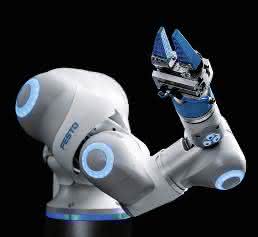
The movements of the bionic cobot can be controlled powerfully and dynamically as required, but also sensitively and flexibly, so that the system does not endanger people even in the event of a collision. This is made possible by the pneumatic automation platform "Festo Motion Terminal", which combines high-precision mechanics, sensors and complex control and measurement technology in a small space. Depending on the task, different grippers can be connected to the Bionic-Cobot. It is operated intuitively via a specially developed graphical user interface: Using a tablet, the user can easily teach and parameterize the actions to be performed. The defined work steps can then be lined up as required in a timeline using drag and drop. The entire motion sequence is virtually mapped and simulated at the same time. The interface between the tablet and the Festo Motion Terminal is the open source platform ROS (Robot Operating System), on which the path planning of the kinematics is calculated. Festo launched the Bionic Learning Network more than ten years ago. In cooperation with students, universities, institutes and development companies, Festo supports projects, test and technology carriers. The aim is to use bionics to identify new technologies and implement them in industrial automation. sw


You might also be interested in
Hamburg Regional Court issues preliminary injunction against Elite Robots Germany
In the copyright dispute between Teradyne Robotics and Elite Robots Germany, the Hamburg Regional Court has issued an interim injunction. The distribution of the software and products concerned is prohibited, and there is also a comprehensive...
 read more...
Schunk founds tech spin-off for humanoid robot hands
Schunk is bundling its activities in humanoid robotics by founding its own spin-off at the beginning of January. The aim of the new company is to develop modular humanoid robot hands for industrial applications.
read more...Partnership for humanoid robotics
Schaeffler and Neura Robotics jointly develop humanoids
Schaeffler and Neura Robotics will work together in the future to develop and supply key components for humanoid robots. The systems will also be integrated into Schaeffler's global production network.
read more...Yaskawa at the Automatica 2025
AI meets robotics
At this year's Automatica, everything at Yaskawa revolves around AI-based robotics solutions for the smart factory and beyond. As a trade fair highlight, the manufacturer is presenting its new Motoman Next product concept.
read more...Kassow Robots at the Automatica
7-axle vehicle in action
At Automatica, Kassow Robots will be presenting a wide range of industrial applications for production and logistics tasks that provide new impetus for efficiency and flexibility in industrial automation.
read more...Robotics and automation in six exhibition halls
From June 24 to 27, 2025, Automatica, the trade fair for intelligent automation and robotics, will bring industry and research together in six exhibition halls. Preparations are in full swing.
read more...Interview with Jörg Rommelfanger
Robotics in 25 years
The annual IFR report shows that the number of industrial robots is steadily increasing worldwide. They have already played an important role in ABB's portfolio for decades. In an interview with INDUSTRIAL Production, Jörg Rommelfanger, Head of...
read more...Reliable end effector for cobots
Collaborative robots are now widely used for a wide range of handling tasks. SMC offers three versions of the RMH pneumatic gripper for this purpose; it is compatible with cobots from a total of twelve companies.
read more...7-axis cobots with controller in robot base
With the Edge Edition, Kassow Robots has launched the world's first 7-axis cobots with a controller integrated into the robot base.
read more...