
Bin Picking
AI-based robot cell
Cell with 3D camera for bin picking and parts handling. The Neocortex Artificial Intelligence (AI) software platform combines sensor data and machine control, ensures optimum perception of the working environment, guides the robot arm and directs the picking and placing of objects.
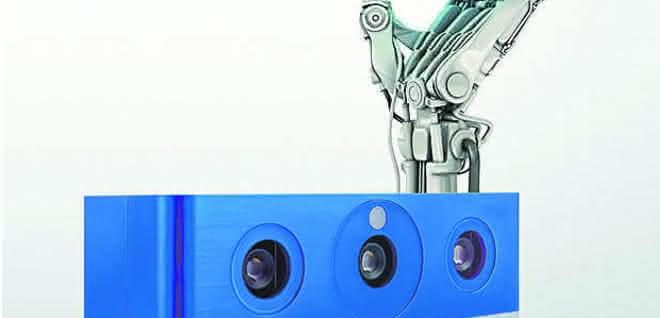
The Neocortex G2R ("Goods to Robot") robotic cells from the American software company and integrator Universal Logic are used in industrial production, particularly for applications such as bin picking, depalletizing and automated parts handling. Up to 1,400 products can be processed per hour. The preconfigured solution can be put into operation within a day and combines a robot with multifunctional grippers, a modular software platform for artificial intelligence and 3D cameras from the Ensenso N series from IDS. With costs of around seven dollars per hour in two-shift operation, the investment usually pays for itself after twelve to 18 months. The cells are therefore interesting components for the smart factory of Industry 4.0.
G2R robot cells are used for the automated handling of different types of objects, work quickly and efficiently and are easy to integrate into existing systems. This is particularly beneficial for users in existing buildings: the robot cells are designed in such a way that they can be easily integrated into existing workstations designed for humans. They are delivered as a complete package - including robot, gripper, 3D cameras and software - so that they can be put into operation as quickly as possible. This means that the system is usually ready for use within a day.
Users can choose from different models to ensure that the cell performs the tasks assigned to it as efficiently as possible: Depending on the intended use and weight of the objects to be moved, the cells are available in "small" (compact working environment, object weight up to seven kilograms), "medium" (allows approximately twice the reach of a human, object weight up to eleven kilograms) or "large" (reach up to 143 centimetres, object weight up to 21 kilograms) versions. The grippers are optionally available with vacuum, magnetic or electrostatic adhesion, so that an optimum setup can be guaranteed depending on the object and task. To choose the right components, it is therefore important to clarify in advance how many and which objects are to be moved and how large the distance is that the robot has to cover between picking up and placing down.
The robots can be used for a wide range of applications: depending on the requirements, they pick different random objects from containers, transport boxes, conveyor belts or pallets and place them in boxes, bags or other mechanical devices. The cells can read barcodes, identify labels or take measurements and can be used both for isolated processes and within production chains.
The system is controlled in real time by the Neocortex Artificial Intelligence (AI) software platform. It combines sensor data and machine control, ensures optimum perception of the working environment, guides the robot arm and controls the gripping and placing of objects. As the "seeing", "gripping" and "movement control" phases are interlinked depending on the situation, the artificial intelligence enables workflows with human-like flexibility.
The system identifies different objects at lightning speed and independently decides how best to pick and place them. The solution can also process randomly mixed objects at high speed. The company is continuing to develop the system: the current version Neocortex 5.0 offers, among other things, improved mixed parts picking, various configuration options for "finger gripping" and integrates additional sensors and controls.
High-resolution stereo cameras from IDS are used for the cell's field of vision. Depending on the task, two or three Ensenso 3D cameras from the N series provide the crucial visual information for each cell. Jeremy Bergh, IDS Imaging Sales Director North America, explains the choice of this camera model as follows: "IDS is constantly setting new standards in terms of speed and resolution in image processing. The combination of our 3D vision technology with Universal Logic's expertise results in flexible and highly efficient picking solutions."
The cameras work according to the principle of spatial vision (stereo vision) for precise perception of the work situation: Two cameras view the area to be recorded - such as picking boxes - from different positions. Although their images appear identical at first glance, the different viewing angles enable the exact position to be determined using triangulation. In addition, a powerful projector projects auxiliary structures onto their surface so that even homogeneous, reflective surfaces can be captured by the cameras in greater detail. This enables stable detection of objects up to a working distance of 3,000 millimetres with a low depth noise (Z-direction) of less than one millimetre.
Like the G2R robot cells, the Ensenso modular camera system is also flexible: depending on the application, you can choose from models in the N or X series with different sensors, resolutions and interfaces (USB or GigE). For use in harsh conditions, models with protection class IP65/67 are also available, whose components are effectively protected against dirt, dust and splash water. pb


You might also be interested in
Basler acquires 76% of Indian image processor
Basler, supplier of image processing components for computer vision solutions, has acquired 76% of the Indian sales partner Alpha TechSys Automation.
 read more...
Process monitoring and fault detection
Cameras ensure quality during laser melting
Powder bed-based laser melting (PBF-LB/M) opens up new possibilities in additive manufacturing. Modern camera systems provide crucial process data to further increase quality and efficiency.
read more...Vision Sensor is three times faster than its predecessor
The 'CS-62' vision sensor from di-soric is around three times faster than its predecessor, the 'CS-60'. In combination with the 'nVision-i 25.1' software, it enables image processing solutions that were previously reserved for smart cameras.
read more...Thermal imaging cameras for quality control
Automated thermal imaging cameras are often suitable for quality control applications where temperature plays a role. However, while there are various solutions on the market for slow processes, it is challenging to select a camera that reliably...
read more...Easy entry into industrial VGA thermography
Reliable temperature measurement is a prerequisite for the success of many industrial processes. Berlin-based manufacturer Optris presents the Xi 640 infrared camera, a new member of its Compact Line, which enables non-contact temperature...
read more...Powder bed-based laser melting optimized
Aconity3D has set itself the goal of optimizing the stability of the manufacturing method of powder bed-based laser melting and thereby promoting its use in a wide range of industries. By using high-speed industrial cameras from SVS-Vistek, the...
read more...INDUSTRIAL Production Products of the year...
2nd place, category handling, assembly and production logistics: SICK
safeVisionary2 is the first 3D time-of-flight camera with Performance Level c safety certification. It enables safe three-dimensional environmental detection and won 2nd place in the competition for Product of the Year 2024 in the handling, assembly...
read more...Nomination Products of the Year 2024
SICK: Camera systems safeVisionary2
safeVisionary2 is the first 3D time-of-flight camera with Performance Level c safety certification. It enables safe three-dimensional environmental detection and has been nominated in the 2024 Product of the Year competition in the handling,...
read more...AI vision brings additional opportunities
The seamless integration of AI into the consumer sector has helped to improve our quality of life and make interactions with technology more efficient. In industry, AI vision with machine learning opens up new possibilities that are not covered by...
read more...