
Automation of a machining center
Robot brings connector housing
Automated machine tools are standard, but it can be tricky with a wide range of parts. The automation of a machining center at Wieland Electric was successfully implemented using a Yaskawa Motoman.
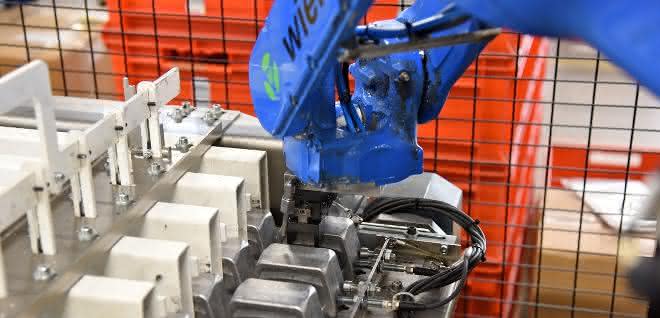
Wieland Electric is a medium-sized family business based in Bamberg and is one of the pioneers of electrical connection technology. Over the course of its 100-year history, the company has developed into an international group with more than 2,200 employees worldwide. The majority of products are still manufactured in Germany, such as robust housings for the revos industrial connector series. A Müga S500 machining center handles the machining of the upper and lower parts of the housing, which primarily involves drilling holes and cutting threads. In the past, the machine tool was loaded and unloaded manually.
Automation solved by EGS
This was to be changed: "The machine employed staff with simple, monotonous tasks, which we urgently needed for higher-value tasks. In addition, manual loading was not ideal for productivity reasons. To remedy this, we contacted EGS Automatisierungstechnik, as we knew that they had proven expertise in the automation of machine tools," reports production planner Frank Hennemann. EGS has already implemented hundreds of automation solutions for machine tools and rose to the challenge of the Wieland task: the large number of housing variants and working with bulk material in bulk material.
Housings arrive disorderly in metal containers and also leave the system as bulk material. This requires a highly flexible feeding system. EGS has a suitable system in its standard range which, with a few modifications, was the ideal solution for Wieland: the Sumo Flexiplex. With this loading system, the workpieces are transported via multi-lane accumulation conveyors. The big advantage: all variants of the connector housings have an identical feature - the width of always 42.5 to 43.5 millimetres. This means that the track width of the Flexiplex does not need to be adjusted during a changeover. The EGS feed solution can cope with the different part lengths, which vary between 60 and 140 millimetres depending on the variant, as well as the height of the housings in the range of 24 to 90 millimetres, and with special housing shapes; only a part holder had to be fitted.
Motoman robots in the cell
Yaskawa was chosen as the right robot: the Motoman six-axis robots are suitable for rough use on and in machine tools thanks to their robust design. They score points for precision and dynamics. In this specific case, EGS chose the Motoman MH12 for all handling tasks within the cell, which is secured by a safety fence. The system operator is responsible for loading the eight tracks of the Flexiplex with unmachined parts in the correct position, as well as stocking empty metal containers to hold machined parts. The containers are brought into the working area of the cell via a driven roller conveyor and discharged onto a buffer section when full. These activities can also be carried out parallel to production.
Autonomy and employee protection
Once automatic operation has started, the workpieces on the feed belt enter the robot's work area. The MH12, which can handle the entire range of parts with one gripper due to its identical width, picks up a part and places it in the machine's clamping device. Once all the nests of the clamping device have been loaded one after the other, the robot triggers the clamping of the raw parts and sends the release signal to the machine for processing. The machine then rotates the loaded side of its swivel table into the processing area and feeds the finished parts into the robot's loading and unloading area. The six-axis robot then picks up the finished parts and places them in the waiting metal container. A new cycle then starts.
Wieland states that there are no malfunctions or longer downtimes on this automated processing machine. The cycle rate is four parts per minute. The achievable autonomy of the system is also impressive - it is several hours, depending on the part variant. Decisive factors for the longest possible autonomous operation are the maximum possible stocking of raw parts by the feed system and the provision of the maximum number of empty metal containers in the system. Last but not least, employee protection has won out: The workpieces are contaminated with cooling lubricants that can cause skin irritation during manual handling; the robot now does the work. pb


You might also be interested in
Housing and inserts for plenty of power
Lapp presented the expansion of its Epic Power series at SPS 2023: four new M23 circular connector inserts and three new M23 housings. The special feature: all housings can be combined with any of the four inserts.
 read more...
News and product updates from Smartgas
Portable gas analyzers for outdoor use
Smartgas is starting the second half of the year with a series of updates to existing products and a number of new products. Portable analyzers expand the range of applications, while new accessories such as protective housings and heating modules...
read more...Everything accurate in switch cabinet construction
To ensure smooth work processes, tools for processing enclosures and housings must function flawlessly and reliably. Häwa rounds off its punching range with the Multi-Press 500.
read more...Shafts and conversion parts
The Rodriguez range includes ball bushings including matching housings, shaft brackets, crossbars and supports.
read more...Cooling and temperature control units
Hygienic packaging sells safely
In few industries are the requirements for hygiene in the production process as strict as in the food sector - the health of consumers has top priority. This results in enormous challenges for all machines and components involved, especially in...
read more...Simple tool change in seconds
With the CMS, Schunk is launching a user-friendly, manual change system for quick component replacement. In addition to its simple and convenient operation, the CMS also stands out with its extensive range of optional modules and complementary end...
read more...Motion controller for small drives
Medium power range covered
Faulhaber has another housing-less and compact motion controller in its range, which is particularly suitable for integration in device construction and medical technology applications.
read more...Welding solutions in the name of resource efficiency
At the Welding & Cutting trade fair in Essen (September 11-15), Fronius will be focusing on the major drivers in welding technology. Quality requirements are increasing in all industries, but the required welding specialists are scarce. In...
read more...Safe solutions for cable installations
From thick power cables to thin sensor lines, cables and lines must be routed safely through systems and machines. A challenge that should not be underestimated, explains Jörg Sokat, Head of Product Management at Pflitsch.
read more...