
Automation
Now it's peppered here
Automatic palletizing of spice cans. Ecoma supports a manufacturer of spices in the continuous automation of production and packaging systems with double palletizing cells. Kawasaki robots work in them.
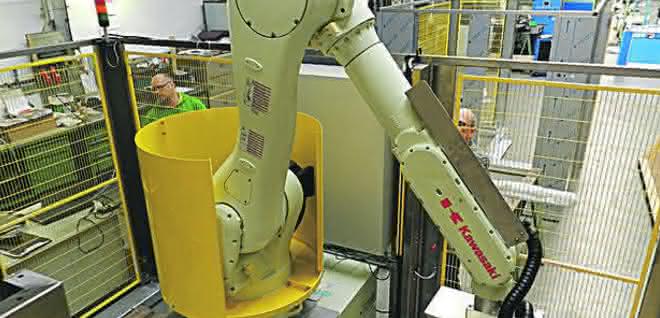
For more than 20 years, Ecoma in Weyhe-Dreye has specialized in the development of systems, machines and special machines for various industries. In the food and pet food sectors in particular, Ecoma sees itself as an expert in automated transport and handling systems. In autumn 2017, the company was commissioned to develop twelve double palletizing cells for the largest plant of a spice producer. The linchpin of the cells: An RD80N robot from Kawasaki Robotics. The in-house production and packaging system was to be systematically modernized and automated - starting with the palletizing of the products, which had previously been handled manually. A short time later, Ecoma commissioned four automated individual palletizing cells based on the Kawasaki RD80N robot. The five-axis robot specially developed by Kawasaki for palletizing tasks can carry a maximum of 80 kilograms and has a reach of up to 2,100 millimetres.
Two pallets are served simultaneously
The efficiency of the palletizing units was to be further increased. Ecoma therefore developed double palletizing cells; twelve of these cells were to be implemented in the packaging system. The advantage of the new cells: By using two pallets in parallel, there are no delays due to the process-independent loading and unloading of the cell, and the overall capacity of the system is doubled. In addition, two pallets can be loaded in parallel with different products using just one robot if required. Twelve cells offer greater capacity per robot. The first of the twelve systems was developed by Ecoma as a pilot project at the start of 2018, put through its paces by the development team and continuously optimized. It was used by the spice manufacturer for the first time in March.
Automatic sorting of products
The double cell is not only able to process two product types in parallel, but also to sort them automatically. The trays, each packed in units of five spice tins, are manually loaded onto the infeed conveyor belt by employees. A barcode reader identifies the product type and automatically feeds it to the correct conveyor belt via a pusher - unreadable or incorrect items are immediately sorted out by the system. The trays are fed to the pre-assigned pallet and positioned on a table in groups of four for the gripper of the RD80N robot. At alternating intervals, the robot gripper packs the four trays onto the pallet provided and loads them up to the intended capacity limit. As soon as this limit is reached in one half of the cell, this is clearly displayed. The cell operator can then remove the finished pallet and replace it with a new one - a semi-automatic cell concept.
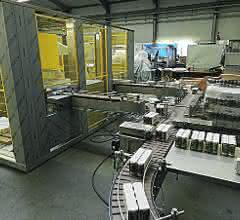
The plan is for 14 cycles per minute
As soon as the door of one half of the cell is opened, the robot immediately stops its activity there and continues working in the other half without interruption. The Kawasaki Cubic-S safety system ensures that robots and workers can work together safely and securely. The software makes it possible to set up particularly space-saving applications and safety areas without complex external safety measures. The robot currently performs eight cycles per minute. The aim is to carry out 14 packs or cycles per minute and cell half using the installed Multipack palletizing software and to expand the trays to eight cans each. The aim is to have a total of 28 packs on the belt at any one time.
The next step has already begun
The spice manufacturer is already planning the next steps in automation together with Ecoma: once the twelve double palletizing systems have been successfully set up, the loading of the cells is also to be fully automated using Kawasaki robots: Where employees previously fed the trays manually, an automatic filling system will ensure faster and more efficient processes. While the palletizing systems currently place the trays directly onto Euro pallets, the system is soon to be converted for use with plastic containers in accordance with the European standard. A feeder installed between the two halves of the cell ensures that the containers are constantly replenished so that the robot can automatically move them into the correct position. The corresponding conversion is carried out on site at the customer's premises after delivery. pb


You might also be interested in
Soft grippers for delicate foods
Irregularly shaped, fragile, and varying in size and weight: products such as potatoes, baked goods, and dairy products push mechanical grippers to their limits.
 read more...
Development Collaboration for Humanoid Robotic Hands Launched
Schunk is entering into a new development partnership with Robert Bosch Robotics. Their shared goal is to develop an industrial-grade robotic hand that can be integrated into various humanoid robot systems.
read more...Robot-controlled packaging of rolls
Koch Robotersysteme, a company specializing in the integration of robotic systems, has developed a complete, automated packaging line for packaging rolls based on Tentoma’s RoRo StretchPack packaging machine.
read more...Robotics and autonomous order picking
Locus Robotics acquires Nexera Robotics and expands autonomous warehouse logistics
Locus Robotics takes over Nexera Robotics and may have taken a decisive step towards truly universal warehouse automation. A new gripping technology should now make possible what was previously considered difficult to automate.
read more...Gentle wheel handling
The newly founded Eisenmann Robotics division develops new robotics concepts to increase the level of automation in modern production facilities.
read more...Gripping systems and vacuum generators
Schmalz is presenting new gripping systems and vacuum generators at Automatica. Exoskeletons, which allow employees to move heavy workpieces effortlessly, will also be on display.
read more...Smart universal gripper for power electronics
The power electronics manufacturer Semikron Danfoss uses the EGU 50 mechatronic parallel gripper from Schunk in a robotic cell. It handles different components and feeds them to a measuring line. With its functionalities, it meets all requirements...
read more...Schmalz takes over finger gripper from Soft Robotics
The vacuum specialist Schmalz is expanding its gripper portfolio and acquiring the mGrip product family from the US company Soft Robotics (SRI), including all finger gripper configurations, patents and the associated know-how.
read more...Soldering with special gripper
In order to make the mini wave soldering of large panels stable and reproducible, Eutect developed a special gripper that prevents the panel from bending, among other things.
read more...