
Robotics
Automated laboratory tests with robots
The current situation shows: The healthcare system quickly reaches its limits when laboratory capacity is lacking or when existing test installations cannot be converted flexibly enough for test variants. In this situation, laboratory robots offer an alternative.
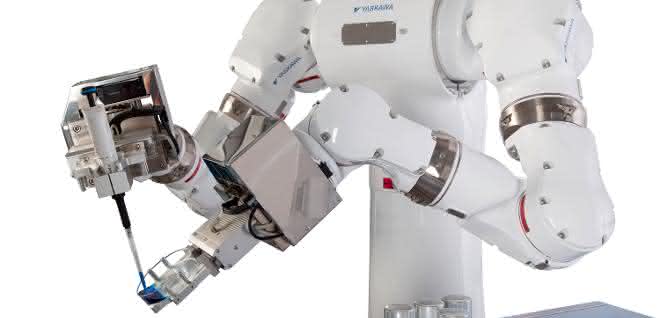
Robots have long been established in industry. But automation is also finding its way into laboratory environments. In research and development (pharmaceuticals, chemistry, life science and bio- and nuclear medicine), blood analysis or individual cosmetics production, robotic solutions have been successfully used for several years now, which are so flexible and universally applicable that they are also suitable for clinical infection tests. In addition to reducing the workload of laboratory staff, the robot offers outstanding and recurring process stability and quality.
There are basically two options for robot-assisted automation of a laboratory process:
Partial automation in which the robot performs recurring handling tasks for the laboratory staff, thus reducing the workload. The robot performs handling tasks, while the process control remains with the laboratory staff or the automated analyzer.
The complete automation of the test procedure, including sample preparation, pipetting, test execution including the operation of all analysis devices by the robot. The robot takes over process control and handling tasks. The aim here is to create standard work cells that can be used universally, with a two-armed robot as the central element, which can be converted to any laboratory equipment and flexibly reprogrammed. Such a solution can carry out laboratory processes autonomously 24 hours a day and with maximum precision and repeatability.
How quickly can robot-assisted automation solutions be deployed?
In the case of partial automation, i.e. if the robot is to be retrofitted for handling purposes, this can be done very quickly with collaborative robots. The design and new installation of a fully automated robot cell, on the other hand, takes several months. However, once such a standard robot cell has been installed, the laboratory and analytical equipment in question has been set up around the robot, and a library of movement patterns has grown and become available over time, "then such cells can be quickly and easily reprogrammed for new tasks," says Thomas Goldfuss, Managing Director of Goldfuss Engineering, which has already implemented several laboratory cells with robots from Yaskawa for customers.
The quick solution: partial automation of handling tasks
Partial automation of handling tasks at existing manual test stations can help to relieve laboratory staff at short notice. The robot takes over recurring movements and thus relieves the qualified laboratory staff. A collaborative robot that can be used in direct contact with humans and can operate without a safety fence is ideal for this purpose.
One such robot is the HRC-capable Motoman HC10DT from Yaskawa. Two variants of the six-axis robot are particularly suitable for use in laboratories: the HC10DT with IP67 protection, which is both dustproof and waterproof, and the HC10DTF with hygienic design, whose operating fluids/gear greases have food approval.
With the Direct Teach (DT) method, the robot arm is simply guided from point to point in a movement sequence. Pre-assigned buttons on the robot are used to determine whether a gripper should be opened or closed at a position. This movement sequence is saved in a library and the robot can repeat this sequence as often as required. Even an operator who is not a robot programming expert can do this.
The fully automated robot workstation
The two-armed Motoman CSDA10F robot from Yaskawa is a robot specially developed for laboratory automation. With its human-like stature and two arms that can perform both individual and synchronized movements, it is versatile thanks to its multifunctional tools and grippers. It works with almost any existing standard laboratory equipment and is capable of handling conventional laboratory equipment as known from manual workstations: Petri dishes, manual pipettors, incubators or reaction vessels. Automation-oriented equipment such as pipettors with expensive tips or microtiter plate stations are helpful in terms of improving throughput, but are not necessary.
The existing analytical devices, including their software connection, are adopted as they are, even if they have not actually been optimized for classic automation. This means that expensive liquid handling systems - with their costly consumables - are not absolutely necessary, as the robot can take over this task directly. In its laboratory workstation, the robot can perform a variety of tasks that previously seemed reserved for humans, such as opening and closing any reaction vessels (not always microplates), pipetting and dosing liquids or powders, preparing nutrient solutions with spatulas, setting up and removing samples, opening, filling and closing reaction vessels, as well as operating devices such as centrifuges, shakers or incubators.
The CSDA10F is suitable for complex, standardized test sequences according to given protocols that were actually written for manual processing. The CSDA10F dual-arm robot is therefore also an interesting solution in process development, for defining, validating and optimizing process steps before upscaling the throughput in a later production line. It is already being used in larger installations in Japan in biomedical synthesis (cancer drug development) and in chemical analysis (sample preparation).
The CSDA10F is based on a robot that has already proven itself in industrial automation. In this new version, it has been specially designed for the hygiene requirements in laboratories, with a particularly substance-resistant paint finish, washable hygienic design, H2O2 sterilization and cleanroom suitability in accordance with ISO 14644-1.
Thanks to its high flexibility, the robot can be used for a wide range of applications - it can learn completely new work processes quickly and easily. Many characteristic movements (pipetting, opening/closing "Eppi", handling microtiter plates, opening/closing incubators, opening/closing screw caps on bottles) have already been standardized and are stored as required as modules in a movement library. The human/robot interface for operation and visualization can be implemented via a PC or a touch panel. The HMI is either customized or connected to existing workflow scheduling software. Once the motion programs have been stored in the library, the operator does not need to be a robot expert; he simply composes and parameterizes the individual process steps of his desired work sequence.
Until now, classic automation in laboratories was often considered too inflexible and too bulky. Today, however, easy-to-operate robot models are available that are capable of carrying out various laboratory tasks. They can take over work that is too dangerous or too monotonous for humans. This is because the use of robots guarantees exact reproducibility of work results, even when processing a large number of samples. However, laboratory automation not only saves time and costs, especially with high throughputs. Thanks to its unrivaled precision, it creates new conditions for research into starting substances that could not previously be produced with sufficient process reliability or reproducibility. as


You might also be interested in
Fraunhofer IOSB Opens Humanoid Robots Lab
The Fraunhofer IOSB is opening a Humanoid Robots Experience Lab in Karlsruhe, Lemgo, and Ilmenau. Companies and organizations can use these facilities to test potential applications for humanoid robots and develop pilot projects.
 read more...
Artificial Intelligence in Manufacturing
Trumpf and IPAI Are Expanding a European AI Network for Industry
The high-tech company Trumpf is an official partner of the IPAI AI network in Heilbronn. Together, the partners aim to exchange experiences, develop new AI applications for industrial use, and advance the development of artificial intelligence in...
read more...Case Study: Networked Manufacturing Platform for Toolmaking
Using a networked manufacturing platform, Escha GmbH & Co. KG, a manufacturer of industrial fastening technology, has comprehensively modernized its toolmaking operations.
read more...Barcelona Declaration on Robotics and...
Robotics Associations Adopt Global Automation Strategy
The global robotics industry is stepping up its collaboration. The associations AER Automation, A3, IFR, and VDMA Robotics + Automation have formed a long-term alliance by signing the “Barcelona Declaration on Robotics and Automation 2026.” The...
read more...Jane Heffner is the new president of the International Federation of Robotics
Jane Heffner is the new president of the International Federation of Robotics. Adrien Brouillard has been appointed vice president of the global federation.
read more...Greater Transparency in the Robotics Market
RoboFinder Launches as an Independent Comparison Platform
Launch at Gitex Europe: 'RoboFinder' aims to bring more transparency to the professional service robotics market. In this interview, founder and CEO Brian Engels discusses market potential, challenges, and the goals of the new platform.
read more...Artificial Intelligence for the Physical Space
Alibaba Expands Qwen Model Family with a Robotics Suite for Physical AI
Alibaba is expanding its Qwen model family with a robotics suite for Physical AI. The three models—for manipulation, navigation, and simulation—are designed to assist autonomous robots with complex tasks in real-world environments.
read more...International Federation of Robotics
U.S. Robotics Industry Sees Double-Digit Growth
In the U.S., sales of industrial robots rose by 11% compared to the previous year: 38,000 units were newly installed in 2025. This significant recovery is driven by robust growth in the food industry and other non-manufacturing sectors. However, the...
read more...Development Collaboration for Humanoid Robotic Hands Launched
Schunk is entering into a new development partnership with Robert Bosch Robotics. Their shared goal is to develop an industrial-grade robotic hand that can be integrated into various humanoid robot systems.
read more...