
Assembly of cylinder head components
Many minds need automation
Insys has developed an assembly cell for Liebherr Machines Bulle that enables unmanned production of up to fourteen cylinder head variants. Gripping system components from Schunk handle the parts handling and positioning of the cylinder heads.
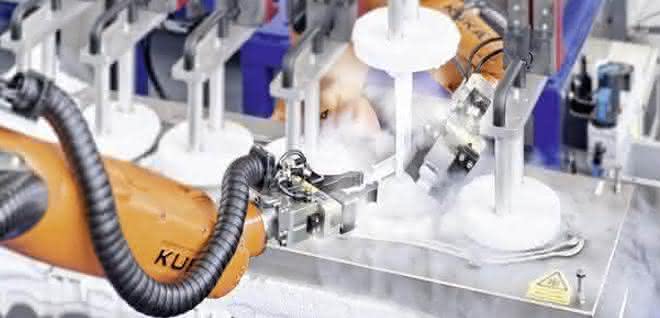
Liebherr Machines Bulle has been expanding its distribution of motors since 2007. This is associated with the expansion of the product range: More and more customers require individual adaptations of the former standards, so that the number of cylinder head variants grew, among other things. The manual effort involved, the ergonomic strain on employees, potential hazards when handling liquid nitrogen and the urgent need for personnel in other areas of production all spoke in favor of a fully automated solution. "Our aim is to automate operations that are always identical," explains project engineer Sebastien Bussard. "In terms of automation, this means that we need increasingly flexible solutions that we can expand individually and where we can parameterize new types ourselves." Fourteen cylinder head variants are already in the program, and the trend is rising.
Insys Industriesysteme from Münsingen has therefore developed a robot cell with which fourteen cylinder head variants can be fitted with valve guides and valve seat inserts fully automatically right from the start. The operator simply places the cylinder heads on pallets and scans the order. The system takes care of everything else: the cylinder heads are individually depalletized by robot, placed on workpiece carrier pallets and fed to a press-fit station.
Another robot is responsible for feeding the valve guides and valve seats, which have been cooled to minus 200 degrees Celsius: it removes the parts from a cooling system and places them precisely in the cylinder head, where they are pressed in using various press-fit tools at a pressure of up to one ton. Eight parts have to be fitted per cylinder head, sometimes from one side, sometimes from two sides, for which the cylinder head is turned over. Finally, the fully assembled cylinder head is removed from the workpiece carrier pallet and set down. The cycle time for a complete cycle is 15 percent less than the value originally required by Liebherr.
According to Urs Künzi, application engineer and project manager at Insys, the high variance was a particular challenge: "We mapped the wide range of variants primarily through automation. We solve the handling of the different feed parts in a diameter range between 40 and 50 millimetres with a single jaw set, i.e. without any jaw changes." Multi-tooth guided Schunk PGN-plus universal grippers ensure a high level of process reliability. The parallel grippers cope well with the constant temperature fluctuations, especially as the cold dissipates quickly via the large surfaces of the gripper fingers.
Insys has chosen a two-stage principle for handling the cylinder heads: The depalletizing and palletizing of the different cylinder head variants weighing between 20 and 25 kilograms is initially performed by two EGM magnetic grippers from Schunk. The cylinder heads are then placed on variant-specific workpiece carrier pallets and fed to the press-fit station using the NSR-A robot coupling.
The reason for the two-stage handling: no access from the outside is possible to depalletize the tightly packed components. The holes in the cylinder heads are also off-limits to gripper fingers. In the end, the decision was made to use two EGM-M magnetic grippers with a pole surface of 50 square millimetres, which are positioned in such a way that the sensitive holes in the cylinder heads are left out. This medium size is already designed for payloads of up to 32 kilograms. As the magnetic surface extends to the outer edge, there are no interfering contours to consider. The grippers can be positioned anywhere on workpieces and flexibly combined to form larger units. The magnetic grippers in the EGM series work with energy-efficient electro-permanent magnets. A current pulse is only required for 300 milliseconds to activate and deactivate them. Otherwise, no energy supply is required. Even in the event of an emergency stop or a sudden power failure, the parts remain reliably gripped.
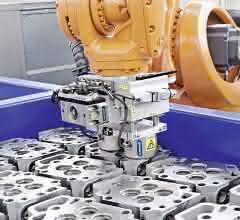
Immediately after depalletizing, the cylinder head is placed on an individual workpiece carrier pallet, which was previously provided from a carrier pallet magazine, using a magnetic gripper and with the support of a camera. The carrier pallet is coupled to the robot via the NSR-A robot coupling and navigated into the press-fit station. The compact robot coupling, which enables flexible and reliable parts handling, had already proven its worth at Liebherr in machine tools, where the carrier plates are placed on the Vero-S zero-point clamping system for machining.
Insys is now going one step further in the press-fit station: instead of initially clamping the pallets with the cylinder heads in the zero-point clamping system, they are positioned and fixed exclusively by the robot throughout the entire process. "The robot coupling is extremely stable and precise," reports Urs Künzi. "It has to be, because high precision is required when pressing in the valve guides and valve seats. It allows us to work in the tightest of spaces and we can expand the range of parts at any time," explains Künzi.
The NSR-A quick-change module enables robot maneuvers directly on the assembly or machine table. With a dead weight of just 1.6 kilograms (size 160), the NSR-A generates an exceptionally rigid system with a locking force of 14,000 newtons. It is suitable for the reliable handling of pallets weighing up to 350 kilograms (at 400 x 400 millimetres). Such large masses are made possible by a locking system developed by Schunk with a patented rapid and clamping stroke. The locking itself is positive-locking and self-locking.
as


You might also be interested in
Motors, gearboxes and encoders: Faulhaber expands Ø 16 mm portfolio
Faulhaber is expanding its portfolio with new DC motors from the SXR and GXR family, a 16 mm planetary gearbox and the IEX3 magnetic encoder for compact drive solutions.
 read more...
New drive solutions for industrial automation and robotics
Faulhaber presents drive solutions with the new GXR and SXR motor family, which offer high efficiency and flexibility in combination with powerful gearboxes and encoders. These optimized components open up new possibilities for applications in...
read more...Marco Altherr becomes new Chief Financial Officer
The Supervisory Board of Ziehl-Abegg has appointed Marco Altherr as the company's new Chief Financial Officer (CFO). Altherr will take up his post in May 2025.
read more...Hydrogen storage in metal hydride
With its focus on storage systems for green hydrogen in solid form (metal hydride), GKN Hydrogen presents itself as a pioneer in safety and efficiency for the industry. GKN Hydrogen offers safe storage systems for green hydrogen and focuses on two...
read more...INDUSTRIAL Production Products of the year...
2nd place, Robotics category: EGS Automation
The SUMO automation systems from EGS Automation - economical standard solutions for automating a wide range of processes in plastics and metalworking - took second place in the robotics category in the competition for Product of the Year 2024.
read more...More productivity with Drive Intelligence
The trends in automation are productivity, sustainability and connectivity. Baumüller is launching new products on the market that address these trends, including new tools for smart energy monitoring, condition monitoring in the drive and new...
read more...Intelligence in Motion
At SPS, Koco Motion will be showcasing its expertise in customized drive solutions based on DC and BLDC motors, stepper motors, servo motors, linear drives and controllers.
read more...Nomination Products of the Year 2024
EGS Automation: SUMO automation systems
The SUMO automation systems from EGS Automation, economical standard solutions for automating a wide range of processes in plastics and metalworking, have been nominated in the Robotics category in the competition for Product of the Year 2024.
read more...Transport technology from the modular system
Many transport tasks can be realized with the help of linear technology. Pre-configured solutions are available to simplify the interaction between the linear unit, motor, gearbox and controller. This minimizes the effort required for research and...
read more...