
Assembly
The two robots do it!
Assembly of guide sleeves for headrests. The assembly of plastic guide sleeves for the headrest adjustment of the SUV series of a German premium manufacturer places high demands on automation. The automotive supplier Ros relies on a system designed in-house with two fast six-axis robots.
The Franconian family business Ros, which employs around 550 people in five plants within the Ros Group, is one of the most renowned manufacturers of customized plastic parts in the automotive, medical and electrical engineering sectors. The company produces around 250 million parts a year and relies on an above-average level of vertical integration.
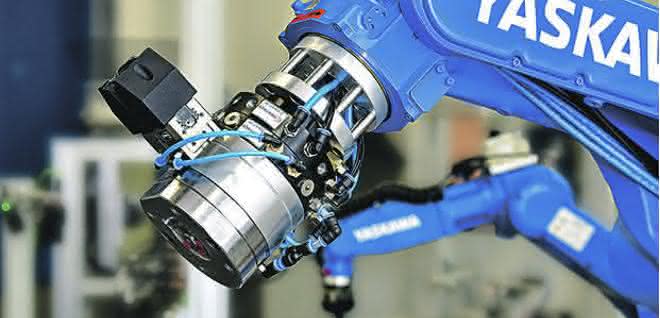
This also applies to the guide sleeves for the headrests, which are completely injection molded in Ummerstadt and then assembled. These guide sleeves differ in key details depending on the vehicle model and their use in the driver, front passenger or rear seat. Ros produces a total of eight different variants, which the recently commissioned assembly system has to cope with. Two Yaskawa Motoman MH5LS and Motoman MH12 robots, a rotary indexing table with eight stations, various feed systems and lots of sensor technology form the basis for the highly flexible, top-class rotary indexing system.
Concept with rotary indexing table and robots
The adjusting sleeve essentially consists of three plastic parts: a guide sleeve, a button with crossbar and spring, and a cap. Christopher Lamprecht, production planner at Ros and project manager for this system, sums up the real challenge in assembling these individual parts: "In order to meet the high demand, we have to achieve an output of several hundred parts per hour, depending on the variant. That's why we opted for a concept with a rotary indexing table and two dynamic robots, which guarantees us overall availability at the highest level."
Assembly begins with the feeding of the guide sleeve, which is separated by a vibrating bowl and reaches the transfer position via a linear system. Here, a camera system records the position of the sleeve, transmits this data to the robot, which then picks up the part and moves it to a second vision system, which reads the part number and checks it for plausibility. The compact MH5LS six-axis robot then places the sleeve quickly and precisely in the workpiece carrier of the rotary transfer system.
The rotary indexing table immediately moves on to station two. The pneumatic "insertion" of the button return springs is on the program here, before another vision system checks the correct position and positioning of the springs at station three. The work at station four consists of feeding the button and fitting the crossbar. After passing through the empty station five, a second integrated QA inspection takes place at station six, where a number of features are checked.
Six-axle machine assembles the cap
Things get exciting at station seven, where the second Yaskawa six-axis machine finally assembles the cap. To do this, the MH12 picks up a cap with its vacuum gripper and fits it onto the sleeve following a sophisticated movement pattern. The robot has to work with extreme precision during this process, in which the cap has to be positioned at a certain angle before it can be sensitively snapped into place.
Similarly high demands are placed on the next station, where the robot grips the fully assembled locking sleeve and ejects it via a chute. Here, too, the robot is challenged in terms of precision and path accuracy, as Lamprecht emphasizes: "Removing the finished part from the workpiece carrier is difficult because the sleeve is at a certain angle to the horizontal head.
This means that the robot cannot simply pull the part vertically upwards out of the workpiece carrier, but must take into account the inclined position of the sleeve in its path, which varies by up to 13 degrees depending on the component variant. Thanks to its excellent path behavior, the MH12 completes this task quickly and precisely, enabling us to keep to the cycle times."
Up to date in terms of control technology
There are several reasons why those responsible at Ros chose Yaskawa as their robot supplier: Firstly, they had already had positive experiences with the Japanese robots. In addition, the good repeat accuracy of the robots, their speed and the simple connection to image processing systems via Profinet were all arguments in favor of choosing Yaskawa.
The system is also state of the art in terms of control and communication technology. Conventional wiring was dispensed with in favor of communication via Profinet, which reduced the effort involved. All workpiece carriers are equipped with an RFID chip, which makes it much easier to identify them, among other things. This is an important aspect, as several different workpiece carrier designs are required for the assembly of the eight sleeve variants. RFID makes it very easy to ensure that the right holder for the selected component variant is located on the rotary indexing table. A positive side effect: the data for each assembly step is also stored on the chip.
The operating team also gets on well with the system. While loading and unloading is largely manual, all assembly steps are fully automatic. Operating the system is extremely simple: the operator selects the appropriate variant on the control system and starts the assembly process. The system would immediately detect an incorrect part and stop the assembly process. pb


You might also be interested in
Basler acquires 76% of Indian image processor
Basler, supplier of image processing components for computer vision solutions, has acquired 76% of the Indian sales partner Alpha TechSys Automation.
 read more...
Process monitoring and fault detection
Cameras ensure quality during laser melting
Powder bed-based laser melting (PBF-LB/M) opens up new possibilities in additive manufacturing. Modern camera systems provide crucial process data to further increase quality and efficiency.
read more...Vision Sensor is three times faster than its predecessor
The 'CS-62' vision sensor from di-soric is around three times faster than its predecessor, the 'CS-60'. In combination with the 'nVision-i 25.1' software, it enables image processing solutions that were previously reserved for smart cameras.
read more...Thermal imaging cameras for quality control
Automated thermal imaging cameras are often suitable for quality control applications where temperature plays a role. However, while there are various solutions on the market for slow processes, it is challenging to select a camera that reliably...
read more...Easy entry into industrial VGA thermography
Reliable temperature measurement is a prerequisite for the success of many industrial processes. Berlin-based manufacturer Optris presents the Xi 640 infrared camera, a new member of its Compact Line, which enables non-contact temperature...
read more...Powder bed-based laser melting optimized
Aconity3D has set itself the goal of optimizing the stability of the manufacturing method of powder bed-based laser melting and thereby promoting its use in a wide range of industries. By using high-speed industrial cameras from SVS-Vistek, the...
read more...INDUSTRIAL Production Products of the year...
2nd place, category handling, assembly and production logistics: SICK
safeVisionary2 is the first 3D time-of-flight camera with Performance Level c safety certification. It enables safe three-dimensional environmental detection and won 2nd place in the competition for Product of the Year 2024 in the handling, assembly...
read more...Nomination Products of the Year 2024
SICK: Camera systems safeVisionary2
safeVisionary2 is the first 3D time-of-flight camera with Performance Level c safety certification. It enables safe three-dimensional environmental detection and has been nominated in the 2024 Product of the Year competition in the handling,...
read more...AI vision brings additional opportunities
The seamless integration of AI into the consumer sector has helped to improve our quality of life and make interactions with technology more efficient. In industry, AI vision with machine learning opens up new possibilities that are not covered by...
read more...