
Sterile goods transportation
Alone in hospital
Transporting sterile goods with robots. In order to be able to provide its patients with optimum care even after a building extension, Zealand University Hospital in Køge, Denmark, is using a mobile transport robot from Mobile Industrial Robots. Equipped with a platform attachment, the MiR100 transports sterile goods in roller cabinets.
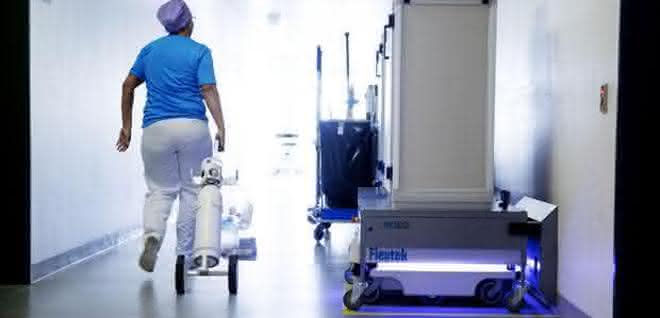
Seelands University Hospital is one of the youngest and most modern university hospitals in Denmark. Every year, it treats around 22,000 patients in various medical specialties. It is also one of the most important teaching hospitals in the region. The Danish authorities want to develop the clinic into a flagship project by 2022. As a medical competence center, it is expected to triple in size and care for many times more patients: 400,000 outpatients and 90,000 inpatients are expected every year - an enormous increase that will also pose challenges for the administration in terms of coordinating internal care.
While the number of patients being cared for is growing, walking distances are also increasing due to the increase in space. This particularly affects the nursing staff, who are already working to capacity with their daily work with patients. It quickly became clear to those responsible that a change was needed to make processes more efficient. "We need to rethink things if we want to optimize the current state of logistics in the hospital and develop a sustainable solution," explains Lilian Hansen, Project Manager at Seelands Hospital. With this in mind, the hospital management initiated a pilot project in June 2018 to test the use of mobile robots in day-to-day hospital operations.
In the search for a suitable provider, the decision was quickly made in favor of technology from Mobile Industrial Robots (MiR). "MiR offers the most advanced solutions for our industry," explains Johnny Lyngård Petersen, Operations Manager at Seelands Hospital. "The MiR robots meet our needs exactly. No special changes to the infrastructure were required for their implementation, as they navigate without rails or magnetic strips - a big plus for us." This autonomous maneuverability also saves time and costs during integration. Lyngård Petersen's confidence in Mobile Industrial Robots was also based on the fact that MiR's robots have already been used successfully in other Danish hospitals in recent years.
At the heart of the project at Seeland University Hospital is a MiR100, which the hospital staff have christened "Optimus". It supplies five specialist departments with sterile disposable items such as syringes, infusion needles and plasters. It covers a distance of ten kilometers every week. Thanks to its sensor technology and safety algorithms, it moves autonomously and safely through the corridors. As a result, it can also travel in the immediate vicinity of people without any risk whatsoever.
No changes to the infrastructure were necessary during implementation,
as the robots navigate without rails or magnetic strips.
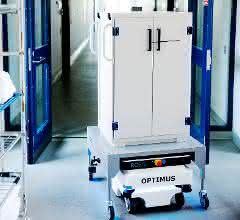
Added to this is the robot's reliable adaptability thanks to its various interfaces, which give it a major advantage in the fast-paced everyday life of hospitals. For example, MiR robots can operate elevator systems via WLAN and thus enter and exit them independently or open electric doors and gates. Johnny Lyngård Petersen really appreciates these features: "The robot can take the elevator, use the corridors side by side with staff and patients, avoid obstacles and even open doors independently."
Before being used for the first time, each robot travels through its future operating environment once and maps it. It can then move autonomously and always calculate the fastest route to its destination. Flexible add-on modules allow MiR robots to be optimally equipped for their respective tasks. The automation solution used in Køge consists of four parts: The mobile robot with its eponymous payload capacity of 100 kilograms serves as the base. An add-on module is installed on its loading area, onto which a mobile transport trolley can be coupled. A cabinet is mounted on this, which the staff can seal for the transportation of sterile goods.
It is loaded with disposable items and sterile instruments by employees from the central sterile supplies department. The robot then travels to the various departments one after the other, where service assistants remove the required material. MiR technology thus ensures that the departments are always supplied with the right sterile supplies. This minimizes waiting times, prevents bottlenecks and leads to leaner transport processes, allowing the hospital to reduce its stocks and save on expensive storage space.
Both patients and staff benefit from the improved service. Before Optimus started working in Seeland, they delivered the sterile goods by hand every week. They are now happy to be able to give up this physically strenuous, monotonous task. "Thanks to MiR's technology, the service assistants can now devote themselves to 'warmer tasks' such as patient care," explains Johnny Lyngård Petersen.
The robot travels through the various departments one after the other,
so that everyone is always accurately supplied with sterile goods.
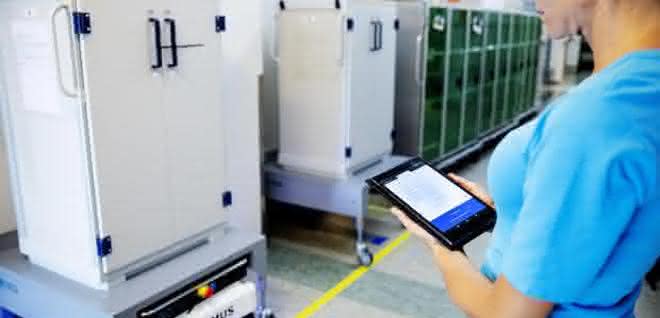
This relief also provides health benefits for hospital employees such as Anne Rosenberg Petersen. She no longer has to constantly bend down to carry the sometimes heavy boxes of sterile supplies. As a socio-medical assistant in the central sterile supplies department, she works with the robot on a daily basis. She is impressed by its intuitive controls, which can be operated via tablet, cell phone or PC: "As soon as I have placed the items in the cupboard, I send the robot to the various departments with just one click on the tablet - with all the items that are needed there. I automatically receive the used instruments and items as well as the empty transport trolleys back from the departments via the robot. That makes my work so much easier."
The employees were involved in the integration of the robot right from the start. When it came to giving it a name, the hospital held an internal competition. The woman who came up with 'Optimus' received a small prize, which the robot then delivered to her personally. Thanks to its simple programming, the staff were able to adapt Optimus perfectly to existing processes. For example, it was programmed to politely warn patients and staff when it was approaching - it moves almost silently. In addition, signs were attached to its front to indicate its current destinations to the people around it. In this way, both staff and patients have quickly become accustomed to their "new colleague". "I'm really surprised at how quickly it went. The staff talk about him as if he were a colleague. After just a few weeks, he was already part of the team," reports Hansen.
The pilot project has given the staff at Seelands Hospital an idea of how such robots can usefully support processes and significantly improve the hospital's intralogistics. The positive experiences have encouraged those responsible to automate further transport processes in the future. They are also considering using mobile robots to transport surgical materials to the operating theaters - this seems particularly sensible in view of the fact that their number will quadruple in the course of the renovation. The collection and delivery of medication is also being considered as a potential task for further MiR robots. In this way, the flexible robots will ensure that the focus is always on people in the hospital of the future. as


You might also be interested in
"We are clearly different from the competition"
The IT company 21unity offers a range of hardware and software services, as well as traditional services. Andreas Mühlbauer spoke to Managing Director Anja I. Gondolf about the company's appearance at the Hannover Messe, its services and future...
 read more...
Think digital, act local
When it comes to industrial damping technology, on-site advice is often very valuable for engineers and designers.
read more...Plagiarius 2024 negative prize
On January 26, 2024, the Plagiarius campaign awarded its dreaded "Plagiarius" negative prize for the 48th time to manufacturers and retailers of particularly brazen counterfeits and fakes.
read more...Spindel Full Service records second-best...
Maintenance as an economic success factor
Spindel Full Service, the spindle repair specialist from Baden-Württemberg, can look back on its second-best financial year in its history - with 15% growth compared to the previous year. And the further forecast also looks good.
read more...Thyssenkrupp and Novelis cooperate
Platform for the circular economy
With a platform for the circular economy in the automotive industry, the two companies Thyssenkrupp Materials Services and Novelis want to set new standards for the recycling of used materials. The open platform will enable access to larger...
read more...How production can benefit from AI
Together with AI technology, IIoT networking makes it possible to better control machine parameters and optimize quality with predictive quality. Downtimes and set-up times can also be further minimized. Cloud platforms also make these technologies...
read more...Marco Ghirardello takes the lead
Fanuc has appointed Marco Ghirardello (48) as the new President and CEO of Fanuc Europe. Ghirardello succeeds Shinichi Tanzawa, who has led the company since 2016 and will take on a new role at Fanuc's headquarters in Japan.
read more...Efficient robot monitoring
Microchips are installed almost everywhere - whether in smartphones, washing machines or cars. With increasing digitalization, the demand for semiconductors has been growing rapidly in all areas of the economy for years.
read more...Everything on one platform
Functional and powerful tools are essential for professional work on the construction site, in the workshop or when carrying out repairs.
read more...