
AI on its way into the industry
Out of the routine
Artificial intelligence expands the potential of automation. In robotics, too, it is foreseeable that new tasks can be automated with AI without having to be programmed.
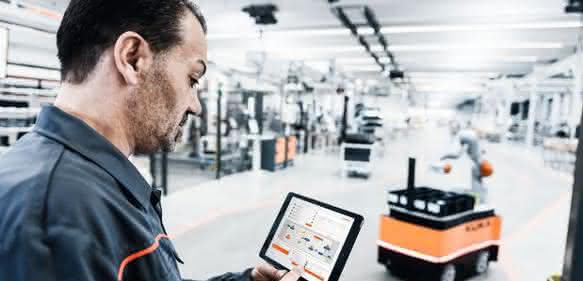
Artificial intelligence (AI) technologies are already enriching our everyday lives, for example in image and speech recognition. The technical background is complex: AI is essentially based on the calculation of probabilities and the recognition of patterns. In the industrial environment, AI algorithms offer new possibilities, as the requirements of production go beyond the current repetitive robot applications.
In many areas of everyday life, AI has already produced spectacular solutions to problems that were difficult or impossible to solve using conventional approaches. These include image and speech recognition or secure payment with credit cards. In robotics, too, it is foreseeable that AI can be used to automate new tasks without having to be programmed. AI is by no means the answer to every problem; the programming effort can be reduced, operation simplified and processes made more flexible. The key question is what is to be produced. "Product-neutral production cells", such as those already available in Kuka's Smart Production Center, are flexible. Car doors can be produced today and washing machines tomorrow. Production systems of this type can be quickly and easily adapted to new requirements.
A pattern from lots of data
Production equipment and components are increasingly being networked with each other - that's Industry 4.0. AI helps to use the data obtained in this way effectively. The corresponding applications require large amounts of data. In order to use the available data effectively, the networked machines and robots forward their data to a software or cloud application, for example. AI algorithms identify certain patterns and anomalies from the data volume. This provides general information about the production process, for example about processes in daily production and upcoming maintenance work. This predictive maintenance makes it possible to identify impending faults in advance and therefore prevent them from occurring in the first place.
The big challenge for intelligent machines is to solve tasks that are difficult to formulate as mathematical rules - for example, speech recognition or recognizing and classifying images and faces.
Machine learning for product-neutral production
Until now, robots were largely predestined for repetitive applications. They carry out their specified tasks with consistently high precision and repeatability. The production of the future will have increasingly complex requirements. As a form of AI, machine learning helps to make robot systems fit for flexible production. This involves interpreting data, finding correlations and deriving information from them.
In modern production, processes are efficiently and precisely coordinated; even short disruptions or downtimes have enormous economic consequences. Machine learning and AI have the potential to optimize productivity and availability during ongoing production. Further improvements can be made to process quality, cycle times, energy consumption and maintenance intervals. This is made possible by central planning. Software based on AI algorithms independently controls the production process. However, as we understand it today, it does not tell the machines how to produce something. Instead, the software plans what needs to be done, taking cycle and delivery times into account. The only decisive factor for implementation is which production resources are available.
AI promotes new forms of HRC
In addition to these technical changes, completely new forms of collaboration between humans and machines may also emerge. Simply talking to machines to program them or stop them in an emergency is entirely conceivable. Just like dynamic image recognition for programming by demonstration. Other possible applications include intelligent service scenarios that are shown directly on the robot using augmented reality glasses, or tablets that are guided over a robot and display information. pb


You might also be interested in
ESTIA aims to strengthen Europe's cloud
New tech alliance for EU sovereignty
Twelve companies, including Dassault Systèmes, are founding the European Sovereign Tech Industry Alliance (ESTIA). The initiative aims to strengthen Europe's technological independence and define requirements for sovereign cloud services. The start...
 read more...
Deutsche Telekom and Nvidia launch one of Europe's largest AI factories
With the Industrial AI Cloud in Munich, Deutsche Telekom and NVIDIA are creating one of the largest AI factories in Europe. Companies can train AI models, carry out simulations and access 10,000 GPUs.
read more...Leveraging data potential with AI and streaming
Huge data treasures are still lying dormant in many manufacturing companies. And yet it is high time that these treasures were unlocked. There is often a lack of resources and capacity to make data usable in real time. Streaming production data can...
read more...More awareness of noise
Dematic offers solutions that are tailored to different cloud environments and reduce environmental impact through reduced material consumption and improved energy efficiency.
read more...Generative AI in the automation environment
The mechanical engineering and automation industry is undergoing profound change. This transformation is being driven by more volatile global trade, geopolitical crises and increasing market pressure, which demands greater agility, technological...
read more...Rigid data structures have had their day
The traditional data center is no longer the center of data. A hybrid cloud storage approach enables manufacturing companies to both meet the current requirements of data-intensive processes and future-proof their infrastructure.
read more...Software as a service in three stages
CIM Database Cloud is a new out-of-the-box solution from Contact for end-to-end digital product development.
read more...How production can benefit from AI
Together with AI technology, IIoT networking makes it possible to better control machine parameters and optimize quality with predictive quality. Downtimes and set-up times can also be further minimized. Cloud platforms also make these technologies...
read more...More expertise for digital engineering
Altair, a computational science and artificial intelligence (AI) company, has acquired OmniV, a technology from Michigan, USA-based software company XLDyn.
read more...