

Added value through collaborative robotics
Keeping an eye on the whole arm
Humans and machines are increasingly working hand in hand. Automated processes will soon be standard in networked production environments. By then at the latest, it will be necessary to broaden our view: Only by focusing on the application as a whole can automation generate sustainable added value.

Collaborative robotics is more than just a trend: it is a technological paradigm shift that is having a lasting impact on and changing prevalent production processes. Thanks to their flexibility, collaborative lightweight robots, known as cobots, can be used in various industries and areas of application. Whereas conventional robots were separated from factory employees by safety fences, cobots operate in close proximity to their human colleagues after successfully completing a safety assessment. Thanks to their quick return on investment and ease of use, they also enable small and medium-sized companies to automate their production. The demand for collaborative robotics has risen massively in recent years, and uninterrupted growth is also forecast for the next five years.
Lightweight robots are becoming the standard
In view of the much-discussed networking of industrial production processes, often referred to as Industry 4.0, this development appears to be absolutely necessary: Smaller production volumes meet individualized customer requirements and an increased number of variants. These increasingly complex production conditions call for flexible and lean manufacturing solutions such as those provided by cobots. Thanks to their wide range of possible applications, they can be individually adapted to the respective requirements and can thus provide optimum situational support.
In the context of increasingly automated production environments, lightweight robots will therefore soon become the standard. What will happen then? It is time to look at the application as a whole. The example of the modern cell phone is a good illustration of what is meant by this: every smartphone is nothing more than a conventional phone. It is only through the installation of apps that it develops its functionality and offers the user more than just the ability to make calls. The same applies to any robotic arm: it only gains its functionality and usability when combined with end effectors, grippers or sensors. In this way alone, it creates added value for the user.
Electric, digital, plug and play
The young company Onrobot is committed to enabling collaborative applications with high user added value. Founded in 2015 in Odense, Denmark, the company develops flexibly adaptable plug-and-play grippers for human-robot collaboration (HRC). They are currently compatible with the lightweight robots from Universal Robots (UR), and work is underway to adapt the products to models from other robot manufacturers.
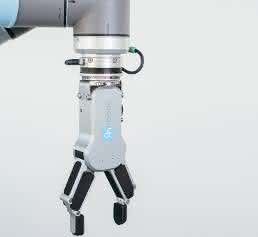
The special feature of the grippers: While traditional solutions for robot accessories are usually pneumatically operated, the electric, digital grippers are easy to assemble and handle. This not only saves space and energy, but also makes them easier to operate. In addition, the control system is integrated into the user interface of the robot itself, which further simplifies handling of the overall system and interaction with the machine. Onrobot grippers therefore enable companies to make the most of all the advantages of collaborative robots: ease of use, cost efficiency and safety - in close proximity to employees.
Higher productivity at Osvald Jensen
The example of Osvald Jensen shows what this can look like in reality. The Danish family business manufactures highly specialized gear parts and uses dual grippers from Onrobot on its UR robots. The purchase of robots and grippers quickly proved to be a very cost-effective investment, reports Production Manager Christian Viereck: "We already had our first Onrobot gripper in use in 2015, which paid for itself in less than three months."
Osvald Jensen then decided to implement another innovation. "Onrobot has developed a dual gripper solution that further increases the productivity of the CNC machines. It can handle two objects at the same time. This has enabled us to further increase our productivity with another cost-efficient investment," explains Viereck. While a single gripper takes 27 seconds to complete a task, the RG2 Dual Gripper does it in just 15 - and is therefore almost twice as fast.
On the one hand, the example of Osvald Jensen illustrates the lasting effect that the use of collaborative robotics can have on the productivity of even small and medium-sized companies. On the other hand, it shows how the added value achieved can be maximized through the clever selection and appropriate use of end-of-arm tools. In order to optimize automation processes, different technologies must work together smoothly. Only then can they achieve the best possible result.
Successful in combination
The grippers from Onrobot describe just one type of end effector that supports the idea of collaborative applications. On their own, they are primarily suitable for classic pick-and-place or packaging tasks. However, their functionality can be increased by combining them with other tools. This is where force-torque sensors from Optoforce come into play, for example. The Hungarian company produces sensors that enable robots to detect even minimal counterforces and react to them in real time. Mounted on the OR grippers, they enable them to perform high-precision joining and assembly tasks. The grippers can then also process sensitive surfaces and polish, grind or deburr them, for example. Without the sense of touch provided by the sensor, they would not be able to do this.
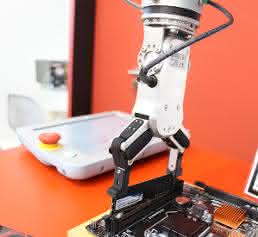
As the possible application scenarios are quite diverse, a wide range of functional end effectors is required. The US start-up Perception Robotics offers solutions for handling very sensitive surfaces. To this end, the company has designed grippers whose adhesive system is sometimes modeled on gecko feet. Flat objects or those with porous surfaces are particularly easy to handle.
It is applications such as those from Onrobot, Perception Robotics and Optoforce that make collaborative robots a real relief in networked manufacturing processes. While the robot arm itself is initially just a blunt tool, grippers and sensors expand it into a functional and individually tailored automation solution: every robot is a complete installation. Broadening the perspective accordingly will be the task of the production of the future. Enrico Krog Iversen/as
Hall B4, Stand 508


You might also be interested in
Hamburg Regional Court issues preliminary injunction against Elite Robots Germany
In the copyright dispute between Teradyne Robotics and Elite Robots Germany, the Hamburg Regional Court has issued an interim injunction. The distribution of the software and products concerned is prohibited, and there is also a comprehensive...
 read more...
Schunk founds tech spin-off for humanoid robot hands
Schunk is bundling its activities in humanoid robotics by founding its own spin-off at the beginning of January. The aim of the new company is to develop modular humanoid robot hands for industrial applications.
read more...Partnership for humanoid robotics
Schaeffler and Neura Robotics jointly develop humanoids
Schaeffler and Neura Robotics will work together in the future to develop and supply key components for humanoid robots. The systems will also be integrated into Schaeffler's global production network.
read more...Yaskawa at the Automatica 2025
AI meets robotics
At this year's Automatica, everything at Yaskawa revolves around AI-based robotics solutions for the smart factory and beyond. As a trade fair highlight, the manufacturer is presenting its new Motoman Next product concept.
read more...Kassow Robots at the Automatica
7-axle vehicle in action
At Automatica, Kassow Robots will be presenting a wide range of industrial applications for production and logistics tasks that provide new impetus for efficiency and flexibility in industrial automation.
read more...Robotics and automation in six exhibition halls
From June 24 to 27, 2025, Automatica, the trade fair for intelligent automation and robotics, will bring industry and research together in six exhibition halls. Preparations are in full swing.
read more...Interview with Jörg Rommelfanger
Robotics in 25 years
The annual IFR report shows that the number of industrial robots is steadily increasing worldwide. They have already played an important role in ABB's portfolio for decades. In an interview with INDUSTRIAL Production, Jörg Rommelfanger, Head of...
read more...Reliable end effector for cobots
Collaborative robots are now widely used for a wide range of handling tasks. SMC offers three versions of the RMH pneumatic gripper for this purpose; it is compatible with cobots from a total of twelve companies.
read more...7-axis cobots with controller in robot base
With the Edge Edition, Kassow Robots has launched the world's first 7-axis cobots with a controller integrated into the robot base.
read more...