

Automatica sprint 2021
ABB presents solutions for flexible production
At this year's Automatica sprint, which will take place completely virtually from 22 to 24 June 2021, ABB will present a wide range of robotics and digitalization solutions that help companies to drive automation forward, make their production even more flexible and thus react more quickly to trends.
"The past few months, which have been dominated by the pandemic, have made it abundantly clear how important it is for companies to be able to produce individually and flexibly. Robotics and automation continue to gain momentum in this regard. Small and medium-sized companies in particular, as well as companies in the healthcare, consumer goods, logistics and food and beverage industries, are increasingly exploiting the potential of robot-supported automation," emphasizes Jörg Reger, Head of ABB's Robotics and Factory Automation business unit in Germany. "With our new generation of collaborative robots, which are easy to install and operate, we are paving the way for them into robotics. At the same time, our digital solutions ensure greater transparency and productivity."
ABB has the most versatile cobot portfolio on the market with its GoFa and Swifti collaborative robots (cobots) and the YuMi family. All cobots offer various payload and reach options for a wide range of tasks: from machine tending and assembly to testing and packaging in production plants, laboratories, logistics centers, workshops and small production facilities. Thanks to state-of-the-art safety systems, they enable the most diverse types of human-robot collaboration, are intuitive to operate and are ready for use within a very short time after installation - without the need for special training. This means that even industries that currently still have a low level of automation can benefit fully from robot-based processes.
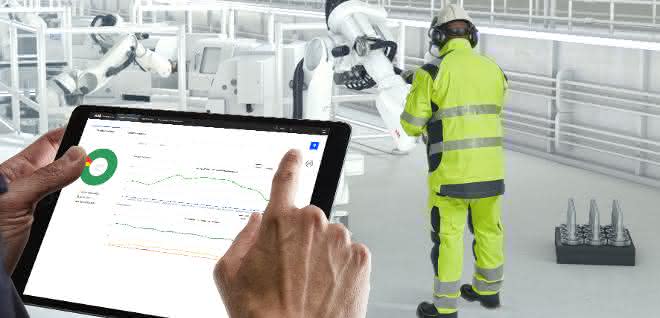
To further simplify the use of robots for users, ABB also offers a comprehensive range of digital tools and services, which can also be seen at the virtual automatica sprint. One core element is the offline programming tool RobotStudio. This allows a complete robot system to be created, simulated and tested in a virtual 3D environment without having to interrupt the actual production line. This shortens the project time and helps to optimize the cell design before building the physical counterpart. Most recently, a new function for calculating robot braking distances with millimeter precision was added to RobotStudio in February. This innovation not only increases operating safety even further, but also enables space savings of up to 25 percent when designing robot cells.
Another key element of the ABB RobotStudio software is the AR (augmented reality) viewer, which can be used to test any cell model for the desired application. Users get a visual impression of the size and scale of a robot or robot cell and quickly recognize whether and how they fit into an existing production system. Using a smartphone or tablet, the model can be embedded in the real production environment, scaled and viewed from different angles.
The third generation of ABB's market-leading PickMaster software will also be presented, specifically for camera-supported picking and packaging applications. Based on the principle of the digital twin, which forms the basis of the software, commissioning and changeover times for systems can be reduced to a fraction, thus significantly increasing the overall efficiency of a system.
In addition, ABB's new Condition-Based Maintenance (CBM) service offers robot users the ability to create a preventive maintenance plan for individual robots or robot fleets based on real-time operational data to increase productivity and minimize downtime. This allows users to better plan their budgets and ensure that resources are available to carry out any work that may be required.
"Customer needs are becoming increasingly individualized, the shortage of skilled workers continues, digitalization is advancing in leaps and bounds and even after the coronavirus pandemic, there is still a great deal of uncertainty in the market. With a triad of collaborative robots, intelligent and powerful software solutions and an international support network, we offer companies the foundation on which they can optimally implement their individual automation scenarios," summarizes Jörg Reger.


You might also be interested in
Fraunhofer IOSB Opens Humanoid Robots Lab
The Fraunhofer IOSB is opening a Humanoid Robots Experience Lab in Karlsruhe, Lemgo, and Ilmenau. Companies and organizations can use these facilities to test potential applications for humanoid robots and develop pilot projects.
 read more...
Artificial Intelligence in Manufacturing
Trumpf and IPAI Are Expanding a European AI Network for Industry
The high-tech company Trumpf is an official partner of the IPAI AI network in Heilbronn. Together, the partners aim to exchange experiences, develop new AI applications for industrial use, and advance the development of artificial intelligence in...
read more...Case Study: Networked Manufacturing Platform for Toolmaking
Using a networked manufacturing platform, Escha GmbH & Co. KG, a manufacturer of industrial fastening technology, has comprehensively modernized its toolmaking operations.
read more...Barcelona Declaration on Robotics and...
Robotics Associations Adopt Global Automation Strategy
The global robotics industry is stepping up its collaboration. The associations AER Automation, A3, IFR, and VDMA Robotics + Automation have formed a long-term alliance by signing the “Barcelona Declaration on Robotics and Automation 2026.” The...
read more...Jane Heffner is the new president of the International Federation of Robotics
Jane Heffner is the new president of the International Federation of Robotics. Adrien Brouillard has been appointed vice president of the global federation.
read more...Greater Transparency in the Robotics Market
RoboFinder Launches as an Independent Comparison Platform
Launch at Gitex Europe: 'RoboFinder' aims to bring more transparency to the professional service robotics market. In this interview, founder and CEO Brian Engels discusses market potential, challenges, and the goals of the new platform.
read more...Artificial Intelligence for the Physical Space
Alibaba Expands Qwen Model Family with a Robotics Suite for Physical AI
Alibaba is expanding its Qwen model family with a robotics suite for Physical AI. The three models—for manipulation, navigation, and simulation—are designed to assist autonomous robots with complex tasks in real-world environments.
read more...International Federation of Robotics
U.S. Robotics Industry Sees Double-Digit Growth
In the U.S., sales of industrial robots rose by 11% compared to the previous year: 38,000 units were newly installed in 2025. This significant recovery is driven by robust growth in the food industry and other non-manufacturing sectors. However, the...
read more...Development Collaboration for Humanoid Robotic Hands Launched
Schunk is entering into a new development partnership with Robert Bosch Robotics. Their shared goal is to develop an industrial-grade robotic hand that can be integrated into various humanoid robot systems.
read more...