
ABB and Economist
Ranking: Who is ready for automation and AI?
Modern automation can create better, more demanding jobs for people. However, in order to be better prepared for the jobs of tomorrow, even well-equipped countries need to rethink their education and training concepts, according to a study.
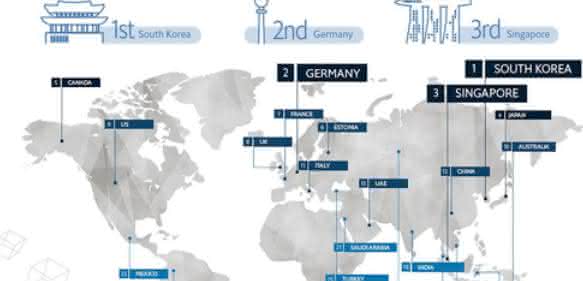
South Korea, Germany and Singapore lead the world in preparing their economies for the smooth integration of smart automation. This is shown in a report published by ABB and the Intelligence Unit of The Economist magazine entitled "The Automation Readiness Index (ARI): Who Is Ready for the Coming Wave of Innovation?"
However, according to the first-ever report, even the best-prepared countries need to develop more effective education policies and training programs and focus more on continuous education. This, the authors recommend, should ensure that people are better prepared for new, human-centered jobs that will emerge as routine tasks are increasingly automated and taken over by robots and algorithms in the face of the rapidly advancing use of automation technologies and artificial intelligence (AI).
"The report clearly shows the pattern of success for the future. We must use these recommendations to our advantage," emphasized Ulrich Spiesshofer, CEO of ABB. "The pace of innovation is so high and the world of work is changing so fast that everyone needs to have access to lifelong learning today. Supporting human potential in a responsible way through technology, while providing education and training, is an opportunity for prosperity and growth."
Closer cooperation between government, industry and education experts
The report, which examined and assessed the automation status of 25 countries, concludes that a number of nations are still in the early stages of addressing the opportunities and challenges created by artificial intelligence and robotic automation. "If policymakers are to keep pace with automation," it says, "government, industry, educators and other stakeholders need to work more closely together."
The use of artificial intelligence and advanced robotics is progressing rapidly in companies - regardless of whether politicians are ready or not. The faster this development continues in the coming years, the clearer the impact on the economy and the world of work will become and the more urgent the need to implement concerted education and training concepts will become.
According to the ARI, in addition to the top trio of South Korea, Germany and Singapore, Japan, Canada, Estonia, France, the United Kingdom, the United States and Australia are among the top ten countries best equipped for this revolution.
The analysis is based on a new index developed by The Economist's Intelligence Unit and a series of in-depth interviews with experts from around the world. The assessment is based on a total of 52 qualitative and quantitative indicators, selected in consultation with automation experts and figures from the worlds of education and business.
With the collaborative robot Yumiand ABB Ability, the cross-industry portfolio of digital solutions for monitoring and controlling automation systems, ABB is helping manufacturers to further develop the factory of the future, in which humans will remain a central element and work side by side with robots.
People in the factory of the future
This new model of human-machine collaboration has the potential to free the workforce of the future from monotonous, physically demanding or dangerous tasks. Instead, they will invest their time and energy in higher-value tasks, using human skills and dexterity to develop the tasks and processes to be carried out by robots, for example, or to monitor and supervise the automated work carried out by machines.
Ideally, a successful transition to a manufacturing industry based on smart automation will offer human talent the opportunity for higher levels of productivity and ultimately more challenging employment.
However, for this brighter future to become a reality, the report says, most countries need to improve their vocational training programs. Science, technology, engineering and mathematics will remain important fields of study, the report states. However, automation and artificial intelligence applications urgently require further basic education programs and a rethink in teacher training.
ABB and The Economist's Intelligence Unit plan to update the ARI annually and adjust the ranking if necessary. The aim is for the index to become a tool that governments can use to define and continuously adapt their strategies for successful participation in a highly automated, highly digitalized global economy.
ABB itself is already preparing for the future by creating digital workplace environments and training employees in digital automation tools. ABB is also promoting innovation in the company's own research centers as well as with numerous cooperation partnerships with start-ups made possible by the venture capital company ABB Technology Ventures (ATV). as


You might also be interested in
German industry under pressure
Industry association cancels growth forecast
The Federation of German Industries (BDI) believes that German industry remains under pressure and expects stagnation instead of growth. At the same time, the association is emphasizing the industry's innovative strength at the Hannover Messe.
 read more...
Why eleven federal states are calling for the use of low-emission steel in the automotive industry
Heads of federal states put pressure on Brussels: Eleven German federal states appeal to the EU to promote low-emission steel in the automotive industry more strongly. The German Steel Federation supports the initiative as an important lever for...
read more...Setting the course for Germany's technological future
The Federal Cabinet adopted the microelectronics strategy today. Germany wants to become a leader in microelectronics. The Federal Government's new strategy: bundling topics such as research, skilled workers and production in order to strengthen...
read more...European elections FSK 16
Good news: over the past 20 years, voter turnout in European elections in Germany has risen continuously - from 43.0% to just under 64.8% recently. I like the idea of allowing young people aged 16 and over to participate in politics in the form of...
read more...Democracy project
Many people are taking to the streets these days because they are fed up with right-wing hatred and populism. Industry is also aware of its social responsibility. "Transformation as the project of the century" is the title of a paper published...
read more...Artificial intelligence in Germany
Microsoft invests 3.2 billion euros in AI infrastructure
Microsoft has announced the largest investment in its 40-year history in Germany to accelerate the possibilities and benefits of artificial intelligence (AI) in the country.
read more...Plagiarius 2024 negative prize
On January 26, 2024, the Plagiarius campaign awarded its dreaded "Plagiarius" negative prize for the 48th time to manufacturers and retailers of particularly brazen counterfeits and fakes.
read more...100 years of Conrad Electronic
One hundred years of change
Conrad Electronic celebrated its centenary on June 21, 2023 with a gigantic event in the spirit of change. 400 high-ranking guests from business and politics as well as long-time Conrad companions were invited to the logistics center in...
read more...Loss of competitiveness?
The major associations BDI, VDMA and ZVEI are calling for more efforts to ensure that Germany remains competitive on an international level.
read more...