
Interview with Helmut Schmid
Catch the worm early
Helmut Schmid has developed Universal Robots from start-up to market leader. He now offers consulting for start-ups with HS Auxsilium. In this interview, Schmid talks about the challenges faced by start-ups, digitalization as a potential winner of the crisis and the potential of automation in assembly.
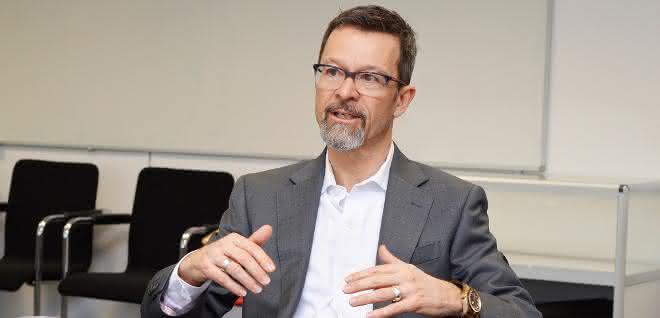
Mr Schmid, you founded a new company during the coronavirus crisis - a bold move, what prompted you to do so?
A crisis always offers opportunities and possibilities, even if it has to be said that this may not be the best time to start a new company. But right now, many companies and start-ups in particular are at a crossroads. What next? And this is exactly where I want to start.
HS Auxsilium offers management consulting for start-ups, what exactly can we expect from this?
With Universal Robots, I have developed a start-up into a market and industry leader. I will contribute this experience of starting and developing a business with a good go-to-market strategy, finding new partners, evaluating sales channels, initiating new marketing tools and, above all, using my network to open doors for many great ideas, applications and solutions, and offer them to companies.
"The area of assembly offers the greatest opportunities for progress."
In this issue of INDUSTRIAL Production, we are particularly interested in assembly. Where does Germany currently stand technologically in this area?
Assembly is generally a very difficult field, as it often involves complex activities that are difficult to automate, as well as many monotonous tasks. Outsourcing to low-cost countries was and still is one of the first solutions. This is why Germany is still at the beginning in terms of technology, with a lot of upside potential.
What defines progress in the field of assembly: fully networked automation? More intelligent human-machine collaboration?
The area of assembly offers the greatest opportunities for progress, as only around ten percent of activities can really be fully automated, we are still struggling with a shortage of skilled workers and the focus is on increasing productivity. In assembly in particular, the focus will be on more intelligent human-machine collaboration in order to combine the best characteristics and skills of man and machine.
What are the trends in assembly with cobots and what should founders bear in mind?
Even if the use of cobots is now straightforward, the devil is usually in the detail. Founders and automation beginners should start with simple, repetitive tasks in order to keep the overall costs for risk assessment, application and use, but also for possible changes, as low as possible. Amortization costs and investment are and remain the main driver and decision maker for automation, especially for SMEs.
Which technologies are currently being implemented in companies?
As costs are the main decision-maker in the area of assembly, low-cost automation with robots, the use of linear axes and the modular assembly of components are the trend. I see enormous potential for the future here in particular, and many start-up companies are working on this to offer the best possible and most cost-effective solutions for assembly activities in Germany. This underpins re-shoring and location security in Germany and significantly strengthens the German labor market for the future.
Are therecertain industry segments that are making a technological leap forward in the assembly sector in particular?
I think all industry segments in the assembly sector can benefit here. However, due to corona, the sectors that are doing well, such as logistics, pharmaceuticals and medical technology, will be the first to make a leap forward, especially as these are also the sectors that have tended to neglect automation to date and now have to increase production capacities and productivity, in some cases enormously.
In the public debate, the coronavirus pandemic is often seen as a driver of digitalization and networking. How do you see this from your experience?
Even if many negative headlines such as job losses are filling the newspapers at the moment, much of this is homemade and not necessarily due to the coronavirus pandemic. I also assume that digitalization/automation and robotics will be potential winners after the crisis. The partners have already received many inquiries on this topic, now they just need to overcome the not-so-small hurdle of investment, because the early bird catches the worm. Those who invest now will be among the winners tomorrow.


You might also be interested in
Hamburg Regional Court issues preliminary injunction against Elite Robots Germany
In the copyright dispute between Teradyne Robotics and Elite Robots Germany, the Hamburg Regional Court has issued an interim injunction. The distribution of the software and products concerned is prohibited, and there is also a comprehensive...
 read more...
Schunk founds tech spin-off for humanoid robot hands
Schunk is bundling its activities in humanoid robotics by founding its own spin-off at the beginning of January. The aim of the new company is to develop modular humanoid robot hands for industrial applications.
read more...Partnership for humanoid robotics
Schaeffler and Neura Robotics jointly develop humanoids
Schaeffler and Neura Robotics will work together in the future to develop and supply key components for humanoid robots. The systems will also be integrated into Schaeffler's global production network.
read more...Yaskawa at the Automatica 2025
AI meets robotics
At this year's Automatica, everything at Yaskawa revolves around AI-based robotics solutions for the smart factory and beyond. As a trade fair highlight, the manufacturer is presenting its new Motoman Next product concept.
read more...Kassow Robots at the Automatica
7-axle vehicle in action
At Automatica, Kassow Robots will be presenting a wide range of industrial applications for production and logistics tasks that provide new impetus for efficiency and flexibility in industrial automation.
read more...Robotics and automation in six exhibition halls
From June 24 to 27, 2025, Automatica, the trade fair for intelligent automation and robotics, will bring industry and research together in six exhibition halls. Preparations are in full swing.
read more...Interview with Jörg Rommelfanger
Robotics in 25 years
The annual IFR report shows that the number of industrial robots is steadily increasing worldwide. They have already played an important role in ABB's portfolio for decades. In an interview with INDUSTRIAL Production, Jörg Rommelfanger, Head of...
read more...Reliable end effector for cobots
Collaborative robots are now widely used for a wide range of handling tasks. SMC offers three versions of the RMH pneumatic gripper for this purpose; it is compatible with cobots from a total of twelve companies.
read more...7-axis cobots with controller in robot base
With the Edge Edition, Kassow Robots has launched the world's first 7-axis cobots with a controller integrated into the robot base.
read more...