
Machine tool industry in Q2/2020
Incoming orders remain weak
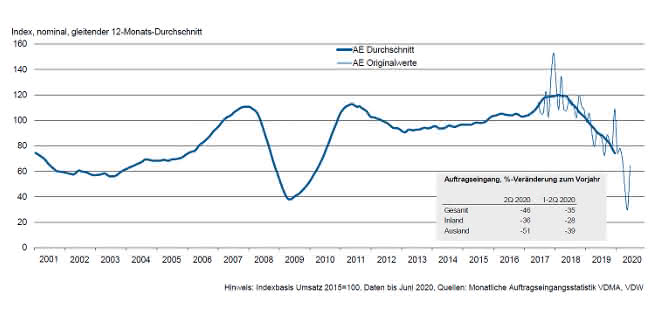
The coronavirus pandemic continues to dominate the mood in the machine tool industry. In the second quarter of 2020, incoming orders in the German machine tool industry fell by 46% compared to the same period last year.

Domestic orders fell by 36% and foreign orders by 51%. Orders fell by 35% in the first half of 2020. Domestic orders were 28% lower than in the previous year, while orders from abroad were down 39%.
"The figures for the second quarter clearly show the impact of the coronavirus lockdown," says Dr. Wilfried Schäfer, Executive Director of the German Machine Tool Builders' Association (VDW ), commenting on the results. Many customer industries, in particular the aviation and automotive industries, are experiencing a sharp drop in sales. Short-time working, temporary production closures and liquidity bottlenecks are the result. Global investment activity almost came to a standstill during the hard lockdown. However, it is encouraging that incoming orders appear to have bottomed out at the current level. In June, it increased noticeably compared to the previous two months.
More positive signals are also coming from the two leading indicators PMI (Purchase Managers Index) and Ifo Business Climate. For the first time, the global PMI scratched the 50-point mark, which stands for growth, again in July. The increase came as something of a surprise and was broad-based, both in China and the USA as well as in the eurozone, e.g. in Germany, France and Italy. According to Ifo, expectations for the capital goods industry in Germany have improved. Retail sales are recovering, and industrial production and exports recently increased again in June. According to Schäfer, this could herald the hoped-for slight recovery in the second half of the year.
However, experience shows that it will take even longer for this to reach the machine tool industry, a late-cycle sector as a manufacturer of capital goods. Accordingly, the industry's expectations for the next six months remain subdued. The sales trend underlines this attitude. In the first half of the year, turnover was 26% down on the previous year.
Companies that supply medical technology, electronics, driven by digitalization and 5G expansion, as well as parts of the mechanical engineering sector are in a slightly better position. "However, there is still a great deal of uncertainty in all sectors with regard to the risks of a second wave of infection, so it is difficult to make reliable statements about the timing of a stabilization of international investment activity," says Schäfer. Companies are now doing everything they can to get through the crisis, pushing ahead with their developments and trying to retain at least their core workforce with the help of short-time working. The number of employees in May of this year was 3.7 percent down on the previous year.


You might also be interested in
Spectra Launches 5G RedCap Router for Industrial IoT Applications
With its new 5G RedCap routers, Spectra is expanding its portfolio to include a mobile communication technology for industrial applications designed to bridge the gap between traditional 5G and established IoT standards such as LTE-M and NB-IoT.
 read more...
5G in the industrial IoT
The Chair of Production Systems at Ruhr-Universität Bochum LPS is researching industrial applications with a local 5G network in the context of Industry 4.0.
read more...Implement milling tasks economically
Milling covers a wide range of applications - from the machining of large free-form surfaces in the aviation industry and in the manufacture of wind turbines to the milling of cavities and highly automated mass production.
read more...Mitsubishi Electric invests in the future
Further production building in Owariasahi City
Due to the growing importance of the Japanese region of Owarisahi in Aichi, Mitsubishi Electric Corporation is increasing its planned investments and announcing the construction of a second production building.
read more...Industrial Connectivity Lab opens
Siemens customers test wireless technologies
Siemens has opened a new test lab for industrial connectivity technologies at its Erlangen site. Embedded in the Siemens Technology Center on the Erlangen campus, the Industrial Connectivity Lab offers 300 square meters of space for testing...
read more...A sustainable foundation for the industry
The networks are growing together - this refers to the ongoing merging of IT and OT. Christian Korff, Managing Director Global Accounts and Member of the Management Board, Cisco Germany, explains the challenges and levers involved.
read more...It started with a timer for X-ray machines
In 2023, the automation expert Omron can look back on 90 years of innovative company history, in which many technological boundaries have been crossed and milestones set.
read more...Flexible component transport in production
Stein Automation presents the Stein 400 workpiece carrier system for parts weighing up to 80 kilograms and the C5G logistics control system.
read more...Extended image processing options
High-performance multispectral line scan camera with 5GigE
The new Linea2 4k Multispectral 5GigE camera takes machine vision systems to the next level with its performance and value, offering a 5GigE interface with five times the bandwidth of the Linea GigE camera.
read more...