
OPC UA-based interface
Umati - Standard interface for machine tools
In the mechanical sector, standards and their benefits are undisputed. In the course of Industry 4.0, experts have also long been discussing standardized interfaces to network products with one another. Standards can be found at individual levels of modern production - be it in the machines with controls and sensors or at company level in production planning. Over the last few years, the technical foundations have been partially consolidated; further standardization is foreseeable. OPC UA has become widely established, not least due to its inclusion in the framework architecture for Industry 4.0 (RAMI4.0) [1].
The OPC UA standard [2] is characterized by two core areas: the modelling of information and its transport. OPC UA provides extensive mechanisms for both. In addition, OPC UA offers a companion specification that allows extensions to be defined for definable domains, for example specific industries or product groups. There are currently numerous working groups developing such specifications under the umbrella of both the VDMA and the OPC Foundation. One of these is the Umati working group [3], in which leading machine tool manufacturers are working on a globally standardized interface for connecting the industry's products to surrounding systems (MES, ERP, cloud, etc.).
Umati - a standard with added value
Umati consistently relies on the use of OPC UA, but goes one step further: Umati defines so-called profiles in the accompanying specification. These specify which requirements must be met with regard to encryption, authentication and server performance as well as for certain expansion stages of the interface. The Umati accompanying specification is to be supplemented by a combination of software components as the basis for implementation.
The Umati brand logo is intended to visibly identify products with the machine tool interface.
Umati began as a project within the VDW; Umati is now backed by a broad international community of machine tool manufacturers of various technologies who are committed to the standard and are currently specifying it in a so-called Joint Working Group with the OPC Foundation [4]. Control manufacturers, software companies and end users are also part of the standardization committee, so that all perspectives are represented. Last but not least, the VDW is closely networked in its standardization activities with VDMA specialist groups, which are also currently developing OPC UA accompanying specifications. Other international associations and, above all, many international partners support the activities and the emerging standard.
Umati at the EMO Hannover 2019
At EMO Hannover 2019, more than 50 companies will be participating in a joint interface demonstrator as part of a showcase. This will illustrate the benefits of the common standard. In addition to machine tool manufacturers, control manufacturers and providers of dashboards and cloud solutions are also taking part. The EMO showcase will use a simplified model to demonstrate how Umati, as a common, fully defined and easy-to-use interface on machine tools, simplifies the step towards digitalization and Industry 4.0 for all users.
With Umati, machine tools can be connected to on-premise or cloud installations of production software regardless of the manufacturer and with different control systems. Users save time-consuming development of interfaces and can adapt their applications directly. Development costs for the exchange of information between machine tools and applications can be significantly reduced.
Application examples of the interface
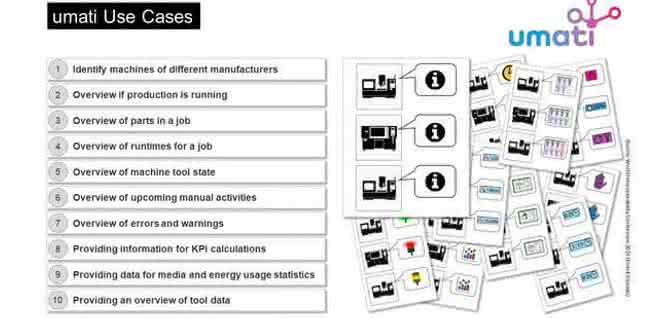
The Umati interface is intended to provide the machine tool with structured information and parameters. To this end, jointly agreed use cases and required parameters were derived on the basis of basic use cases for the interface. The first version of Umati is intended to cover ten of these use cases; the interface of the EMO showcase shows a selection of these as an example (image).
An Umati user can use the OPC UA interface to call up the identification of the machine, its status and its current production order and use this information to determine whether the machine is working productively, for example. With the help of the standardized interface, machines can be connected to applications such as MES systems and evaluated uniformly, regardless of the manufacturer and their control system. This is the basis for many of the use cases that make up Industry 4.0.
The goals for Umati have been set and the broad international support shows that a universal interface for machine tools is useful and necessary. The first results are expected in 2020. Umati is to be expanded by various versions in the following years.
The authors:
Andreas Wohlfeld, Trumpf Machine Tools; Caren Dripke, Institute for Control Engineering of Machine Tools and Production Equipment, University of Stuttgart; Götz Görisch, German Machine Tool Builders' Association VDW / ag
Literature:
[1] RAMI4.0; bit.ly/2yy8OEW
[2] IEC 62541. VDE, http://www.vde-verlag.de


You might also be interested in
ESTIA aims to strengthen Europe's cloud
New tech alliance for EU sovereignty
Twelve companies, including Dassault Systèmes, are founding the European Sovereign Tech Industry Alliance (ESTIA). The initiative aims to strengthen Europe's technological independence and define requirements for sovereign cloud services. The start...
 read more...
Deutsche Telekom and Nvidia launch one of Europe's largest AI factories
With the Industrial AI Cloud in Munich, Deutsche Telekom and NVIDIA are creating one of the largest AI factories in Europe. Companies can train AI models, carry out simulations and access 10,000 GPUs.
read more...Leveraging data potential with AI and streaming
Huge data treasures are still lying dormant in many manufacturing companies. And yet it is high time that these treasures were unlocked. There is often a lack of resources and capacity to make data usable in real time. Streaming production data can...
read more...More awareness of noise
Dematic offers solutions that are tailored to different cloud environments and reduce environmental impact through reduced material consumption and improved energy efficiency.
read more...Generative AI in the automation environment
The mechanical engineering and automation industry is undergoing profound change. This transformation is being driven by more volatile global trade, geopolitical crises and increasing market pressure, which demands greater agility, technological...
read more...Rigid data structures have had their day
The traditional data center is no longer the center of data. A hybrid cloud storage approach enables manufacturing companies to both meet the current requirements of data-intensive processes and future-proof their infrastructure.
read more...Software as a service in three stages
CIM Database Cloud is a new out-of-the-box solution from Contact for end-to-end digital product development.
read more...How production can benefit from AI
Together with AI technology, IIoT networking makes it possible to better control machine parameters and optimize quality with predictive quality. Downtimes and set-up times can also be further minimized. Cloud platforms also make these technologies...
read more...More expertise for digital engineering
Altair, a computational science and artificial intelligence (AI) company, has acquired OmniV, a technology from Michigan, USA-based software company XLDyn.
read more...