

Diamond mounted points
Tools for machining gray and ductile cast iron
There are established solutions for machining gray and ductile cast iron - diamond mounted points increasingly represent functional and economical alternatives, also in automated applications.
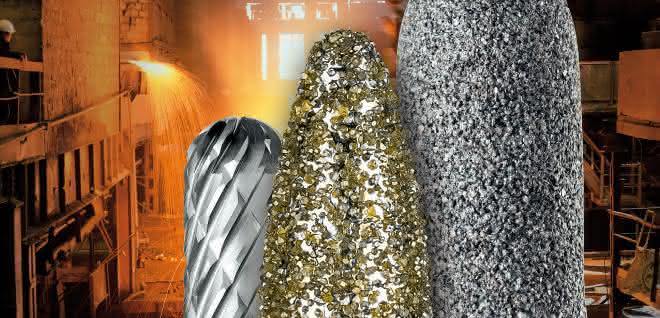
Grinding, levelling or deburring grey and nodular cast iron workpieces (GG, GGG, GJL and GJS) is one of the most common machining tasks in casting finishing. Very different tools are suitable for these tasks. In addition to the classic applications for angle grinders, mounted points, burrs and, increasingly, diamond mounted points are used to machine hard-to-reach areas. But which mounted points are suitable for what?
"When we talk about machining grey and nodular cast iron, i.e. cast iron made from an iron-carbon alloy with a relatively high proportion of carbon in the form of lamellar or spheroidal graphite, then all three types have their raison d'être," explains Jonas Lichtinghagen, Product Manager for grinding tools at the Marienheide-based manufacturer Pferd. "The primary deciding factors are the machining task, the original condition of the workpiece and the machining objective." However, parameters such as ergonomics and suitability for automation are now also criteria for tool selection: "The requirements have increased in recent years, particularly with regard to the legal regulations in the field of work ergonomics," the Pferd product manager points out the complex situation in many areas of the manufacturing industry, "especially in foundries."
Classic mounted points always work
The processing of cast workpieces with classic mounted points is historically established. "Tools of this type have been known since the 1930s and are available in a wide range of dimensions, grit types and bonds. There are numerous solutions for machining castings in particular, such as the CAST lines from Pferd." The material removal with classic mounted points is satisfactory and the achievable surface - depending on the grit size - is quite fine. "The service life of classic mounted points is also long in critical processing areas, such as mineralization or sand inclusions," adds Lichtinghagen. These tools are always a good solution for manual use when they need to be dressed to special geometries.
Automated operations on the rise
"When it comes to automated inserts, which we are increasingly encountering at our customers' foundries, mounted points have a hard time due to their change in geometry during use. Burrs and diamond mounted points offer clear advantages here, as they do not lose diameter." The company recommends carbide burrs, especially when very high stock removal rates are required with lower surface quality requirements: "Also because users really appreciate the extremely low dust exposure during machining." Diamond mounted points are an excellent and increasingly popular alternative to mounted points and carbide burrs, explains the grinding professional: "The stock removal rate of diamond mounted points is high and the surfaces are fine." Grinding is fast and highly aggressive. The main advantage is that mineralization and sand inclusions cannot harm the diamond tools. In addition, the dust load is low, which favors ergonomic use. "And thanks to their dimensional stability and very long service life, diamond mounted points can be excellently integrated into automated processes."
The fettling process is changing
Overall, customers are increasingly using these tools in traditional fettling processes, says Lichtinghagen. "We have responded to this development and have recently almost doubled the range of diamond mounted points so that Pferd can now supply all important shapes and dimensions." On-site advice from the application engineers quickly leads to sustainable results, says the product manager, referring to the process expertise of his colleagues: "We very quickly realize productivity reserves and create ergonomically and economically optimized solutions."


You might also be interested in
Simply in good hands
The organization of workwear for the team usually also includes lockers, waste bins and, above all, locker systems. DBL offers solutions here. A look into practice.
 read more...
Logimat 2025: Gripping and lifting
Even more ergonomics in intralogistics
At vacuum expert Schmalz, trade fair visitors can experience grippers and lifting aids for picking and moving various goods and components.
read more...Relief for the back
More and more companies are realizing this: Exoskeletons make jobs more attractive and help to attract and retain skilled workers.
read more...Exoskeletons in industrial workplaces
To what extent can exoskeletons relieve employees and which exoskeletons are suitable for what? These questions are answered by a working group at the University of Innsbruck.
read more...Working more easily with the S700 exoskeleton
More strength, less load. With the S700 active shoulder exoskeleton, activities above the head and at chest height are demonstrably and noticeably easier. The exoskeleton can also be individually adapted to the user. The S700 offers prevention...
read more...Welding solutions in the name of resource efficiency
At the Welding & Cutting trade fair in Essen (September 11-15), Fronius will be focusing on the major drivers in welding technology. Quality requirements are increasing in all industries, but the required welding specialists are scarce. In...
read more...E-scooter with customizable damping
The startup Scuddy has significantly improved the flexibility, performance, customizability and ergonomics of its second-generation foldable e-scooter of the same name - thanks in part to damping technology from ACE.
read more...The active shoulder exoskeleton S700 from exoIQ
The advantage of an active exoskeleton is obvious. Like passive systems, they transfer the load from weaker to stronger parts of the body. Following intensive biomechanical analyses, the Hamburg-based company exoIQ has developed an active...
read more...Digital assembly processes to combat the shortage of skilled workers
The increasing shortage of skilled workers is putting even well-established companies in manual assembly under pressure. According to the "DIHK Skilled Workers 2022 Report", 58% of industrial companies were unable to fill vacancies in the long term....
read more...