

Precision tools in digital production
Tool data ensures transparent production
Precision tools play a key role in digital production. Precise integration into production processes and the targeted processing of tool data are the basis for future-proof Industry 4.0 solutions.
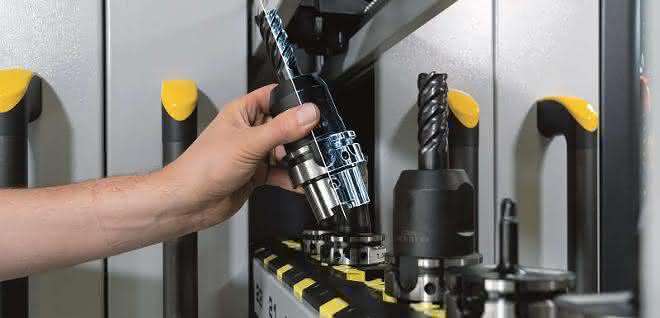
The digitalization of production processes plays an important role for any company that wants to operate successfully on the market. In machining, the tool is an essential part of the process chain and must fit into the digital production environment. "This includes the consistent implementation of all digital options - from the tool itself to the tool holder, including the clamping process and balancing, through to tool presetting and use on the machine," says Andreas Haimer, Managing Director of Haimer, summarizing the spectrum. An important approach in this context is the digital service offered by tool manufacturers for their customers, for example, that all tool data can be accessed online. According to Haimer, a tool management solution that enables a digital workflow for tool data is also crucial. This means that the software must be able to integrate the entire tool environment - shrinking, balancing, presetting - into the digital process and make it automatable.
Location-independent data exchange
Digitalization is changing the entire production process. With the help of stored tool data, the entire production process can be simulated and optimized in advance. Storage systems are also often connected and the whereabouts of each individual tool can be tracked. "The bottom line is that digitalization in production saves companies time, money and resources," says Bernd Schwennig, Technical Sales Manager at E. Zoller in Pleidelsheim, a member of the GTDE association (Graphical Tool Data Exchange - Standard Open Base), which has taken on the topic of tool data exchange under the umbrella of VDMA Precision Tools.
The basis for every automation process is always the tool data, which now includes much more than just geometry data. In addition to machine-specific data, it also includes, for example, the available remaining tool life or the storage location or magazine location on the machine. "This data is, of course, available worldwide if the company so wishes," Schwennig continues. It can also be assumed that data within a company will increasingly be exchanged across location boundaries. "The fact that an order is triggered with a tool supplier when a minimum stock level is not reached in a production plant is certainly only a small aspect of this, but it is already being used today. Overall, the entire exchange is becoming much more open. Of course, this brings with it completely different challenges," he adds in conclusion.
Optimize tool supply to the machine
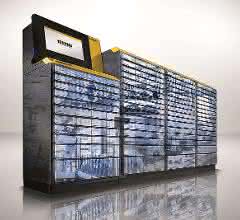
"Even in digital production, the actual machining process is still significantly influenced by the tool in terms of component quality and cost-effectiveness. The tool therefore remains a decisive success factor in machining production," adds Dr. Steffen Lang, Head of the Service Division at Gühring in Albstadt. The digital integration of cutting machines makes it possible to record the performance and current condition of the tool used in the machine much more accurately than before. With the resulting transparency, the entire logistics for tool supply to the machine can be optimized. Lang summarizes the scope of automated tool provision: "It starts with the presetting of the tools actually required on the machines, which are assembled and set in the optimum sequence. It continues with the monitoring of stock consumption and the recording of tool life changes and their direct consideration in further tool scheduling. And finally, the consumption and performance data is forwarded to the suppliers in order to optimize tool performance and supply."
In this context, Gühring offers a machine connection with which the machine status and technological process parameters such as spindle power and torque as well as feed axis forces can be recorded. In addition, the machine data can be recorded directly in production and the machining process can be optimized immediately on this basis.
Digitalization in the tool environment
In order to further advance digitalization, the company has also developed its own tool management software for its products, which carries out and organizes the exchange of target and actual values as well as other tool data between the individual stations in the tool room and the company network. The Haimer devices from the Industry 4.0 series can also be automated using modern digital features and interfaces.
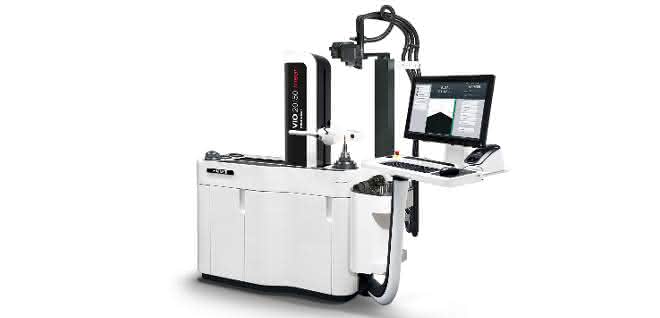
For Zoller, the focus is on holistic tool data handling. The company's presetting and measuring machines determine the necessary tool geometry data and prepare it so that the machine tool can read it in. "Even at this stage of data transfer, we offer a wide range of solutions for every size of business. The data can be entered manually or transferred via a network or RFID chip," reports Bernd Schwennig. In addition to the organization of tool storage, tool management also includes evaluation options, such as tool life or costs for tool use, broken down to a specific order or even a specific component. "Our aim is always to generate maximum transparency throughout the entire tool management system and thus to optimize production processes and make them faster and more economical," says Schwennig.
Utilizing potential
However, users must also address the issue of digitalization. Particularly when making new investments, companies should ensure that every element in the tool environment is Industry 4.0-capable and can be integrated into the digital workflow. "A tool should be able to be clearly identified with RFID data chips or via QR or Data Matrix codes, for example, and provide further tool data such as article numbers or 3D models via this identification," says Andreas Haimer, naming specific key data. Schwenning adds: "The most important thing for optimal tool use is well-maintained tool data. Without tool data, the entire process is inconceivable: neither digitally supported warehousing nor the retrieval of measuring programs and the reading of tool data into the machine." Of course, this first step is tedious hard work, but it provides the necessary basis to be able to survive in the future.
Online monitoring of the machine parameters that determine the machining process, such as torque and power consumption of the spindle, feed forces of the axes, etc., makes it possible to optimize the use of the tool or to better adapt the design of the tool to the machining task. "Both enable users to increase their productivity in a more targeted manner. It is important for them to know and use these advantages of the machine connection in order to increase their competitiveness," emphasizes Dr. Steffen Lang.
Annedore Bose-Munde, trade journalist from Erfurt on behalf of VDMA Präzisionswerkzeuge / ag


You might also be interested in
Further simplify assembly processes
In addition to the proven racks with a length of one meter, Wittenstein alpha now offers optional two-meter racks for linear systems. They are particularly suitable for use in short axes, for example, in order to simplify assembly even further.
 read more...
Hiwin manufactures its own shaft gearboxes
Have you ever waited several months for an urgently needed corrugated gearbox? Hiwin has too. That's why the Offenburg-based drive specialist has decided to produce its own space and weight-saving reduction talent.
read more...Human-robot interaction at the trade fair
Sumitomo Drive Technologies is presenting its drive solutions for automation and robotics at Automatica 2023 together with the Lafert Group. The company will be showcasing two different applications of the Tuaka drive system for robot applications...
read more...Partial automation with robots
At Automatica, Promess will be showcasing its modular individual workstations and how these can be partially automated with robot support. The servo press manufacturer will also be providing information about the latest features of its Revolution X...
read more...A new benchmark for collaborative robots
At this year's Automatica, Denso Robotics will be showcasing its innovations in the field of robotics. The collaborative Cobotta Pro product family will be the focus of the presentations. Visitors to the trade fair can see all variants in various...
read more...Clamping system for a new milling machine
Investments in machinery often lead to further purchases - as is the case at Joma-Maschinenbau, whose modern production facility has recently been supplemented by a 5-axis milling machine.
read more...Schunk wants to simplify processes in automated production
The declared aim of automation specialist Schunk is to make its customers' processes comprehensible, simple and efficient. Data transparency plays an important role in this. It enables reliable processes and provides the basis for resource-saving...
read more...Festo and Hahn Automation develop battery tester for greater safety
The success and reputation of electric vehicle manufacturers depend on the safe and flawless functioning of batteries. Hahn Automation has therefore developed a battery tester that performs a fully automated 100% test of mobile energy storage...
read more...SPN Schwaben Präzision presents gearbox solutions for automation and industrial robotics
Short cycle times, robust technology, wear-free surfaces and compact designs have always been relevant for automation and robotics solutions. This year's Automatica trend topics include "Sustainable production" and "Digitalization and AI". SPN aims...
read more...