

Surface technology
Solutions for surface hardening
Many industrially used components require a combination of a tough core and a hard surface layer so that they can better withstand the stresses of use. Hardening is achieved by rapidly heating the surface and then cooling it quickly. Different processes are available for this. Depending on the component and the task, these have specific advantages and disadvantages.
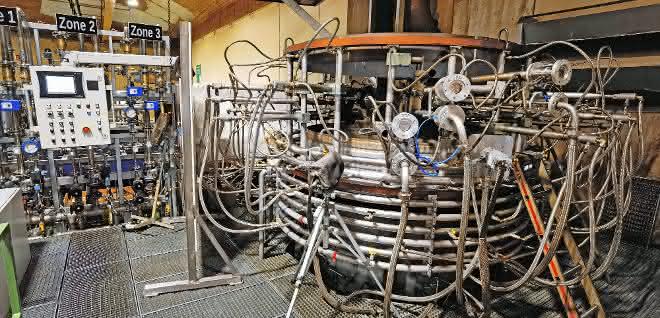
Beat Reinhard, Head of Process Engineering and Development at Härterei Gerster in Egerkingen (Switzerland), explains: "In surface hardening, the near-surface layer of steel components is austenitized to a certain depth in a defined area and then cooled quickly." In contrast to furnace processes such as case hardening, the entire volume does not have to be heated during surface layer hardening. This saves a considerable amount of energy. However, the treatment must be individually tailored to the conditions of the part. According to Reinhard, it is not only the hardening process itself that needs to be considered, but also the upstream and downstream value chain. Gerster, a medium-sized family business founded in 1950 with around 110 employees, has extensive expertise in this area thanks to its many years of experience and can therefore offer its customers cost-saving solutions. The company has also continuously invested in these technologies.
Example: Cam disk for mechanical engineering
"The advantages that can result from optimizing the hardening process are shown by the example of a double cam disc for a machine manufacturer," adds Micha von Felten, project engineer at Gerster. This is a wear part for textile machines that has to be kept in stock at all times. In the past, it was first forged and mechanically pre-machined in a complex process. The wheel was then completely hardened and ground. Keeping these expensive parts in stock tied up a lot of capital in the warehouse.
An alternative process path was developed in collaboration with the customer. The Gerster hardening shop was responsible for supporting the review and subsequent optimization of the entire manufacturing process as well as the selection of the optimal hardening process. The hardening process was then selected and adapted to the application - for example the position of the hardening and slip zones. As a result, the cost of production was reduced by around 50% with the new process. After forging and machining to finished size, the cam disk is now only hardened in the area of the running surfaces using the laser process and then finished using vibratory grinding. The elimination of expensive CNC grinding played a decisive role in the cost reduction. There were also other advantages: The replenishment time was reduced from 80 to 20 days, the batch size was reduced from 100 to 50 pieces and the capital tied up in stock was reduced by 75%.
The three most important curing processes
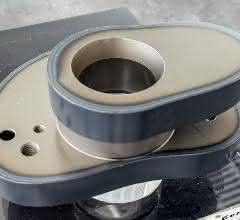
"The three main surface hardening processes we use are flame hardening, induction hardening and laser hardening," says Reinhard. Flame hardening with gas burners is the oldest process and still accounts for around 10% of the surface layer hardening treatments carried out at Gerster. As the heat from the gas burners has to penetrate from the surface into the interior of the components, the process times for greater hardening depths are correspondingly long. However, the output is easily scalable by using more burners. The process is particularly suitable for components with larger dimensions and greater curing depths of up to 40 mm. Depending on the application, water, polymer mixtures, oil, inert gas or compressed air are used for quenching.
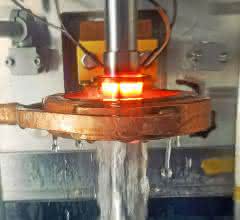
Induction hardening is carried out using inductors to transfer energy at frequencies between 10 and 1,200 kHz. The alternating fields apply energy directly to the inside of the material with the help of the form-adapted inductors. As a result, heating is faster than with flame hardening. The hardening depth can be up to 5 mm. The process can be controlled electronically with extreme precision and repeatability, making it very easy to control. Quenching is carried out with the same media as for flame hardening.
The domain of laser hardening is the creation of locally very precisely defined, comparatively thin hardened surfaces with a depth of typically 1 mm. The high-energy laser beam causes extremely rapid heating of the surface layer, which is then cooled again extremely quickly by the cold interior of the material. This creates a hardened layer with very fine-grained martensite. Tempering treatment is usually not required and the parts suffer only minimal distortion. The process is highly productive and therefore cost-effective. The laser beam is guided with high precision by a robot so that hardening only takes place in precisely defined areas. If shielding gas is used, the surfaces also remain bright.
"Surface hardening always requires a part-specific adaptation of the process," says von Felten. That's why there are hardly ever "off-the-shelf patent solutions". The range of geometries, materials and required properties is simply too wide. In addition, there are commercial aspects such as quantities, logistics requirements and the production of part-specific devices or even complete systems.
Experience as a success factor
According to von Felten, a great deal of experience is therefore a prerequisite for finding the optimum solution in terms of both technology and cost. For larger order volumes or due to special requirements, it sometimes makes sense to integrate the hardening process directly into a customer's production line. Gerster is open to these requests and supports such relocations as part of its "Gerster Support Services". In addition to its flexible and efficient internal departments for design, consulting, process development and production, Gerster can also rely on a broad network of suppliers and engineering service providers for such services.
"Our customers are usually under a lot of time pressure. That's why we attach great importance to responding to inquiries or orders as quickly as possible," says Reinhard. The service also includes design advice, for example when it comes to assessing risks relating to stresses, warping or cracking. Gerster also responds flexibly to inquiries where the dimensions or weight of the workpieces to be treated exceed the capabilities of the company's own infrastructure. In such cases, mobile treatments on site or options within the supplier network are also examined.
Quality assurance at a high level
"Of course, our services also include efficient quality assurance," says von Felten. The employees have a wide range of modern methods at their disposal, from light microscopes and a wide variety of hardness testing methods to spectral analysis. The company also has certifications for important general quality management systems such as ISO 9001 and ISO 14001 as well as industry-specific QA systems for the automotive, medical technology and aerospace industries.
Around 50 different systems are used for surface hardening at the Egerkingen site in Switzerland. However, the overall portfolio of heat treatment services offered is considerably broader and covers the entire range of classic hardening services. Gerster Germany was founded in Sprockhövel in 2022 in order to better serve the growing number of German customers.
Klaus Vollrath


You might also be interested in
E-scooter with customizable damping
The startup Scuddy has significantly improved the flexibility, performance, customizability and ergonomics of its second-generation foldable e-scooter of the same name - thanks in part to damping technology from ACE.
 read more...
Hurdles on the road to success
Welding is one of the most complicated processes in the manufacturing process, and it is becoming increasingly difficult to find suitable personnel. Can this problem be solved by automating processes? Can or should the robot colleague replace the...
read more...New plug-and-play solutions for the warehouse
Exotec announces a new Skypath conveyor system, the optimized Skypicker picking robot and Deepsky, another proprietary storage software. All three products can be seamlessly integrated into the manufacturer's Skypod system.
read more...Production automation
At Motek, Weiss will be presenting solutions for the linear and rotary movement of workpieces that can be easily integrated into the overall system of hardware and software.
read more...Wheel bearings and wheel bearing sets
Low-friction rolling behavior
Hecht Kugellager offers a wide range of bearing technology for use in the automotive industry, commercial vehicles and mobile machinery.
read more...Simulation in product development
The Munich-based start-up Spyra significantly shortens the development time of its production by using Solidworks simulation solutions.
read more...Doubling production capacity by 2026
Nabtesco is investing in a third production site, doubling its production capacity to two million precision gearboxes per year by 2026.
read more...Counterbalance trucks with lithium-ion technology
Clark has relaunched the GEX and GTX series.
read more...Intelligent sensor detects leaks
Fraunhofer IPA is working with Sick to develop an additional leakage service for an intelligent flow sensor. Self-learning algorithms evaluate the measurement data and detect leaks.
read more...