
Tool concepts
Safe implementation of new processes in automotive engineering
In the automotive industry, new machining processes need to be brought safely into mass production. This also requires appropriately developed tool concepts. An example from Mapal and Daimler.
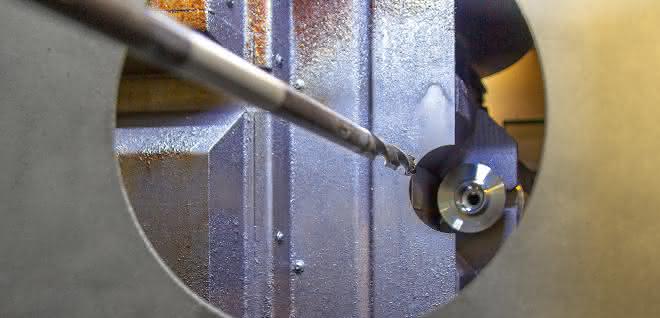
In order to meet the requirements for ever smaller engines with increasing performance and reducedCO2 emissions, various adjustments are being made. For example, new materials are being developed that are lighter and yet more stable. Or engine components are modified in order to reduce the rotating mass and, in turn, fuel consumption. For example, crankshafts for different engines are designed with a lightening bore. This results in a significant reduction in the weight of the component.
A new machining process
For the production of crankshafts, however, the relief bore means an additional machining process. At Daimler, the process development, planning and tool management departments work closely with the production department on an interdisciplinary basis. However, in addition to the internal participants, suppliers are also needed to provide the optimum tools for reliable machining.
When the process was first designed, tools from different suppliers were considered. Several manufacturers developed concepts for drilling the hole through the crankshaft bearings. The solution from Mapal was the most convincing. Employees from the precision tool manufacturer are constantly on site at the production facility in Untertürkheim to resolve problems and provide support during production. In addition, the company has carried out development work and preproduction tests throughout the entire time leading up to series production, as there is often not enough time for this in large-scale production.
Facilitation drilling in four steps
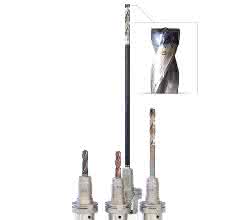
The process for machining the relief bore of the micro-alloyed steel crankshaft is realized with a total of four specially designed, double-edged tools. Cooling takes place with minimum quantity lubrication. The first solid carbide drill (diameter 19.2 millimetres) is used to pre-machine the cover bore. The second solid carbide drill (diameter 18 millimetres) produces the pilot hole for drilling through the first bearing. A replaceable head drill (diameter 18 millimetres) is used as the third machining step. It finishes the first bearing and drills through the second bearing. Finally, the remaining bearings are machined with another long TTD replaceable head drill (diameter 18 millimetres). This threads through the first two bearings at a slow speed and low feed rate, supports itself in them and thus achieves good results when machining the remaining bearings despite the long overhang. This specially designed replaceable head drill consists of a steel holder with CFS interface, the CFS replaceable head holder with a base body length of 119.2 millimetres and finally the TTD replaceable head made of solid carbide. When machining the crankshaft of a 6-cylinder engine, the holder with CFS interface alone is 480 millimetres long.
Burr formation when starting up the series
The four-stage machining process delivered the desired results in the tests and series production with low quantities. However, a problem arose during the ramp-up of series production. A burr formed at the entry and exit of the individual bearing bores after around 100 bores, which grew larger with each machined bore. As a result, the drill heads of the third and fourth drills had to be replaced after just 100 holes. This was because the burr would not have guaranteed the mechanical cleanliness of the component. There must not be any metallic particles on the component. These could come loose during operation of the unit. For this reason, any residual dirt and metallic particles on the components must be categorically excluded.
A deburring cutter is the solution
Those responsible approached Mapal with this problem. The burr formation was to be eliminated without using an additional tool for deburring. This would have increased the cycle time and the process would have had to be restarted. "We worked intensively on solutions in our development department and equipped the replaceable head drill, which finally machines all bearings, with a deburring cutter," explains Tobias Moser, the sales representative responsible for the project. The deburring cutter is spring-mounted directly after the interface to the replaceable head on the CFS replaceable head holder. The bore entries are deburred during the forward movement and the bore exits are deburred accordingly when the drill retracts.
The long drill therefore enters the hole at a feed rate of 200 millimetres per minute for drilling. At a defined point, the feed rate is reduced to 125 millimetres per minute over a distance of four millimetres. Over this distance, the deburring cutter creates the chamfer at the bore entry point and is simultaneously pressed into the interior of the holder by the suspension. The bore can then be machined at a feed rate of 375 millimetres per minute. The same happens when retracting.
Off to mass production
At the beginning of 2017, Mapal tested the new concept in the Research and Development department using an original crankshaft. "We were able to work well with these results and further optimize the tool," says Moser. Things finally got serious in the summer. The modified tool with deburring edge was tested on the machine for series production. Here, too, the results were good and the process, including forward and backward deburring of the bores, has been in use in large-scale production since September 2017. "Thanks to the deburring cutter, the service life of the tools is also much longer than before," says Moser. The first two drills are replaced after 2,000 holes, the drill heads of the two replaceable head drills after 800 holes.
And the deburring blade? It only has to be changed after 25,000 bores. This process is therefore the new standard for the lightening bore of the crankshaft and is currently being transferred to two other lines.
Longer service life thanks to PVD coating
However, despite the reliable and satisfactory process, work is of course continuing on improving and optimizing the tools. The first step was to achieve process reliability in large-scale production. Now the task is to make machining even more economical. A first step in this direction has already been taken. "We initially used the deburring cutting edge uncoated, but now it has a special PVD coating for even longer tool life," explains Moser.
In order to be able to achieve higher work rates and thus further reduce the cycle time, the same process is also currently being tested on a test machine with the three-edged counterparts, different versions of the Tritan drill, to the drills previously used. With extremely promising results.
Intec, Hall 3, Stand G05


You might also be interested in
Motors, gearboxes and encoders: Faulhaber expands Ø 16 mm portfolio
Faulhaber is expanding its portfolio with new DC motors from the SXR and GXR family, a 16 mm planetary gearbox and the IEX3 magnetic encoder for compact drive solutions.
 read more...
New drive solutions for industrial automation and robotics
Faulhaber presents drive solutions with the new GXR and SXR motor family, which offer high efficiency and flexibility in combination with powerful gearboxes and encoders. These optimized components open up new possibilities for applications in...
read more...Marco Altherr becomes new Chief Financial Officer
The Supervisory Board of Ziehl-Abegg has appointed Marco Altherr as the company's new Chief Financial Officer (CFO). Altherr will take up his post in May 2025.
read more...Hydrogen storage in metal hydride
With its focus on storage systems for green hydrogen in solid form (metal hydride), GKN Hydrogen presents itself as a pioneer in safety and efficiency for the industry. GKN Hydrogen offers safe storage systems for green hydrogen and focuses on two...
read more...INDUSTRIAL Production Products of the year...
2nd place, Robotics category: EGS Automation
The SUMO automation systems from EGS Automation - economical standard solutions for automating a wide range of processes in plastics and metalworking - took second place in the robotics category in the competition for Product of the Year 2024.
read more...More productivity with Drive Intelligence
The trends in automation are productivity, sustainability and connectivity. Baumüller is launching new products on the market that address these trends, including new tools for smart energy monitoring, condition monitoring in the drive and new...
read more...Intelligence in Motion
At SPS, Koco Motion will be showcasing its expertise in customized drive solutions based on DC and BLDC motors, stepper motors, servo motors, linear drives and controllers.
read more...Nomination Products of the Year 2024
EGS Automation: SUMO automation systems
The SUMO automation systems from EGS Automation, economical standard solutions for automating a wide range of processes in plastics and metalworking, have been nominated in the Robotics category in the competition for Product of the Year 2024.
read more...Transport technology from the modular system
Many transport tasks can be realized with the help of linear technology. Pre-configured solutions are available to simplify the interaction between the linear unit, motor, gearbox and controller. This minimizes the effort required for research and...
read more...