
Metav
Quality Area: Processes digitally under control
The motivations for visiting the Quality Area at Metav 2018 vary, but many visitors are currently interested in one topic in particular: How can the quality of their processes be improved with digitalization? Andreas Wank, research associate at the Institute for Production Management, Technology and Machine Tools (PTW) at TU Darmstadt, reveals what small and medium-sized enterprises (SMEs) in particular should look out for.

Companies sometimes have it easier when it comes to Industry 4.0, Wank explains his field of research: they tend to have the means to build a new factory on a greenfield site, where they can safely test and introduce the new digital methods. The situation is different for small and medium-sized companies, which usually find it difficult to digitize their existing production facilities - so-called brownfield factories. As a first step, brownfield manufacturers should therefore carefully consider which key figures they specifically want to improve.
However, Wank not only conducts research in the field of digitalization, but also helps SMEs to safely break new digital ground as Managing Director of the new Mittelstand 4.0 Competence Centre in Darmstadt. "Above all, we approach digitalization methodically," explains the scientist. "The focus is not on replacing human work, but on supplementing it." For example, the aim is to automate previous manual activities such as recording and entering measurement data in the digital process. To this end, the experts use their Value Stream Mapping 4.0 to look for digital types of waste in manufacturing processes, for example. These include digital media breaks, where data is either not recorded or not forwarded. Wank: "Measurement data is often entered manually into the measuring computer, but regular analyses and forwarding of the information are not carried out."
Chaos cannot be eliminated digitally

Newcomers should therefore first learn to understand their processes and stabilize them before digitizing them. "It's often not worth going straight into further digitalization if you don't know exactly what the processes look like," explained Wank. "Most of the time, things go wrong when someone tries to eliminate chaos with digitalization." For example, when analyzing a Hessian company with a large number of variants, the Darmstadt-based company discovered that the flow of information between purchasing, work preparation and assembly was not functioning properly. Digitization had already failed in the first step because no one really understood the flow of information.
The experts at the competence center supported the company with a systematic approach: They first defined the ideal process flow in order to then develop digital support together with the employees.
Help for digital self-help
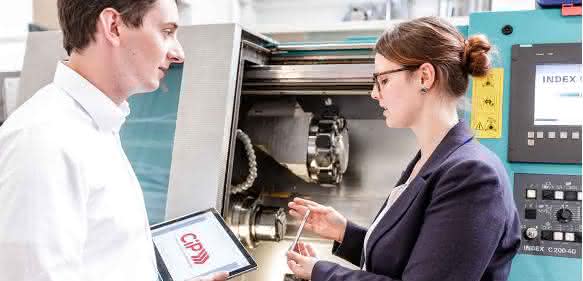
However, the merging of existing, historically grown IT systems into a consistent digital concept is also problematic. "The big problem is developing a consistent digital solution without stopping operations," says Wank. "What's more, in SMEs, this task is usually undertaken by employees alongside their usual job." As an alternative to expensive management consultants, the competence center offers help for digital self-help. It trains employees in the methodical approach, which they can then safely test in the process learning factory (CiP) or the new energy efficiency factory (ETA) at TU Darmstadt before using it in their own company.
In his work, the scientist sees the chance that the flow of information in companies will be completely paperless in the future as an important challenge. "Ideally, the entire process will run digitally because the products will provide the necessary information," says the expert, looking to the future. "Then the processes can be dynamically controlled or interlocked on the basis of real-time data. This would not be possible with a static, paper-based way of working." The scientist is particularly interested in the digital view of quality assurance in conjunction with metal processing. Wank: "I therefore see the Quality Area at Metav 2018 as a very interesting topic area for us."


You might also be interested in
Plagiarius 2024 negative prize
On January 26, 2024, the Plagiarius campaign awarded its dreaded "Plagiarius" negative prize for the 48th time to manufacturers and retailers of particularly brazen counterfeits and fakes.
 read more...
Ivalua honors winners of the Generative AI...
AI-supported "add-ons" for buyers within 48 hours
Ivalua, provider of cloud-based spend management solutions, announced the winners and innovations of the first Generative AI Innovation Cup. The competition took place in December 2023. It was open to all Ivalua partners and employees - more than...
read more...Efaflex celebrates 50 years of high-speed...
The emphasis is on "fast"
Since day one, Efaflex has wanted to use new technologies as early as possible and drive progress in the industry. This year, the family business is celebrating its 50th anniversary under the motto "Fast Forward".
read more...Security of supply even during power outages
In the winter of 2022, Germany was worried about energy shortages. The drugstore retailer dm did not paint any horror scenarios, but nevertheless saw the possibility of controlled, temporary, regional power cuts (brownouts).
read more...Safety technology in mechanical engineering
Modules with new functions
Euchner's product highlights at EMO 2023 include the communication-capable solenoid interlocks.
read more...Transforming the paper industry towards climate neutrality
Together with partners from industry and research, Voith is developing a project for the optimization of energy and material flows in paper production. The aim of the research project is to develop a digital framework that enables effective process...
read more...Up to 95 percent less flue gas thanks to direct extraction
The requirements for occupational safety measures and safety technology are also constantly increasing in welding technology. The Technical Rules for Hazardous Substances (TRGS) stipulate that welding fumes and harmful substances must be extracted...
read more...Competitive advantages with large machines
Whether 3D-printed components for machines and systems, prototypes or aids for design: additive manufacturing is almost indispensable for modern companies in mechanical and plant engineering and automation if they want to play in the premier league.
read more...Transport technology from the modular system
Many transport tasks can be realized with the help of linear technology. Pre-configured solutions are available to simplify the interaction between the linear unit, motor, gearbox and controller. This minimizes the effort required for research and...
read more...