
Workpiece handling
Stress field machining
High flexibility, dynamics and precision are required, especially when it comes to complex components. With a new series, a machine tool manufacturer guarantees reliable complete milling-turning machining. Workpiece automation is integrated into the handling process, based on product developments from Festo.
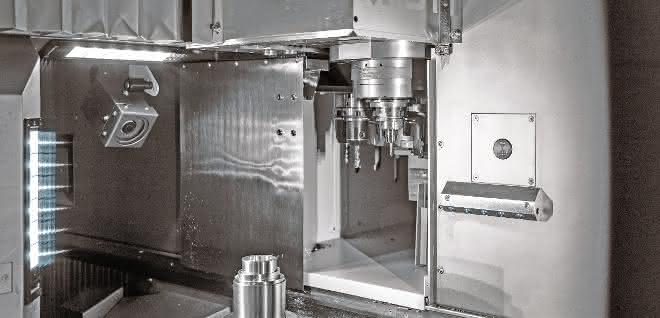
If you want to be at the forefront in the construction of machines for machining production, you have to develop solutions that sustainably increase productivity. In the field of machining, the machine tool manufacturer Stama sees complete machining as a key technology that meets the requirements of both series production and variant production. Until now, resolving the contradiction between high flexibility and productivity was seemingly irreconcilable and at the same time a challenge for the company's development work.
The developers put various machine concepts to the test and designed a new generation of milling/turning centers with the MT 733 series, whose four types perform heavy milling/turning and drilling operations highly dynamically and with high precision in 5 axes simultaneously in just one set-up. Four customer-specific solutions from Festo contribute to the fast handling processes: the newly developed loader axis ELGW, a background magazine, the Festo Motion Terminal VTEM with Motion App "Soft Stop" and the energy efficiency module MSE6-E2M.
Ready-to-install solutions
The particularly robust ELGW loader axis ensures reliable feeding of the chuck blank and removal of the workpiece finished on six sides. With its length of up to 6 m, the electric linear axis with toothed belt offers a large scope for automation solutions of various dimensions. The axis owes its high stability and running performance to a new extruded aluminum profile with "Clean Design".
The new background magazine offers more flexibility and autonomy - in addition to the machine-side tool magazines with 2×36/64 slots, up to 256 additional tools can be provided. Like the loader axis, the background magazine was also developed specifically for the special requirements of the MT 733 because none of the standard tool magazine solutions on the market were able to fully meet the requirements of the Stama developers.
Two double grippers remove tools from the milling-turning center in parallel and change the new tools previously stored in the magazine in a matter of seconds. The new Festo surface background magazine is designed as a modular system and can be individually configured according to specific customer requirements. Stama provides an easy-to-use configuration tool for customer-specific selection.
Motion Terminal
Small flap, big effect - the tool change flap separates the tool magazine with the individual tools from the machining area. It ensures that dirt and chips remain inside the machine and thus protects the magazine. During the design phase of the new machines, Stama's development engineers were faced with the question of how to move the flap - electrically or pneumatically.
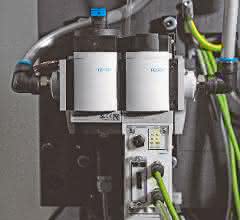
An electric drive was not implemented due to the limited installation space and increased costs. The task was solved using pneumatics with end-position cushioning via app - the Festo Motion Terminal VTEM with the "Soft Stop" motion app. With its help, the end position damping can be controlled adaptively by applying maximum counterpressure at exactly the right moment. This enables faster tool changes.
The interplay of Festo automation solutions at Stama is completed by the MSE6-E2M energy efficiency module. It reduces compressed air consumption by actively intervening in the supply, especially during the standby times of the mill-turn machine. In addition, the monitoring and control of central operating parameters such as pressure and flow rate ensures reliable production processes.
During system downtimes, the energy efficiency module automatically shuts off the compressed air supply, thereby reducing energy consumption. It can also automatically detect leaks in the pipe system using pressure drop parameters defined in advance as critical, thus contributing to increased system availability. The retrievable flow, consumption and pressure measurement values form the basis for intelligent energy monitoring. The values are visualized in a user-friendly way for easy operation.
"We cannot say with certainty today which workpieces our customers will machine with our milling-turning centers in the future, because a constantly changing market requires more individuality in the products and their manufacturing processes," says Dr. Frank Müller, Head of Design and Development at Stama.
"One of the key challenges today and in the future is to maintain a high level of flexibility in the processes, while at the same time increasing productivity and thus significantly reducing unit costs. We have therefore pursued four overarching goals in the new development: greater stability based on higher static and dynamic rigidity, higher dynamics thanks to lower moving masses, increased precision due to thermal stability and increased reliability based on better machine availability," says Müller.
Complete processing in one set-up
Like all previous models, the new generation of Stama milling-turning centers does not require the classic swivel head - an advantage of the Stama milling-turning technology. It swivels the bar blank up to a length of 1000 mm and a diameter of 102 mm or the chuck blank. The tool itself remains fixed. This procedure offers a stability advantage for complex components and materials that are difficult to machine thanks to reduced bearing kinematics. The new portal design of the MT 733s with its increased thermal, static and dynamic stability makes the machining process even more precise.
"Thanks to the automatic, high-precision workpiece transfer, we not only increase precision but also process reliability," says Müller. With the four MT-733 models, Stama offers an innovative and future-oriented machine concept for complete machining, both for flexible variant production and for highly productive series production. Workpieces that were previously finished on two or more machines can now be milled and turned on the MT 733 in a single set-up thanks to Festo's integrated automation solutions.


You might also be interested in
Plagiarius 2024 negative prize
On January 26, 2024, the Plagiarius campaign awarded its dreaded "Plagiarius" negative prize for the 48th time to manufacturers and retailers of particularly brazen counterfeits and fakes.
 read more...
Ivalua honors winners of the Generative AI...
AI-supported "add-ons" for buyers within 48 hours
Ivalua, provider of cloud-based spend management solutions, announced the winners and innovations of the first Generative AI Innovation Cup. The competition took place in December 2023. It was open to all Ivalua partners and employees - more than...
read more...Efaflex celebrates 50 years of high-speed...
The emphasis is on "fast"
Since day one, Efaflex has wanted to use new technologies as early as possible and drive progress in the industry. This year, the family business is celebrating its 50th anniversary under the motto "Fast Forward".
read more...Security of supply even during power outages
In the winter of 2022, Germany was worried about energy shortages. The drugstore retailer dm did not paint any horror scenarios, but nevertheless saw the possibility of controlled, temporary, regional power cuts (brownouts).
read more...Safety technology in mechanical engineering
Modules with new functions
Euchner's product highlights at EMO 2023 include the communication-capable solenoid interlocks.
read more...Transforming the paper industry towards climate neutrality
Together with partners from industry and research, Voith is developing a project for the optimization of energy and material flows in paper production. The aim of the research project is to develop a digital framework that enables effective process...
read more...Up to 95 percent less flue gas thanks to direct extraction
The requirements for occupational safety measures and safety technology are also constantly increasing in welding technology. The Technical Rules for Hazardous Substances (TRGS) stipulate that welding fumes and harmful substances must be extracted...
read more...Competitive advantages with large machines
Whether 3D-printed components for machines and systems, prototypes or aids for design: additive manufacturing is almost indispensable for modern companies in mechanical and plant engineering and automation if they want to play in the premier league.
read more...Transport technology from the modular system
Many transport tasks can be realized with the help of linear technology. Pre-configured solutions are available to simplify the interaction between the linear unit, motor, gearbox and controller. This minimizes the effort required for research and...
read more...