
Machining
More precise as a duo
Mechanical dial gauges are by no means "old fashioned", as the long-established company Käfer Messuhrenfabrik shows. With two new Duo-S machining cells from CNC Häberle, the company is continuing its careful automation.
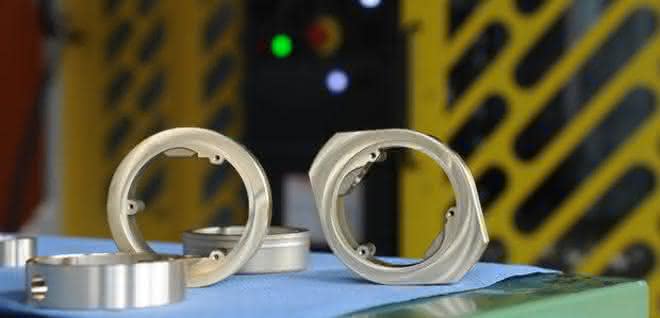
Käfer Messuhrenfabrik from the Black Forest concentrates almost exclusively on the manufacture of mechanical dial gauges and their components. It is clear that this can only be achieved with a high level of vertical integration. All mechanical processing steps are carried out at the headquarters in Villingen-Schwenningen; only "exotic" processes such as eroding, die casting or electroplating are carried out outside the company. Over 200,000 workpieces leave production every year and are sent all over the world. Many a watch is given a customer-specific look with a specially printed dial and corresponding logo. In some cases, customers only buy movements or even individual components to create their own measuring equipment.
Käfer relies on mechanical dial gauges, as Operations Manager Matthias Osterhues says: "The solid construction of our mechanical dial gauges and our focus on quality have allowed us to survive. Mechanical dial gauges will always be around because they are easy to handle, easy to read from a distance and permanently reliable." While other manufacturers have focused on mass production, Käfer has concentrated on what it does best: adapting flexibly to customer requirements and manufacturing sustainable products.
Standard housing in series
Last year, Käfer needed to make a replacement investment for its housing production. The system integrator CNC Häberle from Laichingen was quickly found as a partner and supplied two machining cells. These two almost identical RobodrillDuo-S cells replace processing machines that had been decommissioned after decades. The problem was that the disposal of the old machines had not freed up much space. But master craftsman Bernhard Milost had already noticed how "small and compact" the Robodrill machines are. Häberle as a partner was also ideal for Käfer "because with the Häberle/Fanuc combination, we got everything from a single source."
Both cells were set up at Häberle before delivery and the processes were run in. During this time, the machine operators were also trained by Käfer and familiarized with the machine. The RobodrillDuo-S cells each consist of two Robodrill α-D21SiB5 processing machines with Fanuc ADV equipment. Between the two machines is a standardized Plus-E cell from Häberle, in which a Fanuc LR Mate 200iD robot works, which is "fed" from an integrated pallet storage system. Osterhues sees this confirmed in the first weeks of practical use: "We bought the cells with an all-round carefree package, i.e. including tooling and a service contract." While the Robodrill has a three-axis design as standard, the machines for Käfer are each equipped with DTT 5-axis tables from Häberle. Master craftsman Bernhard Milost: "5-axis machining is fundamental to the precision of our dial gauges. We can only achieve the tight tolerances if we work in a single clamping operation." One Robodrill performs the 5-axis machining, after which the robot removes the almost finished case and loads it into the second machine for finishing.
Elements such as clamping jaws, storage cassettes and gripper fingers were designed and manufactured by Häberle. Häberle's own development also comes into play when it comes to operating the machines: HaebPara allows the user interface of the CNC to be designed and expanded with numerous functions. This software enables the machine operator to independently create individual screens and input masks. In addition to the clear HMI design, comments, images, system variables such as zero points or tool data and much more can be stored - a tool that is highly valued at Käfer, as Osterhues confirms. The two Duo-S cells also take automation one step further. Käfer has already been using a Fanuc robot for loading and unloading a machine for some time.
Käfer knows that there will be no getting around further automation in the future. "But not at the cost of reducing our workforce," assures Osterhues. On the contrary, because new machines and the use of robots will enable the company to remain competitive.
In principle, both cells can perform the same machining tasks. However, Käfer has decided that one type of housing, of which over 100,000 are needed per year, will be produced in one cell, while the quantities of all other housing types are in the order of 5,000 to 7,000 dial gauges per year. As far as amortization times are concerned, the design was based on 16-hour operation, but today it is already at 20 hours. "So that we still have a little reserve, the cells were deliberately not designed for 24-hour operation from the outset," says Osterhues. The machines are fed by the centrally positioned robot, which removes the blanks to be processed from a pallet and places the finished workpieces back into it.
Accuracy is particularly important
It goes without saying that special care is required in the manufacture of measuring devices. For the accuracy of the dial gauges, the crucial bores and surfaces are tolerated to within 1/100th of each other. As a measuring device manufacturer, Käfer is critical and meticulous by nature. "The machine easily meets our requirements," says the master craftsman. While finished housings were checked relatively frequently in the first few days of machine operation, two checks per day are now sufficient. Milost carries out a final check before closing time. Then the machines run unmanned into the night.
Matthias Osterhues was surprised by the "cold start behavior" of the Robodrill. The temperature compensation with AI function is an extremely useful detail, especially because the Robodrill at Käfer does not run at night. This function regulates the processing parameters depending on the temperature of the machine. This eliminates the need for the usual warm-up after switching on other machines. CNC Häberle's package also included the complete tool procurement. "We didn't want to experiment for long." In any case, apart from two or three special tools, they were to be standard tools.
If you buy a Beetle dial gauge today, you can be sure that it will still be repaired in ten years or more. The calibration and repair service in Villingen-Schwenningen services every Käfer dial gauge. When it comes to service, Käfer has a simple objective: to provide rapid assistance when service is required. Even though the concept has proven itself so far, some fine-tuning was necessary during the ramp-up phase of the Duo-S cells. But even then, there was a quick solution by phone or uncomplicated help on site.
Bernhard Foitzik


You might also be interested in
Housing and inserts for plenty of power
Lapp presented the expansion of its Epic Power series at SPS 2023: four new M23 circular connector inserts and three new M23 housings. The special feature: all housings can be combined with any of the four inserts.
 read more...
News and product updates from Smartgas
Portable gas analyzers for outdoor use
Smartgas is starting the second half of the year with a series of updates to existing products and a number of new products. Portable analyzers expand the range of applications, while new accessories such as protective housings and heating modules...
read more...Everything accurate in switch cabinet construction
To ensure smooth work processes, tools for processing enclosures and housings must function flawlessly and reliably. Häwa rounds off its punching range with the Multi-Press 500.
read more...Shafts and conversion parts
The Rodriguez range includes ball bushings including matching housings, shaft brackets, crossbars and supports.
read more...Cooling and temperature control units
Hygienic packaging sells safely
In few industries are the requirements for hygiene in the production process as strict as in the food sector - the health of consumers has top priority. This results in enormous challenges for all machines and components involved, especially in...
read more...Simple tool change in seconds
With the CMS, Schunk is launching a user-friendly, manual change system for quick component replacement. In addition to its simple and convenient operation, the CMS also stands out with its extensive range of optional modules and complementary end...
read more...Motion controller for small drives
Medium power range covered
Faulhaber has another housing-less and compact motion controller in its range, which is particularly suitable for integration in device construction and medical technology applications.
read more...Welding solutions in the name of resource efficiency
At the Welding & Cutting trade fair in Essen (September 11-15), Fronius will be focusing on the major drivers in welding technology. Quality requirements are increasing in all industries, but the required welding specialists are scarce. In...
read more...Safe solutions for cable installations
From thick power cables to thin sensor lines, cables and lines must be routed safely through systems and machines. A challenge that should not be underestimated, explains Jörg Sokat, Head of Product Management at Pflitsch.
read more...