
Milling technology
High-precision machining of large parts at automotive supplier
The Swiss company Aquatec succeeded in establishing a fully automated production chain for large parts by intelligently integrating an acquired company.
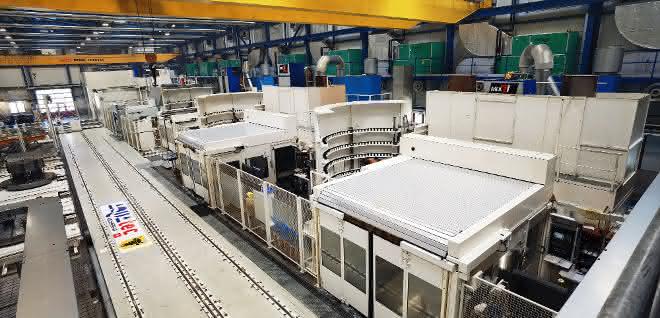
The demand for high-precision machined components with large dimensions is growing in numerous industries. Customers include the aerospace industry and high-end mechanical engineering companies such as manufacturers of systems for chip production or pumps and compressors. The large parts machining service provider Aquatec succeeded in rescuing a globally unique interlinked production line for the one-off and series production of large components from bankruptcy. Synergies between the systems and technologies at the parent plant in Emmerich and the new site in Altdorf (Switzerland) provide additional benefits by extending the value chain.
"The production line that we were able to take over from a bankrupt company in Altdorf in October 2021 is almost unique in the world in this configuration," says Martin Meenen, Managing Partner of Aquatec in Emmerich. His company, which originally specialized in the waterjet cutting of large-format components, has made a name for itself in the one-off and series production of high-quality components for demanding industries.
Takeover of a RUAG plant
Customers come from the automotive industry, aerospace, mechanical engineering and architecture. A large number of different individual machines have been procured to fulfill a wide variety of tasks. Automated interlinking is therefore not possible. This proved to be a bottleneck for some orders. The necessary reclamping not only cost working time, but was also associated with quality risks. This shortcoming has now been overcome with the takeover of a former RUAG plant in Altdorf.
"The heart of the new system technology is a continuous transfer device for workpieces measuring up to 5,850 x 5,000 x 3,000 mm," adds partner Lucia Esposito, who is responsible for marketing and finance on the management board. The first station is the set-up area, where the workpieces are clamped on square or round pallets and the required tools are prepared. In the next hall, two five-axis MultiTec 2500 milling machining centers from Waldrich Coburg are located along this transfer line, followed by another MultiTec 2500 with an additional turning function.
Next up are a DMC 340 FD turn-mill center and a Mastertec turn-mill center from Waldrich Coburg for workpieces measuring up to 5,850 x 5,000 x 3,000 mm. Another DMC 340 FD in the neighboring hall is also connected to the transfer line via an airlock. The line is completed by a large coordinate measuring machine type MMZ G from Zeiss with measuring room dimensions of 3,000 x 6,000 x 2,000 mm and a basic accuracy of ± 3 µm. The central chip removal system is equipped with a chip breaker and material separator. Finally, a DMC DF 200 turn-mill center with five pallet spaces is available in the adjoining hall for smaller components.
Unhindered workflow
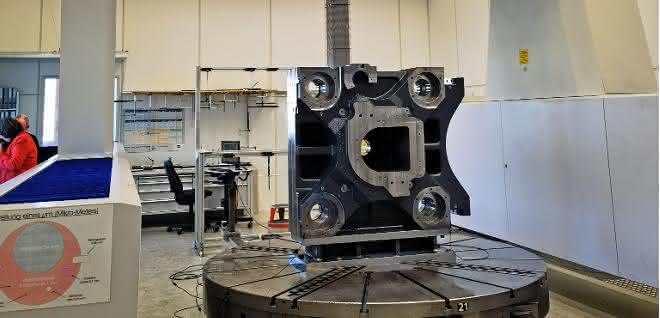
"The transfer line has a total of 27 pallets as well as numerous set-up, buffer and inspection stations," reveals industrial engineer Serge Truttmann, co-partner and operations manager of the plant in Altdorf. Due to the usually very long processing times on the individual machines, the workpieces can generally be moved along the transfer line in both directions without any time delay, whereby they remain on the pallet in the same clamping position. This also applies to measuring in the coordinate measuring machine.
In the case of critical accuracy requirements, a component can therefore be measured again between roughing and finishing. This makes it possible, for example, to compensate for minor position tolerance deviations when boring holes. To ensure the highest possible precision, great importance is also attached to temperature consistency. The entire hall is kept at a constant temperature of ± 1 °C with the help of large air conditioning units. In the separately enclosed measuring room, the temperature is even kept constant at ± 0.5 °C. Further measures include maintaining sufficient time intervals to ensure that the temperature of the workpieces is equalized and documenting the workpiece temperature during the measuring process using thermocouples.
"As we machine both individual items and medium-sized batches, the TopSolid Cam CAD-CAM system is used throughout all machining processes," says Martin Meenen. On the basis of the CAD
Based on the customer's data, all machining steps are planned end-to-end, the clamping positions are defined and the required clamping devices are designed. Once the optimum machining strategy has been determined, the required tools are determined and assigned to the relevant jobs. The tool management system integrated into the CAD program manages a tool pool with several 1,000 different tools, including many special designs such as spindle tools up to approx. 1,500 mm in diameter. All tools are equipped with RFID chips from Balluff. Preparation and testing are carried out in parallel to setting up the workpieces on pallets. They are then fed into the magazines of the relevant machining center.
Synergies by complementing the locations
"After taking over the largely run-down company, we were fortunately able to rehire around 25 employees from the original workforce," reports Serge Truttmann. Many of them are highly qualified and have many years of experience in operating the sophisticated machines and systems. This also applies to the associated peripherals, including the CAD-CAM software.
"The merger will result in considerable synergies for our two sites in Emmerich and here in Altdorf," says Lucia Esposito. At the Emmerich site, there are numerous machines, some with very special features, such as a system with an installation space length of up to 12,500 mm and some highly dynamic machining centers with high cutting performance. On the other hand, however, these do not quite achieve the accuracy values that can be guaranteed in Altdorf. The measuring room of the coordinate measuring machine in Emmerich is also smaller than the one in Altdorf. It therefore makes sense to rough down large structural components in Emmerich from 32 to 7 tons, for example, and then have them cut to final dimensions in Switzerland. Conversely, there is the possibility in Emmerich of assembling components machined in Altdorf into welded constructions and thus extending the value chain. The company is now considering carrying out additional processing steps at the Swiss plant, such as shrinking bushings.


You might also be interested in
Atlas Copco takes over long-standing sales partner
Atlas Copco has taken over Heide-Pumpen. The specialist for mobile pumps has been working closely with Atlas Copco in sales and service for a long time, especially for surface pumps for construction site dewatering and wastewater detour or in the...
 read more...
Lutz Pumpen at the Achema 2024
New mobile drum pump with battery drive
The new B3 Battery from Lutz Pumpen promises mobile and safe working with aggressive liquids without having to compromise on pumping performance compared to wired versions. The battery-powered drum pump will be on display at Achema, the world's...
read more...Maintenance and Pumps&Valves in February
Final preparations are underway in Dortmund: On February 21, 2024, maintenance will start as the leading trade fair for industrial maintenance and with it Pumps&Valves as the trade fair for industrial pumps, fittings and valves.
read more...Liquid separator keeps pumps dry
Vacuum clamping minimizes distortion and enables five sides to be machined in one clamping operation. The use of cooling lubricants poses a challenge: If they get into the vacuum generator, they can cause serious damage.
read more...Spring clutches for construction machinery
Spring clutches from Torsion Control Products (TCP) are ideal for use in construction machinery where modern diesel engines are used.
read more...Protection against cooling lubricant
Liquid separator from Schmalz keeps pumps dry
Anyone clamping with a vacuum during CNC machining must protect the pump from cooling lubricant. The NLS liquid separator from Schmalz separates the cooling lubricant and returns it to the running process - without interrupting the vacuum.
read more...Which clutch for what?
Mechanical engineering and its applications are multifaceted. Every application is special and requires a perfect machine design. Individual components in the system must also be optimally designed.
read more...Energy efficiency needs electrical engineering and IT
The energy crisis makes one thing clear: it is not enough to simply screw a photovoltaic system onto your roof or purchase green electricity. Industry is faced with the challenge of reducing consumption in order to counter the rise in energy prices,...
read more...Solutions for a networked and climate-neutral industry
At the world's leading trade fair for industry, around 4,000 companies from the mechanical engineering, electrical and digital industries as well as the energy sector will be showcasing solutions for the production and energy supply of the future.
read more...