
Sustainability
Grinding instead of new production
The RoboGrind research project aims to use an AI-based, flexible automation solution for robot-assisted surface processing to make the remanufacturing of worn components competitive with new production.
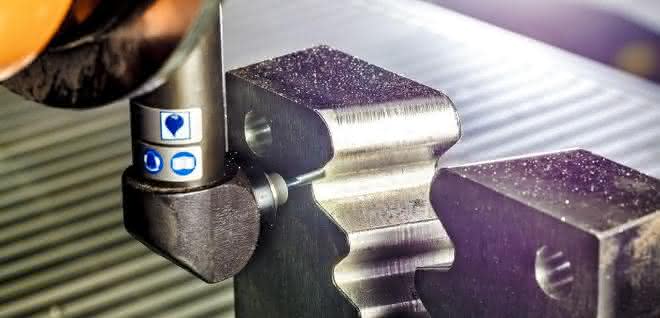
For green technologies to be sustainable in the overall cycle, the remanufacturing of worn-out devices and parts is crucial. The remanufacturing of wind turbine rotors, gearwheels, battery cells or hydrogen tanks, for example, minimizes the environmental impact by requiring fewer raw materials and energy-intensive processing steps compared to new production and avoiding additional material transport.
As the wear mainly affects the shape or surface properties, remanufacturing has so far been associated with a high workload. Even with a robot-based machining process, the current state of the art requires very frequent manual and therefore expensive adaptation of the robot program. This often makes new production more economical, although it is significantly less sustainable.
The aim of the RoboGrind research project is therefore to develop an AI-based, flexible automation solution that allows the robot to program and set itself up independently for the machining task. RoboGrind is an InvestBW-funded joint project between the University of Stuttgart, DHBW Karlsruhe and the company SHL and is coordinated by robotics software and solution provider Artiminds Robotics. The project results are to be used in the partners' offerings after the end of the project in September 2023.
Surfaces take center stage
The project focuses on the process steps of grinding, polishing and deburring in the areas of green mobility, green energy storage and green power generation. AI researcher Prof. Marco Huber from the IFF at the University of Stuttgart explains: "A cost-effective and flexible system for automated surface processing is required for the economical reconditioning of wind turbine rotor blades or electric motor gears. By using AI-based software solutions, it is possible to integrate object detection and measurement, force-controlled surface processing and downstream visual inspection in a single robot system."
In order to achieve the highest possible degree of autonomy and precision, a hybrid AI approach is being pursued that combines both knowledge-based and learning, data-based methods. "In this way, the robot should be able to anticipate deviations and surface conditions at runtime and adapt automatically.
This is achieved on the one hand through prior knowledge, which qualified workers can contribute, and on the other hand by means of sensor data, for example from force-torque sensors or vision sensors," says Dr. Darko Katic, technical contact for the RoboGrind project and Senior Team Leader Artificial Intelligence at Artiminds.


You might also be interested in
Fraunhofer IOSB Opens Humanoid Robots Lab
The Fraunhofer IOSB is opening a Humanoid Robots Experience Lab in Karlsruhe, Lemgo, and Ilmenau. Companies and organizations can use these facilities to test potential applications for humanoid robots and develop pilot projects.
 read more...
Artificial Intelligence in Manufacturing
Trumpf and IPAI Are Expanding a European AI Network for Industry
The high-tech company Trumpf is an official partner of the IPAI AI network in Heilbronn. Together, the partners aim to exchange experiences, develop new AI applications for industrial use, and advance the development of artificial intelligence in...
read more...Case Study: Networked Manufacturing Platform for Toolmaking
Using a networked manufacturing platform, Escha GmbH & Co. KG, a manufacturer of industrial fastening technology, has comprehensively modernized its toolmaking operations.
read more...Barcelona Declaration on Robotics and...
Robotics Associations Adopt Global Automation Strategy
The global robotics industry is stepping up its collaboration. The associations AER Automation, A3, IFR, and VDMA Robotics + Automation have formed a long-term alliance by signing the “Barcelona Declaration on Robotics and Automation 2026.” The...
read more...Jane Heffner is the new president of the International Federation of Robotics
Jane Heffner is the new president of the International Federation of Robotics. Adrien Brouillard has been appointed vice president of the global federation.
read more...Greater Transparency in the Robotics Market
RoboFinder Launches as an Independent Comparison Platform
Launch at Gitex Europe: 'RoboFinder' aims to bring more transparency to the professional service robotics market. In this interview, founder and CEO Brian Engels discusses market potential, challenges, and the goals of the new platform.
read more...Artificial Intelligence for the Physical Space
Alibaba Expands Qwen Model Family with a Robotics Suite for Physical AI
Alibaba is expanding its Qwen model family with a robotics suite for Physical AI. The three models—for manipulation, navigation, and simulation—are designed to assist autonomous robots with complex tasks in real-world environments.
read more...International Federation of Robotics
U.S. Robotics Industry Sees Double-Digit Growth
In the U.S., sales of industrial robots rose by 11% compared to the previous year: 38,000 units were newly installed in 2025. This significant recovery is driven by robust growth in the food industry and other non-manufacturing sectors. However, the...
read more...Development Collaboration for Humanoid Robotic Hands Launched
Schunk is entering into a new development partnership with Robert Bosch Robotics. Their shared goal is to develop an industrial-grade robotic hand that can be integrated into various humanoid robot systems.
read more...