
Automated machine tools
DMG Mori presents integrated automation solutions
DMG Mori strengthened its automation expertise in November 2017 with the DMG Mori Heitec joint venture. The newly founded company acts as an automation partner. The interaction between the engineering of the DMG Mori production plants and the automation expertise of the joint venture provides customers with a customized solution. The aim is to bundle joint know-how in order to accelerate the development of innovative automation solutions. By Sascha Dietze
With its holistic approach, DMG Mori Heitec sees itself as a provider of modular, coordinated automation solutions. DMG Mori as a machine tool manufacturer, customers and partners are intensively involved in this work. "Basically, we implement modular production cells and systems on the basis of a construction kit, which allow for individual set-up and adaptation," explains Kai Lenfert, Managing Director of DMG Mori Heitec, together with Markus Rehm, Managing Director of Deckel Maho Seebach and DMG Mori Heitec. This is a crucial aspect for small and medium-sized companies in particular. "Even though these companies represent a large proportion of DMG Mori customers, as an automation specialist we do not differentiate according to company size," adds Markus Rehm. For DMG Mori, the only thing that counts is solving the problem. "This perspective blurs the boundaries very quickly."
Automation of the value chain
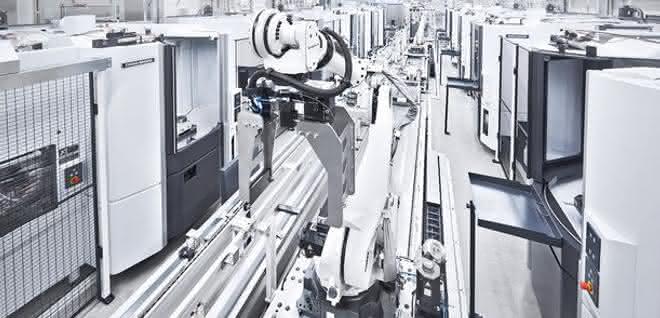
With its first projects, DMG Mori Heitec has shown that the boundaries are blurring. At Leistritz Turbinentechnik in Nuremberg, a 5-axis machine from Deckel Maho Seebach's eVo series with a robot-assisted workpiece handling system was installed for blade machining. "The main aim here was to automate a machining process that had previously only been operated manually," says Kai Lenfert.
Such specific tasks are only one side of the coin. DMG Mori Heitec also relies on far-sightedness in value creation. Markus Rehm is convinced: "Automation is far more than the sum of machines and the associated handling, storage and logistics systems." It is also about considering the important implications of automation for the entire production complex. Kai Lenfert gives a simple example: "A customer who opens up the unmanned night shift with an automated system must also be able to provide the necessary resources in the run-up to and during further processing." This would give rise to fundamental questions: "Are there enough programs? Are the necessary raw parts and tools available? Who prepares the tools? Who takes care of the supply of raw parts? Who checks the finished parts and are the downstream areas equipped for the increased supply from mechanical production?" The more complex the task, the more detailed a system needs to be planned with foresight and, above all, integrated into the value chain. "This also applies to the calculation of the ROI during the investment decision as well as to the economic use of the system in practice," Markus Rehm notes.
Holistic overview with digital engineering
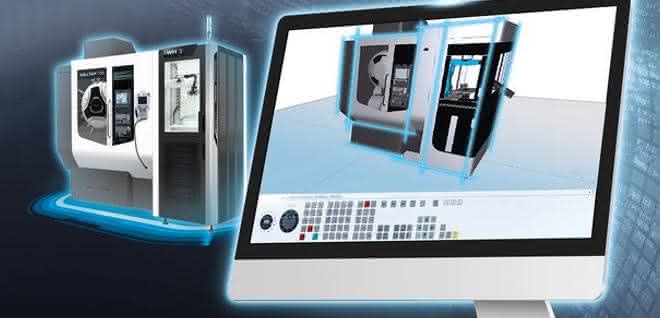
Thanks to the direct interaction with the DMG Mori plants, DMG Mori Heitec can plan each automation project very specifically with the virtual image in real time and optimize it for the customer. The actual component programs for the customer can even be run in simultaneously on the computer before installation. This creates a high level of investment security for the user, guarantees rapid installation and commissioning on site and ensures an unbeatably fast production start.
Above all, however, the customer can use the knowledge gained from the virtualized results of digital engineering during the decision-making phase to estimate very precisely how the system will work in the process chain and what they may need to do to ensure efficient operation of the system and its entire production process. "For example, we were able to plan, test and commission the Leistritz system mentioned above at an early stage using a virtual image of the machine and robotics," recalls Kai Lenfert.
DMG Mori Heitec sees the possibilities of real-time simulation of processes and the analytical predictability of events alone as an important building block for Industry 4.0. But Markus Rehm emphasizes: "Automation and digitalization are only two elements alongside information and production technology as well as technology and process - and none of the elements can be considered independently of the others." Ultimately, the company faces the interdisciplinary challenge of being an adequate and holistically good partner for customers in all areas of expertise.
The conditions for a holistic partnership are good: "DMG Mori's innovation leadership in global machine tool manufacturing and its close-knit global direct sales network as well as DMG Mori Heitec's enormous backup are key points of trust that our customers can count on," says Markus Rehm. Trust is a valuable asset when it comes to digitalization and automation. However, Kai Lenfert also knows: "We are well aware of the challenges we face in the shark tank of automation technology. We want to grow sustainably and are thinking very carefully about which steps are necessary and how we will take them."
Sascha Dietze, editor at pressGate / ag
DMG Mori at the AMB 2018
Every fourth new machine from DMG Mori is already automated or prepared. Of the more than 30 exhibits on show, the company is presenting a total of 13 automated manufacturing solutions, underlining the importance of automation. The exhibits include the Robo2Go 2nd generation, the PH 150 pallet handling system on a CMX 800 V, the DMU 50 3rd generation with WH 15 workpiece handling and an NHX 5000 with RPS 14 circular pallet storage system.
AMB 2018: Hall 10


You might also be interested in
Fraunhofer IOSB Opens Humanoid Robots Lab
The Fraunhofer IOSB is opening a Humanoid Robots Experience Lab in Karlsruhe, Lemgo, and Ilmenau. Companies and organizations can use these facilities to test potential applications for humanoid robots and develop pilot projects.
 read more...
Artificial Intelligence in Manufacturing
Trumpf and IPAI Are Expanding a European AI Network for Industry
The high-tech company Trumpf is an official partner of the IPAI AI network in Heilbronn. Together, the partners aim to exchange experiences, develop new AI applications for industrial use, and advance the development of artificial intelligence in...
read more...Case Study: Networked Manufacturing Platform for Toolmaking
Using a networked manufacturing platform, Escha GmbH & Co. KG, a manufacturer of industrial fastening technology, has comprehensively modernized its toolmaking operations.
read more...Barcelona Declaration on Robotics and...
Robotics Associations Adopt Global Automation Strategy
The global robotics industry is stepping up its collaboration. The associations AER Automation, A3, IFR, and VDMA Robotics + Automation have formed a long-term alliance by signing the “Barcelona Declaration on Robotics and Automation 2026.” The...
read more...Jane Heffner is the new president of the International Federation of Robotics
Jane Heffner is the new president of the International Federation of Robotics. Adrien Brouillard has been appointed vice president of the global federation.
read more...Greater Transparency in the Robotics Market
RoboFinder Launches as an Independent Comparison Platform
Launch at Gitex Europe: 'RoboFinder' aims to bring more transparency to the professional service robotics market. In this interview, founder and CEO Brian Engels discusses market potential, challenges, and the goals of the new platform.
read more...Artificial Intelligence for the Physical Space
Alibaba Expands Qwen Model Family with a Robotics Suite for Physical AI
Alibaba is expanding its Qwen model family with a robotics suite for Physical AI. The three models—for manipulation, navigation, and simulation—are designed to assist autonomous robots with complex tasks in real-world environments.
read more...International Federation of Robotics
U.S. Robotics Industry Sees Double-Digit Growth
In the U.S., sales of industrial robots rose by 11% compared to the previous year: 38,000 units were newly installed in 2025. This significant recovery is driven by robust growth in the food industry and other non-manufacturing sectors. However, the...
read more...Development Collaboration for Humanoid Robotic Hands Launched
Schunk is entering into a new development partnership with Robert Bosch Robotics. Their shared goal is to develop an industrial-grade robotic hand that can be integrated into various humanoid robot systems.
read more...