

Corona pandemic
Mechanical engineering increasingly affected
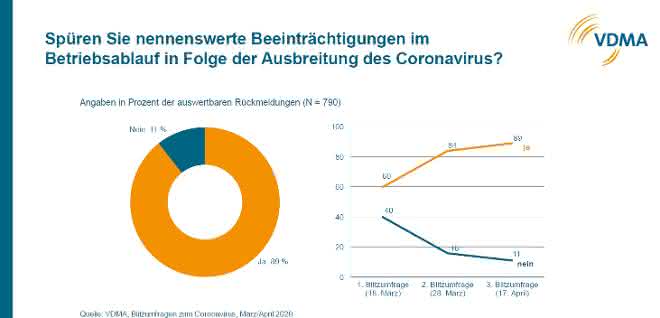
According to the VDMA, the situation in the mechanical engineering sector has worsened once again due to the consequences of the coronavirus pandemic. At the end of March, 84% of the member companies surveyed by the VDMA were already reporting adverse effects; this figure has since risen to 89% (mid-April).
In addition, the relative shift in problems has continued: towards demand-side disruptions, i.e. order losses or cancellations. "Overall, 45% of companies are reporting noticeable losses of orders or cancellations, with 32% of respondents even reporting serious ones. However, supply chains are also still under strong pressure," says VDMA Chief Economist Dr. Ralph Wiechers.
The epicenter of the disruption continues to be Europe. More than 90% of mechanical engineering companies cited supply-side and demand-side disruptions from Europe. On the demand side, there are also high levels of disruptions from the USA (47%). In China, on the other hand, the situation appears to be stabilizing.
No easing expected for the time being
More than three quarters of companies do not see any easing of the disrupted supply chains in the next three months, and 28% of companies even expect the situation to worsen. Most respondents are even more critical of the development of the order situation - on the demand side, 43% expect the situation to worsen. With regard to expected turnover, the companies' assessment has not changed significantly: similar to March, around 60% of companies expect turnover to fall by between 10% and 30% for 2020 as a whole.
A total of 790 companies from the mechanical engineering sector took part in the third VDMA flash survey on the consequences of coronavirus. The proportion of companies making capacity adjustments has risen from 75% to 83% in the last three weeks. "More and more companies are putting their employees on short-time working and initiating production stops and staff reductions - including for parts of the core workforce. Large companies with an annual turnover of more than 1 billion euros are using these instruments to adjust capacity more frequently than medium-sized companies," explains the VDMA chief economist.
If the measures to contain the coronavirus pandemic are eased in the foreseeable future, a third of companies expect to need 1 to 3 months and 3 to 6 months respectively to return to normal capacity utilization. More than 20% of the companies surveyed even expect this step to take 6 to 12 months.


You might also be interested in
The AKIMI Research Project at WZL
Agent-Based AI Aims to Simplify Robotics for Small and Medium-Sized Businesses
The AKIMI research project is developing an agent-based AI designed to significantly simplify the setup, programming, and reconfiguration of robotic systems for small and medium-sized enterprises. The goal is to make robotics more flexible and...
 read more...
BS Rollen Strengthens Its Presence in North Rhine-Westphalia
With the groundbreaking ceremony, BS Rollen is launching the construction of a new company facility in Hückeswagen. The new building will house administrative offices, an assembly line, and a high-bay warehouse, and is intended to facilitate further...
read more...Intelligent brownfield networking
Many industrial companies are struggling with established plant structures and proprietary interfaces. Stefan Klaus' presentation will show in a practical way how brownfield environments can be efficiently networked with open technologies and made...
read more...Factory-X in practice
How can set-up processes in highly variant production be automated efficiently? Markus Benndorff from soffico shows how Factory-X, industrial data rooms and modular architectures create new possibilities for flexible production concepts.
read more...Mechanical engineering | Case study
Cordless in brush production
The machine manufacturer Wöhler Bohemia is integrating wireless HMI panels from Keba into its brush production systems. The background to this is the need for flexibility, robotics integration and new market strategies.
read more...International product approvals as a strategic competitive advantage in the global market
Which certificates are valid worldwide? Christian Latte, Head of Technical Compliance and Approval Officer at Hummel AG, explains this in an interview. He provides insights into product approvals and explains why early approval strategies shorten...
read more...Foundry modernizes plant park with continuous wire belt shot blasting system
The Spanish foundry Funosa is modernizing its equipment fleet with an RDGE 1250 wire belt continuous shot blasting machine from Rösler. Focus: sand removal from heavy iron castings, energy efficiency, ease of maintenance and ESG strategy.
read more...How bridging steps, stairs and catwalks are changing processes in production and logistics
At Logimat 2026, Munk Günzburger Steigtechnik will be showcasing modular bridging steps, stairs, platform and walkway systems for production, warehousing and logistics. With online configurators, distances can be efficiently shortened, processes...
read more...Drilling cycles optimized
A new replaceable head drill from Walter can reduce machining time in series production thanks to its patented interface and screwless design.
read more...