
3D measurement technology
Everything in view with Visual Inspect AR
Augmented reality is currently on everyone's lips. In industry, the use of tablet PCs with an integrated camera has become established. The video image captured by the camera is shown on the display and "enhanced" with additional information in real time. The high accuracy of the overlay enables components, tools and production systems to be checked quickly.
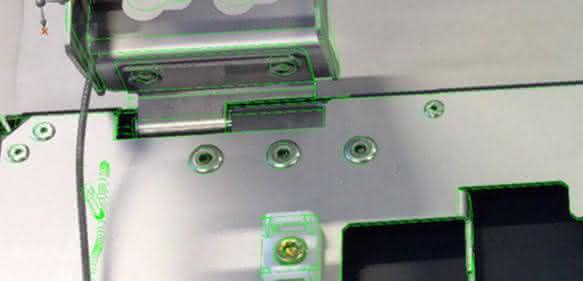
Today, industrial production processes often span the entire globe, which makes end-to-end quality assurance complex and expensive. The systems required for quality assurance are therefore increasingly moving away from rigid control stations and input terminals towards mobile devices. The use of augmented reality technologies creates significant added value here: they enable direct and intuitive access to the required information and a quick target/actual check - because the information is available where it is needed. This means that entire process chains can be supported end-to-end and without a media bridge.
With "Visual Inspect AR", the measurement technology specialist Faro offers a directly applicable "out-of-the-box" solution. Visual Inspect combines augmented reality with a wide range of applications - for toolmaking, for example.
Incoming and outgoing goods inspections, for example of raw castings, are usually carried out using specially created drawings or checklists. Faro Visual Inspect AR superimposes the video image of the casting precisely onto the CAD model, enabling a direct comparison. Deviations can be documented directly in the program and entire reports can be exported at the touch of a button. Checklists and step-by-step instructions support the workflow.
In addition to the pure geometry, all other necessary information such as metadata, ISO standards or master data is also available to the inspector on the device. This means that no additional medium is required for the inspection process. Incoming goods inspections can therefore be carried out more quickly and easily than before. Inspection after machining can also be optimized using augmented reality. Component and design data can be compared in just a few minutes and directly on site - there is no need to reclamp and set up.
Augmented reality technology offers the same advantages when assembling components. Components can be identified directly at the assembly site, their installation position determined and assemblies checked. There is no need to create 2D documents for the workshop. When servicing existing systems, the fitter can quickly access all documents on site. Installation positions can be easily identified using the AR overlay.
The mobile use of the system eliminates the need to walk to permanently installed terminals. At the same time, quick intermediate checks are possible at any time. This means that errors are detected and rectified earlier. In addition, fewer systems and licenses are required, as the existing ones can be used more flexibly and therefore more efficiently. cs
Metav, Hall 16, Stand B13


You might also be interested in
Protection against electrostatic discharge
StoFloor ESD KU 614 from StoCretec: dissipative flooring with the latest technology meets all ESD standards, is economical, extremely durable, mechanically and chemically resistant. The surface can be adjusted to be slip-resistant. The system is...
 read more...
Cables and wires from Helukabel
Food cultivation on a new level
Vertical farming - cultivation in multi-storey greenhouses - is considered one of the most exciting trends in food production. One of the pioneers in this field is the Romanian start-up Ultragreens. The company relies on solutions from Helukabel to...
read more...Further training for specialists to become security experts
With the "CESA - Certified Expert for Security in Automation" qualification, automation expert Pilz offers a two-day expert course designed to provide participants with compact security knowledge in line with the latest standards.
read more...Meaningful data on the service life of the seal
Seals prevent substances from penetrating or entering technical components. The intelligent seals from Freudenberg Sealing Technologies can significantly expand this core task in the future: the seal itself is also a sensor and becomes a "smart...
read more...Online stud configurator according to drawing
For standard bolts, with head, thread or hole
For standard bolts, with head, thread, bore or as a version with recess, mbo Osswald configurators map the standard specifications, are very easy to use, take a lot of work off the user's hands and save a lot of time.
read more...Safe palletizing with the Cobot
Verla-Pharm's medicinal products and food supplements have been available for decades. Ever-increasing throughputs result in ever-increasing logistics costs, whereby optimum utilization of the available production space is necessary.
read more...The tiger among processors
Since the move towards the Industrial Internet of Things (IIoT) and Industry 4.0 has picked up speed, processor boards and modules must be able to process exponentially growing amounts of data.
read more...VDWF publishes "Sustainability Compendium"
Nowadays, nobody can avoid "sustainability": In addition to a far-reaching presence in the media, it is also becoming increasingly important for companies in the tool and mold making industry to develop and implement appropriate concepts.
read more...More transparency and synergies with QM software
Weber, manufacturer of wood and metal sanding machines and extruders, has reorganized its quality management with ConSense IMS Professional. The software solution enables transparent documentation and more efficient processes.
read more...