
Basis for the digital factory
Networking in a vacuum
To make electric vacuum generators, grippers or compact ejectors visible for the smart factory, they must provide digital energy and process data in real time. Schmalz integrates interfaces such as IO-Link, Ethernet or NFC into its vacuum components for this purpose.
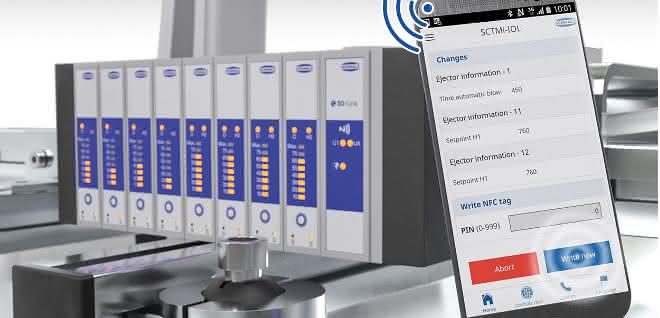
Cyber-physical systems are the protagonists of the fourth industrial revolution. They link real objects with virtual objects, i.e. machines with information-processing systems. The innovation level compared to the wave of automation through electronics and IT from the 1970s onwards is cross-system communication. This allows energy and process control as well as predictive maintenance to be realized - if the devices have the appropriate interfaces.
Schmalz develops vacuum components specifically for networking in vacuum automation that not only record energy and performance-relevant data and send it to the cloud, but also monitor and analyze it. Thanks to IO-Link or industrial Ethernet interfaces, the smart field devices are able to communicate seamlessly from the sensor and actuator level to the higher-level controller (PLC) and on to the control level. Communication works in both directions: In addition to transmitting data on the status or energy consumption, parameters can be changed via the controller and transferred to the smart field device.
NFC interface
In addition to the IO-Link and Industrial Ethernet interface, Schmalz also integrates an NFC (Near Field Communication) interface into its intelligent vacuum components. In order to exchange information wirelessly over short distances, a point-to-point connection is established between the smart field device and the user's NFC-enabled mobile end device. No separate energy source is required in the component for transmission. Instead, a coil is installed that is energized via the smartphone. The coil induces a voltage in a processor, which then transmits its information via an antenna.
The user can therefore read process data as well as maintenance and service information directly on the smartphone. The device speaks to the user in plain language: if there is a standstill, it provides clear information about the source of the error instead of cryptic error codes. The component can also be parameterized via the smartphone. Schmalz has programmed the Control Room app for this purpose. Parameter changes made via NFC can be transferred directly to the device or copied from one device to another.
Another advantage of NFC is the direct assignment of product to smartphone. Two devices are only connected over a short distance of a maximum of two centimetres. This means that the user can be sure that no neighbouring devices are parameterized unintentionally.
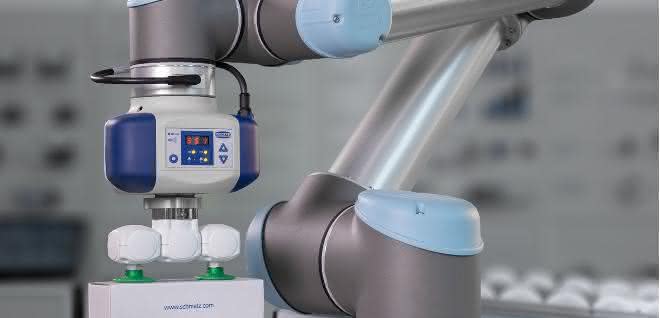
From the air flow to the data stream
The benefits of digitalization at component level for vacuum applications can be seen in the SCTMi compact terminal, which combines up to 16 individual vacuum generators into one compact unit with just one electrical and one compressed air connection. Schmalz thus enables the simultaneous, independent handling of different parts with just one system. The vacuum is generated by a Venturi nozzle and detected by a sensor. The user can read out the exact vacuum value via the IO-Link process data or on the display of the generator.
The ejectors are also controlled via the cyclical process data and current information is reported back by the SCTMi. Setting values, parameters and measurement and analysis data are also available to the user via the IO-Link connection. In addition, the diagnostic and forecasting functions of the vacuum components derive information about the status of the system and identify trends in quality and performance.
Transmitted to an internal or external cloud, the data is processed and analyzed and generates real added value: if the system detects values running out of tolerance or creeping changes, these can be quickly and clearly displayed to the user. For example, the system checks the leakage and dynamic pressure for predictive maintenance evaluations.
Condition monitoring events are triggered, for example, if the dynamic pressure values deviate, the evacuation times of the ejectors exceed their limit values or sensor voltages are outside the operating range. The energy monitoring function keeps an eye on the energy consumption of the connected vacuum systems. This monitoring is based on the measured air consumption, which is calculated taking into account the system pressure and nozzle size. Users can specify an externally recorded pressure value via the IO-Link process data. If this value is available, the ejector can also measure the absolute air consumption in addition to the percentage.
Quickly integrated
These diverse functions enable the user to keep their system efficient, avoid machine downtimes and increase system availability. However, IO-Link also offers decisive advantages when integrating the compact terminal into the system environment: Schmalz provides the user with a comprehensive IO-Link configuration file IODD (IO Device Description), which includes information on identification, device parameters, process and diagnostic data and communication properties. The replacement of devices is also simplified, as the IO-Link protocol contains an automatic data transfer mechanism. When replacing a device with a new one of the same type, the setting parameters of the old device are automatically saved by the master in the new device.
The SCTMi compact terminal is part of the constantly growing range of intelligent field devices. Their process and status data make Industry 4.0 concepts possible. Users benefit from fast commissioning, reliable operation and lower failure risks. In addition to special compact ejectors, Schmalz has also equipped the VSi electronic vacuum pressure switch - which measures and monitors negative and positive pressures in automation and handling systems - as well as the SNGi-AE special gripper and the ECBPi electric vacuum generator with IO-Link and NFC for the digital factory. as


You might also be interested in
ebm-papst is growing again thanks to AI and data centers
ebm-papst returned to a growth trajectory in fiscal year 2025/26. Air Technology, data center applications, and artificial intelligence are driving revenue and investment.
 read more...
SPE on the Verge of a Market Breakthrough
Single Pair Ethernet (SPE) has moved beyond the conceptual phase and is increasingly being implemented in industrial settings. The focus here is not only on higher data rates and simplified cabling, but above all on the issue of system integration...
read more...More than 900 exhibitors already registered
Around six months before the start of the trade fair, more than 900 companies have registered for SPS 2026 in Nuremberg. The trade fair focuses on industrial AI, cyber security and digital transformation.
read more...Virtual PLCs in practice: How vPLCs make production systems more flexible and scalable
The increasing networking of IT and OT is fundamentally changing industrial automation. The IT/OT Integration Summit shows how modern technologies can make production environments more efficient, flexible and future-proof. The event will focus on...
read more...Sales growth in a turbulent market environment
Thanks to innovations and a focus on strategic industrial markets, Sick was able to moderately increase its sales in the 2025 financial year. In a turbulent market environment, the company was able to maintain its position and gain market share with...
read more...Siemens presents new AI agent
Siemens is launching 'Eigen Engineering Agent', an AI for automation technology. The solution is integrated into the TIA Portal, has been tested with over 100 companies and is designed to significantly accelerate engineering processes.
read more...Schaeffler keeps sales almost stable
Schaeffler generated revenue of EUR 23.5 billion in 2025 and increased EBIT before special items to EUR 936 million. At 266 million euros, free cash flow was significantly above the prior year and forecast. Net income remained negative due to high...
read more...Advancing artificial intelligence together
Helukabel is stepping up its activities in the field of artificial intelligence and is now a member of the IPAI. The innovation and collaboration platform for companies, research facilities, institutions and administration has set itself the goal of...
read more...New impetus for ifm sales
Two new positions were filled at ifm at the start of 2026: Markus Wolf becomes Managing Director Sales Germany, Sven Quant takes over the position of Central Managing Director in the Process Sensors division within the ifm Group.
read more...